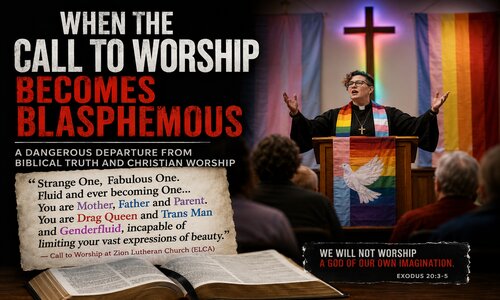
When The Call To Worship Becomes Blasphemous
June 02, 2026
By PNW Staff
Reprinted from Prophecy News Watch
There was a time when the call to worship served a simple but profound purpose: to summon God’s people into His presence with reverence, humility, and awe.
Last Sunday at Zion Lutheran Church (ELCA), however, the congregation was invited into something very different.
The call to worship reportedly declared:
“Strange One, Fabulous One. Fluid and ever becoming One…You are Mother, Father and Parent. You are Drag Queen and Trans Man and Genderfluid, incapable of limiting your vast expressions of beauty.”
The words were not offered as commentary, discussion, or theological speculation. They were presented as worship itself. Congregants were invited to participate in a call-and-response liturgy affirming these descriptions of God.
That distinction matters.
Because when the call to worship becomes blasphemous, the damage extends far beyond one controversial statement. It strikes at the very heart of what worship is meant to be.
What Is A Call To Worship?
Historically, a call to worship is one of the most sacred moments in a church service.
Throughout Christian history, churches have opened services with passages such as Psalm 95:6: “Come, let us worship and bow down; let us kneel before the Lord our Maker.”
The purpose is not entertainment. It is not self-expression. It is not cultural commentary.
The call to worship is an invitation for God’s people to turn their eyes away from themselves and toward the holiness of God.
It establishes the foundation for everything that follows.
The songs, prayers, Scripture readings, preaching, and communion all flow from that opening declaration that God alone is worthy of worship.
In many churches, the call to worship is carefully drawn directly from Scripture because Christians have long understood a simple truth: God defines Himself. We do not define Him.
That is precisely why what occurred at Zion Lutheran Church is so troubling.
Worshiping God As He Is–Or As We Want Him To Be?
The central issue is not merely the inclusion of contemporary gender terminology.
The deeper problem is that the language fundamentally reverses the biblical pattern of worship.
Throughout Scripture, God reveals His nature to humanity. He speaks. We listen.
At Sinai, God declared who He was.
Through the prophets, God declared who He was.
Through Christ, God revealed Himself most fully.
The consistent pattern is revelation flowing from heaven to earth.
But modern progressive theology increasingly reverses the direction. Instead of receiving God’s self-revelation, it projects human identities, experiences, and cultural movements back onto God.
In effect, God becomes a mirror reflecting whatever society currently wishes to celebrate.
The result is a deity shaped less by Scripture and more by social trends.
When God is described as a drag queen, a trans man, or genderfluid, the question Christians should ask is simple:
Where did God reveal Himself this way?
Not in Genesis.
Not in the Psalms.
Not in the Gospels.
Not anywhere in Scripture.
These descriptions originate not from divine revelation but from contemporary ideological frameworks.
That should concern every believer.
The Second Commandment Problem
Many Christians immediately think of the First Commandment: “You shall have no other gods before Me.”
But there is another commandment that speaks directly to situations like this.
The Second Commandment forbids creating false representations of God.
Historically, Christians understood this commandment as protecting God’s people from substituting their own imagination for God’s revelation.
Idolatry is not merely worshiping a different god.
It can also involve worshiping a distorted version of the true God.
That danger is especially subtle because people may sincerely believe they are worshiping God while actually worshiping an image of Him fashioned according to cultural preferences.
The golden calf in Exodus was not presented as an entirely new deity. It was presented as a representation of the God who brought Israel out of Egypt.
Yet God fiercely condemned it.
Why?
Because people had replaced God’s self-revelation with their own invention.
The same principle remains relevant today.
The Disappearance Of Holiness
Another striking aspect of this call to worship is what is absent.
There is no mention of God’s holiness.
No mention of His majesty.
No mention of His righteousness.
No mention of His sovereignty.
No mention of repentance.
No mention of sin.
Instead, the focus centers almost entirely upon affirming modern identity categories.
This reflects a broader trend within progressive Christianity.
The church increasingly becomes a place where God exists to affirm humanity rather than humanity being called to submit to God.
Yet throughout Scripture, genuine encounters with God produce reverence.
Isaiah cried, “Woe is me!”
Peter fell at Jesus’ feet.
John collapsed “as though dead” before the glorified Christ.
Biblical worship is filled with wonder, humility, repentance, and awe.
Modern progressive worship often replaces those themes with affirmation and self-expression.
The difference is not minor. It is transformational.
Why This Matters
Some Christians may be tempted to dismiss this as another strange incident from a declining denomination.
But that would be a mistake.
What happens in worship shapes what people believe.
Week after week, year after year, congregations are discipled by what they sing, pray, recite, and hear from the pulpit.
If worship teaches people that God is primarily a reflection of contemporary identities, they will eventually lose sight of the God revealed in Scripture.
The tragedy is that churches were never called to reinvent God for each generation.
They were called to proclaim Him faithfully.
A call to worship should direct hearts toward the eternal God who does not change.
Instead, this liturgy presented a deity constantly reshaped according to the latest cultural movements.
The Christian faith has survived empires, persecutions, revolutions, and countless social transformations because it rests upon a God who declares, “I the Lord do not change.”
The church’s task is not to make God resemble the culture.
It is to call the culture to encounter the living God.
When the call to worship becomes blasphemous, worship itself is no longer centered on God. It becomes centered on humanity.
And that is perhaps the greatest danger of all.
You can watch the blasphemous call to worship here:
“Strange One, Fabulous One. Fluid and ever becoming One…You are Mother, Father and Parent. You are Drag Queen and Trans Man and Genderfluid, incapable of limiting your vast expressions of beauty.”
‘Pastor’ at Zion Lutheran Church (ELCA) gives the call to worship pic.twitter.com/xGRPbMgmgB
— Protestia (@Protestia) June 1, 2026
RELATED:
Pride Month Has Begun – Or Did It Ever End? The Rainbow That Never Comes Down
The False Gospel Of Inclusion Is Disrupting Christian Music
Abortions, Transgender Summer Camps… See What Else James Talarico’s Church Bankrolls



Leave A Comment
You must be logged in to post a comment.