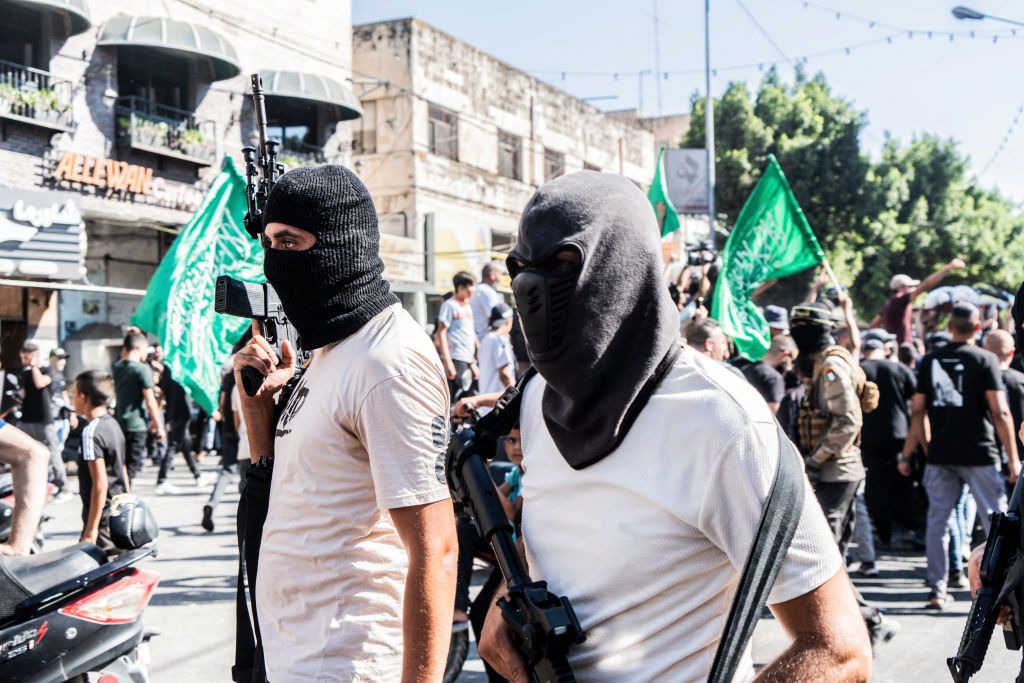
Hamas, the Iranian-backed group responsible for the October 7, 2023 massacre in Israel, is openly calling to escalate attacks against Israel and signaling its intention to shift the center of its jihad (holy war) from the Gaza Strip to the West Bank. Pictured: Hamas and Islamic Jihad members in the city of Jenin. (Photo by Khadija Toufik/Middle East Images/AFP via Getty Images)
It’s very interesting while also being strange living each day. From the viewpoint of being blessed to have heard the LORD and had one’s heart, mind, and life changed, to be born anew. Changed within. indwelt of the Holy Spirit and living firmly in the here and now, in the flesh, while also living in and knowing the Word of God.
Very strange, indeed. And interesting.
So much occurring every day at this point in the human historical timeline. Faster than ever before. Greater volume than ever before.
It may seem I’m consumed with so-called news, but I’m not. At all. I am only drawn to current events as they unfold from myriad elements of our being here. Now. And while seeing things, hearing things, being here, the strange part, the most interesting part is knowing what’s in the Holy Bible, and believing every word, and as a simple, invisible man of no consequence, other than to God, Jesus, the Holy Spirit, and my wife, and only through understanding provided by the Holy Spirit, for I am not a prophet, I’m nothing but an observer, a watchman on the wall so to speak, I’m not particularly bright, but have always been a keen observer, watching and listening. Always. This trait, added to being born again and reading and being able to discern, as well as its measured out for me to understand, to witness the words, the events of this world, while reading God’s Word, is just astounding. Amazing. It truly is.
Because the words of the true prophets, the words of Jesus, the words of God resonant continually daily, and the Scriptures cannot, they CANNOT be isolated, removed from, altered to fit, ignored in relation to everything unfolding.
It’s incredible. Right before our eyes and ears.
Read on… MAINLY READ ON, STUDY ON. BELIEVE UPON THE WHOLE WORD OF GOD…
Ken Pullen, Friday, June 19th, 2026
Trump’s Iran ‘Deal’ Has Already Emboldened Hamas
A first reaction to U.S. President Donald J. Trump’s “Memorandum of Understanding” (MOU) has already come from Tehran’s terrorist proxy, Hamas. The Iranian-backed group responsible for the October 7, 2023, massacre in Israel is openly calling to escalate attacks against Israel and signaling its intention to shift the center of its jihad (holy war) from the Gaza Strip to the West Bank.
The timing is not a coincidence.
To Hamas and the rest of Iran’s “Axis of Resistance,” the prospect of a “deal” between Washington and Tehran is not being interpreted as a sign of American strength. It is being viewed as a sign of America’s weakness and a victory for the Iranian regime — which the U.S. defeated — and proof that the U.S. is eager to end conflicts at virtually any price.
The world had been expecting to hear the U.S. announce that unless Iran accepted all of America’s terms unconditionally, the ceasefire was over. Instead, the U.S. has agreed in principle to Iran’s terms. America has deliberately chosen to lose a war — again.
Hamas officials and spokesmen have therefore been intensifying their calls for Palestinians to increase what they call “all forms of resistance,” and confront Israelis throughout the West Bank. Hamas also praised recent shooting and car-ramming attacks against Israelis, and have been describing the perpetrators as “heroic resistance fighters.”
After a shooting attack near the Israeli town of Kochav Yair, Hamas military spokesman Abu Obeida hailed the operation and called on Palestinians in Jerusalem, the West Bank, and inside Israel to intensify attacks and join what Hamas calls the battle of “Al-Aqsa Flood” — the name Hamas uses for the October 7 massacre.
Likewise, after another shooting attack near the West Bank city of Hebron, Hamas praised what it called the “pure hands that fight the occupier” and urged Palestinians to carry out more attacks.
Hamas-affiliated organizations have begun publishing detailed statistics highlighting terror-related activities in the West Bank and Jerusalem. According to figures released by Palestinian media outlets affiliated with Hamas, 243 acts of “resistance” were recorded during May alone, including shootings, car-ramming attacks, armed clashes, demonstrations, and confrontations with Israeli security forces. Other reports proudly documented dozens of incidents over just a few days.
The message is clear: Hamas wants Palestinians to believe that the next phase of the war against Israel, with the help of the Iranian regime, should be fought soon and from within.
This should deeply concern not only Israel but also the US.
Unlike the Gaza Strip, the mountainous terrain of the West Bank is high ground. It overlooks the low broad plain along the Mediterranean coast that is home to Israel’s most densely populated areas. Major Israeli cities, Ben-Gurion International Airport, and critical infrastructure are within easy range of terrorists operating from the hills: one can comfortably look down over all of central Israel.
Unlike in the Gaza Strip, there are hundreds of thousands of Israelis who live in the West Bank — easy targets for the terrorists.
October 7 demonstrated what happens when a terrorist army is allowed to establish itself along a border. Hamas now appears more determined than ever to create similar conditions to Gaza in the West Bank.
All this appears to have been inspired by the Trump Administration’s preparations to implement a deal with a regime in Iran that funds, arms, trains, and directs Hamas, Hezbollah and other terrorists. With the many billions of dollars Iran expects to receive just in the early stages of this agreement, the opportunity to escalate its “resistance” must look too tempting to pass up.
One of the most astonishing aspects of the reported MOU is that it does not address Iran’s terrorist proxies: Hamas, Hezbollah, the Houthis in Yemen, and various Shiite militias across the Middle East. This is not a minor detail. It is fundamental — seen by these groups as a green light to step up their terrorism ever since Trump tried to stop Israeli Prime Minister Benjamin Netanyahu from dismantling them.
The terrorists see the “daylight” that Iran’s regime maneuvered Trump into creating between the U.S. and Israel as a most welcome gift.
To Hamas, Hezbollah, and Iran, public friction between Washington and Jerusalem signals that at last, the U.S. may be distancing itself from its closest ally in the Middle East.
Such perceptions greatly encourage radicals, undermine American and Israeli deterrence, and strengthen the belief among jihadist groups that time is on their side and no one will stop them.
Iran’s regional strategy does not rely solely on its nuclear and ballistic missile programs. Its greatest weapon is its network of proxies, which Tehran uses to continue waging war while claiming plausible deniability.
Ignoring Iran’s proxies while negotiating with their terror-master is tantamount to treating the symptoms while ignoring the disease.
Hamas, of course, is not the only jihadist group drawing conclusions from Washington’s current approach. Hezbollah in Lebanon and the Houthis in Yemen are watching developments closely.
While Hamas feels emboldened today, Hezbollah and the Houthis are sure to escalate their own attacks tomorrow.
The Iranian regime and its proxies are experts at waiting – what the West calls “strategic patience.” Unlike many Western policymakers who seek immediate solutions and quick diplomatic victories, Iran’s regime and its allies think in terms of decades. They have no problem signing agreements, waiting for political circumstances to change, then resuming their campaigns against their enemies.
Israel reached several ceasefire agreements with Hamas in the Gaza Strip. Hamas repeatedly violated them.
Israel reached understandings with Hezbollah in Lebanon. Hezbollah violated them.
The US reached ceasefires with Iran. Iran violated them.
International agreements and diplomatic arrangements do not persuade terrorist organizations in the Middle East to abandon their jihadist ideology or their objective of destroying Israel.
Does anyone seriously believe that Iran and its proxies will behave differently now? Or that Iran will use the $300 billion it is promised in the MOU – or the other many billions from unfrozen assets or its neighbors — to build shelters for abused women?
Trump promised a new reality for the Gaza Strip – a “Riviera of the Middle East.” More than six months after his much-publicized “Board of Peace” initiative and ceasefire plan, however, Hamas remains in power there, more brutal than ever. It still controls large parts of the territory, continues to recruit and train terrorists, retains substantial military capabilities, and openly rejects disarmament.
If the US has so far been unable to compel Hamas to lay down its weapons, how can it guarantee that the Iranian regime will fully honor any new agreement?
So long as this Iranian regime and its proxies remain intact, there will be no genuine peace or stability in the Middle East.
Far from making the region safer, a deal that ignores Iran’s proxy armies will only embolden them.
Hamas’s latest calls for more attacks against Israel are just an early warning of what will likely come next.
Those celebrating an agreement with Iran, instead of dictating terms as a victor, should pay close attention to what Hamas is saying. Iran and the terrorists — thanks to what appears to be Trump’s capitulations — clearly believe they are winning. That alone should set off alarm bells in Washington.
RELATED:
The Best Discussion Yet About the Biggest Story Right Now
Khaled Abu Toameh is an award-winning journalist based in Jerusalem.








Leave A Comment
You must be logged in to post a comment.