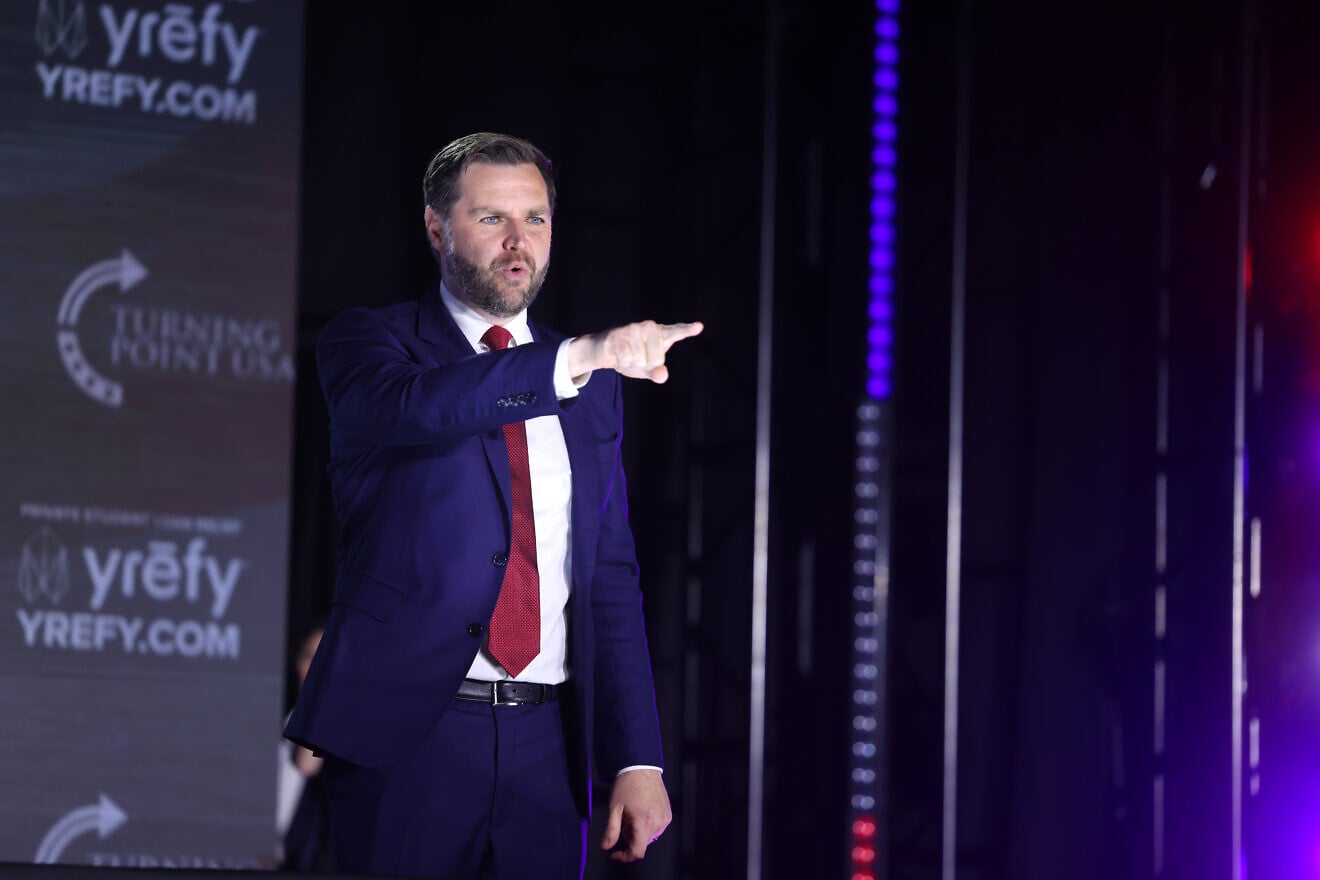
U.S. Vice President J.D. Vance speaks with attendees at the University of Mississippi tour stop of the “This Is The Turning Point” tour at the SJB Pavilion in Oxford, Miss., Oct. 29, 2025. Credit: Gage Skidmore via Creative Commons.
Sorry, J.D., antisemitism and ‘not liking Israel’ aren’t that different
Why is U.S. Vice President Vance staking out a position that aligns him with young conservative Zoomers who are against the Jews and the Jewish state?
December 19, 2025
By Jonathan S. Tobin
Reprinted from jns — Jewish News Syndicate
Intense scrutiny comes with high office.
So when someone like Vice President J.D. Vance makes a statement in an interview or posts a comment on social media about a hot topic, it inevitably becomes news. And when that topic is especially controversial—antisemitism, for instance—and he’s made little or no effort not to get mired in it, anything he winds up saying or writing is likely to feed speculation about where he really stands.
And that has been the case of late. When Vance denied that Jew-hatred is “exploding” among young conservatives in an interview with NBC News and then engaged in an exchange on X with an Israel-bashing white nationalist who uses antisemitic tropes, as he has done in the last two weeks, it’s far from unreasonable to wonder about his motives.
But there’s more to it than that. Vance is the current frontrunner for the 2028 Republican presidential nomination. That fuels the belief that his every action is calculated to enhance his chances of being President Donald Trump’s successor.
An antisemitism problem
Fair or not, and though he and his supporters would deny it, that means he now has an antisemitism problem.
Any discussion about the vice president—and the question of anti-Jewish and anti-Israel bigotry—starts with his apparently unbreakable ties with Tucker Carlson. The former Fox News host and current far-right podcaster is, by all accounts, a good friend of Vance. In fact, he owes Carlson a debt of gratitude. Carlson was a significant booster of Vance’s successful campaign for an Ohio U.S. Senate seat in 2022 and then reportedly played a decisive role in persuading Trump to choose him as his running mate in 2024.
When Carlson hosted faux historian and Holocaust denier Daryl Cooper on his podcast just weeks after Vance was tapped for vice president, what followed was significant. Not only did Vance not disassociate himself from Carlson. Instead, he kept a commitment to appear with him on one of the political commentator’s live shows, which, for all intents and purposes, turned out to be a Republican campaign rally.
Flash-forward a year later, and Carlson’s flirtation with antisemitism and Israel-bashing has turned into a full-blown obsession. Vance’s buddy seems to platform virtually anyone who will demonize Israel, including floating antisemitic blood libels about its war against Hamas in Gaza or opposing efforts to stop the nuclear threat from Iran. After his chummy interview with “groyper” Nick Fuentes—a self-avowed neo-Nazi—and his attacks on Christian Zionists and even the idea of a Judeo-Christian heritage, there’s no denying that he’s become the most dangerous antisemite in the country.
But for Vance and some other increasingly disreputable voices on the right, like podcaster Megyn Kelly, the priority is protecting their friendship with Carlson. Given that distancing himself from a conservative movement that has a lot at stake in the success of the Trump administration and in the failure of the Democrats to win back the White House in 2028, Vance’s decision to stick with his friend must be seen as significant.
A crisis among young Zoomers
That’s the context for the dustup about Vance’s denial of the growing antisemitism problem on the right. That comment was enough to feed the controversy. But it only grew after he decided to engage in a back-and-forth with Sarah Stock, another person with a problematic record on Jew-hatred, and, oddly enough, to do it on the same evening that he was hosting a Chanukah party at the vice-presidential residence in Washington.
That Vance would deny that antisemitism is “exploding” among young conservatives is perhaps to be expected. But after the Fuentes interview and the subsequent blow-up at the Heritage Foundation, when its president, Kevin Roberts, refused to disavow Carlson and the growing belief that a sizable percentage of young conservatives are following the groypers, that’s no longer a credible position.
Writer Rod Dreher wrote that he was told that 30% to 40% of Zoomers who work for the administration or Republicans in Washington these days are fans of Fuentes. Heritage vice president Victoria Coates told me in an interview on my “Think Twice” podcast that she fears the true number might be double that.
The situation on the right might not be as dire as that on the left, where the intersectional base of the Democratic Party is clearly hostile to Israel and has accepted blood libels about it committing “genocide” in Gaza. But if the true number of Fuentes followers among young conservatives is even half of either Dreher’s or Coates’s estimates, then there’s no denying that the right has a crisis that needs to be acknowledged.
Indeed, a Manhattan Institute poll published earlier this month showed that some 17% of Republicans are “anti-Jewish” and hold views that encompass Holocaust denial or the left-wing myth about Israel being a “settler-colonial” state that has no right to exist. Those numbers are far higher among younger GOP voters and minorities.
Anti-Zionism and antisemitism
Vance’s exchange with Stock was equally problematic.
The vice president was partially correct. One can criticize Israeli policies without being antisemitic. After all, 10 million Israelis do it every day on one issue or another, just as 340 million Americans find fault with their government.
The problem is that the “criticism” being voiced and the attitudes that have surfaced in the Manhattan Institute poll reflect the spread of pro-Hamas propaganda that delegitimizes the Jewish state and treats its justified war of self-defense after the Oct. 7 attacks as genocide. In the current context, talk of “not liking” Israel isn’t an innocent opinion about not being enamored with the weather in Tel Aviv. It’s invariably the product of some of the lies being platformed on Carlson’s show and even on more extreme venues, such as what is heard on the podcasts of Fuentes or the unhinged conspiracy theorist Candace Owens.
More to the point, language such as that used by the vice president can be interpreted as maintaining the entirely fictional distinction between antisemitism and anti-Zionism. Anti-Zionists may claim not be antisemitic, but that is a distinction without a difference.
To deny the Jews, alone of all the peoples in the world, the right to live in peace, security and sovereignty in their ancient homeland is not an assessment about which reasonable people should be expected to agree to disagree.
To support the elimination of the one Jewish state on the planet—something that could only be accomplished by the genocide of its citizens—while having no problem with the scores of other nations that are explicitly Muslim or officially devoted to one specific faith or ethnic group is to discriminate against Jews.
And there is more proof of prejudice. Carlson continues to declare that the fictional “genocide” being committed by Israel is the most urgent of issues. At the same time, he remains unconcerned by the fact that the Palestinians intend to continue their murderous onslaughts against the Jews, all while downplaying and denying that genocidal assaults on Christians are right now being waged by Muslims in African countries.
A political calculation
The vice president is clearly treading in dangerous waters. But that begs the question as to why he’s doing so.
The only logical answer? It seems that similar to the leadership of the Democratic Party, he has come to the conclusion that it’s good politics.
Democrats have embraced open antisemites like New York City mayor-elect Zohran Mamdani, whose short political career has revolved around his obsession with destroying the Jewish state, not to mention the members of the left-wing congressional “Squad” who are treated like rock stars by their voters, as well as the chattering classes.
By contrast, the Republicans had become a lockstep pro-Israel party in recent decades, with only libertarian outliers like Rep. Thomas Massie (R-Ky.) or erratic extremists like Rep. Marjorie Taylor Greene (R-Ga.) being exceptions to a pro-Israel consensus among GOP officeholders.
But Vance, a savvy political player and someone, in contrast to Trump or veteran conservatives, who is very much attuned to online trends, is sensing that the tide is shifting against the Jews among younger Republicans.
This generation has largely been indoctrinated in the same leftist ideologies like critical race theory, intersectionality and settler-colonialism in K-12 schools and colleges that grant a permission slip to Jew-hatred as their liberal compatriots. And they are swimming in the same sea of anti-Jewish prejudice and Israel-bashing that the algorithms of TikTok and other social-media platforms enable.
Their vulnerability to these toxic myths and lies is partly due to their addiction to the internet, as well as the product of the deleterious impact of the COVID pandemic isolation they suffered.
But if Vance aspires to become president, then voters have a right to expect him to do more than appease or validate these prejudices, as did his predecessor, former Vice President Kamala Harris. And for him to argue that antisemitism isn’t that big a problem or that it’s OK to “not like” Israel in the aftermath of two years of a post-Oct. 7 surge in Jew-hatred that culminated in the massacre of 16 people on Bondi Beach in Australia isn’t just bad taste. It’s not unreasonable to conclude that he is dog-whistling to Fuentes fans and other young antisemites that he’s on their side—or at least doesn’t openly oppose them.
The jury is still out about whether that is as smart a political move as he may think it is.
For those who spend their days on X or TikTok, the views of Carlson or even the groypers may seem normative. But in contrast to the situation with the Democrats, the GOP base, which is dominated by evangelical Christians, remains solidly pro-Israel. So, too, are the majority of Republican voters and even most Americans.
What voters want
Working-class Americans of all races who played a decisive role in re-electing Trump to a second term agree with Vance on immigration and share his skepticism about the European establishment’s disdain for democratic norms that interfere with policies that undermine their national sovereignty. But they’re not going to turn out for him if he becomes too closely identified with extremism and hate.
In a 2024 speech to the Quincy Institute, Vance made a strong case for Israel as the perfect “America First” ally for the United States because of its strength, technological prowess and willingness to defend itself. He’s also consistently denounced antisemitism.
Still, he seems to be drifting away from that principled stance in less than a year as vice president. He seems to think that the political future belongs to ignorant young voters who have been spoon-fed anti-Israel and antisemitic propaganda for years. Whether or not that’s a correct analysis of the 2028 electorate, it’s feeding a crisis that is both undermining Jewish security and harming an alliance that benefits the United States.
Jonathan S. Tobin is editor-in-chief of JNS (Jewish News Syndicate). Follow him: @jonathans_tobin.






Leave A Comment
You must be logged in to post a comment.