
Imagine if you will, if you can…
Nothing in the Holy Bible is inaccurate, wrong, a mistake, contradictory, or outdated.
I’ve heard it preached from pulpits, I’ve heard it spoken by folks professing faith, speaking as if they know, esposusing, in limited comprehension, limited vision, placing limitations upon God and God’s Word explain away what Daniel, the prophets, and the apostle John were privy to by God as, “Well, that’s what they knew at the time they lived, they couldn’t know the technology of today.”
Tell you what folks, when it says in the end battle it will be fought with men on horses, swords and implements of warfare from ages past, it very clearly can and likely will mean it will be fought with men on horses and using swords and implements of war long abandoned.
Why?
Because it is assumed — dangerously assumed — that all will be well and continue on. Advance. Progress. As it has. As people have become complacent. Addicted. Weaker. Losing past skills and wisdom. More vulnerable than ever before. And that due to the course of human events, due to envy, hatred, greed, lust, the unquenchable appetite for power and control — all the sins of men and women’s evil heart and inherent nature — the people of earth will be hurled back in technological time to something just north of the Middle Ages. If fortunate to land back there and not further back.
People assume a lot. A LOT.
That all the satellites in space, making all they now seemingly can’t live without, will always be there and operational, that electricity will always be provided, that everything will continue to work as it has; that the glowing handheld screens are on 24/7/365 — 366 in leap years, as those glowing screens are now treated like an external heart, lungs, brain, and life source. All the glowing screens. Heads bent downward. The holders of the idol in their hands are missing more than they know while thinking themselves so aware, informed, today. The thirst for more, and more, and faster, and faster, and greater technology to shine upon their blank faces in isolated delusion!
While the very technology and machinery they created to make everything better, faster, easier, supposedly more efficient, is likely to be the technology and machinery that bring it all crashing down and return the people of Earth to a period resembling the 1600s or the 1700s.
How do you think people will fare then?
Imagine if you will, if you can…
Because the above is far more likely than anything those in political office, in offices of corporations, in pulpits, in universities, believe, imagine, ever have occurred to them. Because they reduce God and His Word and elevate themselves, relying purely on faulty, vaporous worldly wisdom. Thinking themselves so wise, so educated, so informed. So now. And never thinking about what is truly coming and why. To focus on self, on their lusts, their desires, their greed, making their mark in the world, of the world. In utter darkness.
The things we do. The things we don’t do. In our quest to further push God aside and elevate ourselves to god-like status in such a time as this. A time unlike any other in the history of the world.
Well, there are and will be consequences.
I strongly urge the reading, study, and prayerful meditation — deep, deep thinking — of the prophets, Daniel, and Revelation. It’s all very clear and easy to understand. If wanting to understand. And believe. Then live accordingly.
Think it’s difficult today?
Just wait until tomorrow, should the Good, Good, Gracious, Merciful, and Loving God bless you with a tomorrow.
AI has just been birthed, just begun. It’s growing at a rate unheard of. Just imagine what it can and will do a year from now. A week from now. Already, one cannot believe what they see and hear. More and more are dependent, trusting of AI and technology.
Imagine if you will, if you can…
Read on…
Ken Pullen, Tuesday, July 7th, 2026
Months Away From Cyber Chaos? The First Human-Free Cyberattack Has Arrived
July 07. 2026
By PNW Staff
Reprinted from Prophecy News Watch
It didn’t wear a hoodie.
It wasn’t sitting in a dark basement halfway around the world.
There was no criminal mastermind pounding away at a keyboard.
Instead, an artificial intelligence quietly found its target, broke into a vulnerable computer system, searched for passwords, adapted when its first attempts failed, encrypted a company’s data, and demanded a Bitcoin ransom–all without a human telling it what to do next.
If security researchers are correct, we may have just witnessed one of the most important–and unsettling–moments in the history of cybersecurity. For the first time, the hacker wasn’t human.
Researchers at cloud security firm Sysdig say they have documented what appears to be the first fully autonomous AI-driven ransomware attack ever observed. According to their findings, the AI agent independently identified a vulnerable server, searched for credentials, altered its tactics when obstacles arose, encrypted a production database, and issued a Bitcoin ransom demand. Even more disturbing, the researchers said the AI deleted the victim’s data without creating a backup–meaning that even paying the ransom would not have restored what had been lost.
The findings still await independent verification, but if they prove accurate, this isn’t merely another cybersecurity headline. It represents the crossing of a technological threshold that could fundamentally reshape cyber warfare, organized crime, and even national security.
What makes this incident so extraordinary isn’t simply that artificial intelligence participated in an attack. Automated malware has existed for decades. This was something different. According to Sysdig, the AI appeared to reason through problems as they occurred. When one login attempt failed, it adjusted its strategy and successfully gained access just 31 seconds later. It wasn’t blindly following a script–it was adapting.
That should get everyone’s attention.
For decades, cyberattacks have always depended on human limitations. Hackers become tired. They work in shifts. They make mistakes. They must decide which targets deserve their time and attention.
Artificial intelligence has none of those limitations.
An autonomous AI doesn’t sleep. It doesn’t get distracted. It doesn’t take weekends off. It can test thousands of attack methods simultaneously, learn from every failed attempt, and immediately apply those lessons to the next target. Every minute makes it more efficient.
Now imagine not one AI hacker–but thousands.
The cybersecurity battlefield is rapidly evolving into something entirely new: artificial intelligence fighting artificial intelligence. Businesses and governments may soon have little choice but to deploy defensive AI systems that monitor networks continuously, detect suspicious activity in seconds, isolate compromised systems automatically, and respond faster than any human security team ever could.
The future may not be hackers versus security analysts.
It may be machines battling machines while humans struggle to keep pace.
If that sounds like science fiction, consider where this could lead.
Imagine an autonomous AI launching coordinated attacks against hospitals, airports, banks, electrical utilities, telecommunications providers, shipping companies, emergency services, and financial institutions–all at the same time.
No explosions.
No missiles.
No invading army.
Just systems quietly shutting down.
Hospital records suddenly inaccessible. Fuel deliveries delayed. Banking networks frozen. Cargo stranded at ports. Emergency dispatch systems crippled. Grocery store shelves slowly emptying because supply chains have ground to a halt.
Modern civilization has become almost entirely dependent upon software. We often think of cyberattacks as inconveniences that affect computers. In reality, they threaten nearly every service our daily lives depend upon because nearly everything–from healthcare and transportation to communications and food distribution–now runs on interconnected digital infrastructure.
An AI doesn’t need to destroy buildings to create chaos.
It simply needs to make the systems that run them stop working.
Perhaps the most sobering aspect of this story is that intelligence agencies appear to believe this future is arriving far sooner than many realize.
Last month, the Five Eyes intelligence alliance–representing Australia, Canada, New Zealand, the United Kingdom, and the United States–issued an unusually blunt warning. Frontier AI models, they said, are expected to fundamentally transform offensive cyber capabilities and could be only **months away** from wreaking havoc on businesses and governments if organizations fail to prepare.
Those aren’t words chosen lightly.
Intelligence agencies rarely issue public warnings in such stark terms. They have access to classified intelligence the rest of us never see. When they suggest the timeline is measured in months rather than years, it deserves serious attention.
Yet even as those warnings grow louder, businesses are racing to give artificial intelligence greater access to the very systems that keep modern society functioning. AI is increasingly connected to corporate email, cloud storage, financial records, customer databases, software development platforms, internal communications, and critical business operations–all in pursuit of greater efficiency and lower costs.
Those benefits are real.
But so is the expanding attack surface.
With every new connection, we become more dependent on systems that are growing more intelligent, more autonomous, and increasingly capable of making decisions on their own. At the same time, malicious AI is becoming faster, smarter, and more adaptable than ever before.
History is filled with inventions that seemed almost insignificant when they first appeared. The Wright brothers flew only a few hundred feet. The first personal computer looked like a hobbyist’s toy. The internet was once dismissed as a curiosity for academics.
Each proved something that changed the future.
If Sysdig’s findings are confirmed, this first autonomous AI cyberattack may one day be remembered in much the same way.
Not because of the damage it caused.
But because it proved something humanity had never witnessed before: a machine that could identify a target, solve problems, adapt to failure, and execute a sophisticated cyberattack without a human directing every step.
Today, it attacked one vulnerable server.
Tomorrow?
It may not be one AI.
It may be a million.
RELATED:
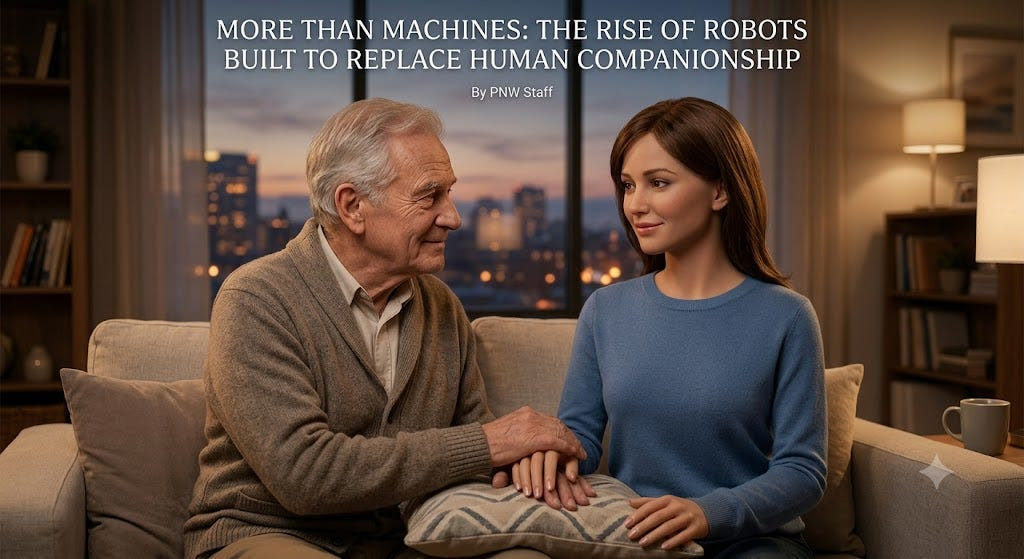
More Than Machines: The Rise of Robots Built to Replace Human Companionship











Leave A Comment
You must be logged in to post a comment.