Iran And The Red-Green Alliance: A Warning For The West
January 13, 2026
Reprinted from Harbinger’s Daily
Since the New Year, Iranians have been filling the streets in sustained protests against the current Iranian regime, which has ruled since the Islamic Revolution of 1979. These protests are not merely indicative of periodic unrest. They reflect a people pushed to the limit by economic strain and cultural and religious repression. In the face of extraordinary danger, with thousands giving their lives, the people are rejecting the authority of the Islamic Republic itself. As part of this process, there have been calls for the exiled crown prince Reza Pahlavi to return. He is the son of the last Shah.
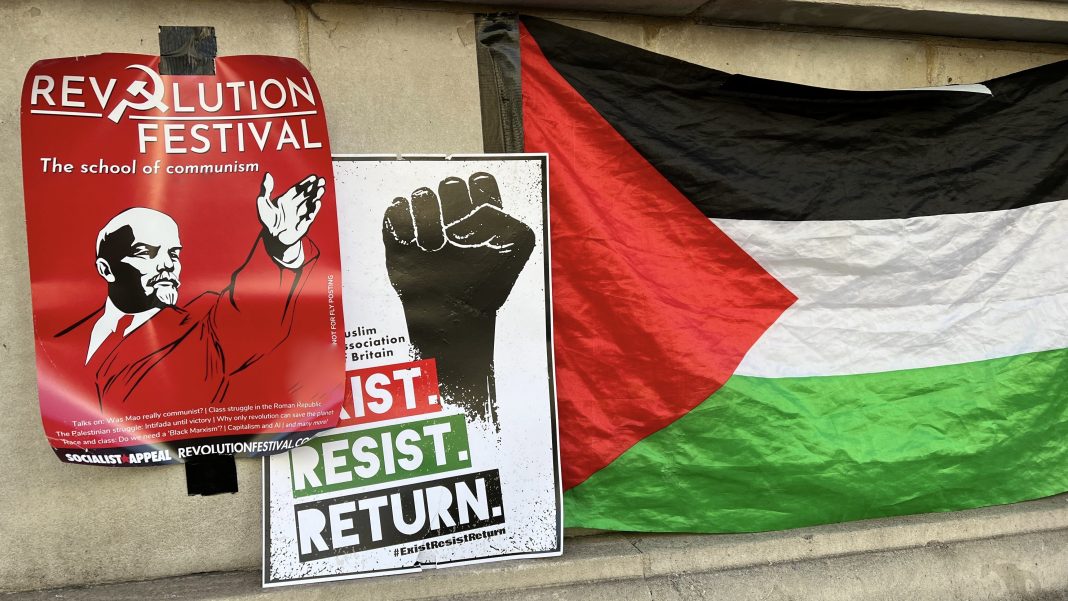
To fully understand the deeper meaning of what is happening in Iran right now, we must understand the historical context and the emergence of the Red-Green Alliance. Historically, the colour red symbolised socialist and communist ideologies, while green represented Islamist movements. Though seemingly at the diametrically opposite ends of the political and theological spectra, one inherently atheistic and the other theocratic, these two currents have repeatedly formed alliances of convenience. Their shared opposition to Western liberal democracy, Israel, and the United States has provided sufficient unity for cooperation.
The roots of this alliance in Iran can be traced to the early twentieth century. The Soviet Union sought to influence the southern regions of its borders. In 1920, Bolshevik forces supported the establishment of the short-lived Persian Socialist Republic in Gilan, northern Iran. This introduced Marxist ideology into Iranian political life. Although the state itself failed within a year, communist networks and ideas survived underground for decades. By the late 1970s, these Marxist elements aligned with Islamist forces led by Ayatollah Ruhollah Khomeini. Together, they opposed the Shah, Mohammad Reza Pahlavi, whom they both denounced as a puppet of Western interests, particularly those of the ‘great Satan,’ the United States, and the ‘little Satan,’ Israel. Under conditions shaped by the Cold War and Soviet strategic interests, the Islamic Revolution gained sufficient momentum to overthrow the Shah in 1979. The Shah fled the country without formally abdicating the throne.
Once the Red-Green alliance had secured power, the green Islamist faction quickly turned on its leftist partners. Communist agitators were imprisoned and executed, and Iran was transformed into a radical Shia Islamist republic under the Ayatollah’s rule.
The enduring hostility of the Iranian regime towards Israel and the United States must be understood within this historical framework. Both nations symbolise the Western political and moral order that the alliance defines as its enemy. The real target is Judeo-Christian civilisation. This pattern is now evident in many Western cities. In the U.K., it is common to see Islamist activists and far-left progressive students uniting in demonstrations, carrying slogans and placards calling for the elimination of Israel and the “Zionists.”
With the full collapse of the Soviet Union in 1991, the Red side of the alliance lost its primary state sponsor. The Green Islamist side, however, did not disappear; it quickly found a new generation ready to partner. Marxist-derived ideologies continued to flourish within Western universities, media institutions, and leftist student activist movements. As a result, this new generation of the Red-Green Alliance marches in support of causes that ultimately oppose the cultural, political and religious freedoms they themselves enjoy. Ironically, they are marching for their own destruction.
Iran serves as a warning to us in the West. History shows that when Islamist ideologues seize power by exploiting leftist progressive allies, those allies are often discarded once they have served their purpose. It is abundantly clear that the Red-Green Alliance is controlling much of the political landscape in the U.K. right now. This is why the same protestors who so loudly yelled “free Palestine” have very little to say when a real freedom revolution begins. Its existence undoes their entire narrative. The crucial question facing the U.K. and the West right now is whether they will recognise this pattern before it is repeated.
As Christians, the response must first begin with the Church. The Bible offers us a model to follow in the prophet Daniel. He was taken into captivity by the Babylonians and continued to live faithfully amid pagan rule. The Babylonians subjected him to an extensive “re-education” program to try to persuade him to accept their ideologies and beliefs (Daniel 1:3-7). Yet we learn that Daniel “made up his mind” (Daniel 1:8) that he would not compromise. His convictions were grounded in the Word of God, formed before the captivity arrived. Daniel was also a man of prayer. Even when the Persians signed a law to outlaw prayer to God, He continued to pray “as he had been doing previously (Daniel 6:10). Daniel remained faithful, he studied scripture, prayed regularly and refused to compromise to fit the world’s mould.
As believers today, we must adopt the same posture. Our convictions must be resolute and established before testing times come. Our practice of prayer should be habitual, not reactive. Above all, we must remain rooted in the grace of God and not repay evil for evil.










Leave A Comment
You must be logged in to post a comment.