HAPPENING IN AMERICA. RIGHT NOW
The following is happening in America. Today. Not in Canada, in Europe, in an Islamist nation. No, in America today. To anyone refusing to believe there are any signs of the end of the age, asking for signs, saying or thinking nothing has changed, and there are no indicators of these being the last of the last days, the Rapture is close, as is the fulfillment of every word of Bible prophecy — THIS NEVER HAPPENED BEFORE IN AMERICA, BUT IT’S HAPPENING NOW.
It’s going to get worse.
Much worse.
I do not like writing that. I do not like being a person who has to present such things, but few will venture into the reality department, speaking and writing clearly regarding the times. It isn’t being negative, or pessimistic to state the facts — according to God’s Word — that things on this earth are only going to get worse, not better, never truly better until the end of the Great Seven Year Tribulation when Jesus comes back a Second Time, final time, to this earth to establish His kingdom.
Of course, it’s going to get better for every true believer in Jesus Christ, Yeshua Hamashiach, be they Jew or Gentile, when the LORD comes to catch us up to Him in the Rapture.
But as for life on earth? From this day forward? It’s only going to increase in evil, in wickedness, in lies, in deception, in upheaval, violence, and rebellion. The people have an ever-growing rage within them. Impatient. Self-centered.
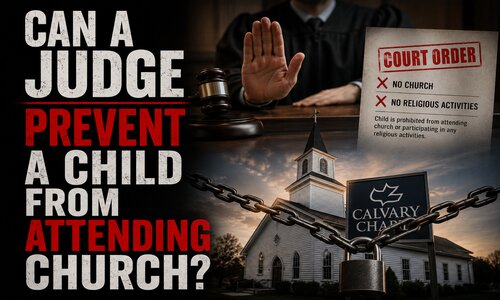
If a judge in America is permitted to prevent a child from attending church, in America, and get away with that…and folks are needing a sign of the times? If parts of the sky fell all around them and a cow, a bird, and a flying fish appeared in front of them and sang them a song about the end of days, and the cow was an accomplished tap dancer, and the bird could…well, you get the picture. They still wouldn’t believe, still would be asking for a sign.
Because that’s the way it is, and that’s people being people in times such as this. It’s Scriptural that there are those who scoff, deny, question, and refuse to believe Jesus’ Second Coming is coming. Most people deny [including many attending churches every Sunday, many pastors in pulpits every Sunday, so many professing to be Christian included] the Holy Bible’s inerrant, infallible, unchangeable, eternal living and active words FROM God to man, woman, and child — but those same people gravitate to and believe every lie that comes along, becoming more deluded by the day.
Come on, people…
Really.
No excuses.
This in America today!
Read on…
Ken Pullen, Thursday, June 11th, 2026
Can A Judge Prevent A Child From Attending Church?
June 10, 2026
By PNW Staff
Reprinted from Prophecy News Watch
What happens when a government court decides that a child can no longer attend her church?
That question is now at the center of one of the most extraordinary religious liberty cases unfolding in America.
For nearly 18 months, a 13-year-old Maine girl has been prohibited from attending Calvary Chapel in Portland, Maine–the church she regularly attended with her mother and where many of her closest friends worshipped. The ruling effectively severed her from her church community, youth activities, Bible studies, Christian fellowship, holiday celebrations, and many of the relationships that had become central to her spiritual life.
The case involves Ava Bickford and her mother, Emily Bickford, who have spent the past year and a half fighting a court order that many religious liberty advocates believe strikes at the heart of the First Amendment.
The restrictions were imposed in late 2024 during a custody dispute between Ava’s parents and remain in place while Maine’s Supreme Judicial Court considers an appeal that could have ramifications far beyond a single family.
For many Christians, the case raises a troubling question: If a court can prevent a child from attending a Bible-believing church because of concerns about the church’s teachings, where does that authority end?
This is not a case involving abuse, neglect, criminal activity, or physical danger.
Instead, the controversy centers on whether a court can restrict a parent’s ability to raise a child in the Christian faith based on claims that exposure to certain biblical teachings may be causing emotional distress.
The dispute intensified after Ava expressed a desire to be baptized at Calvary Chapel.
Her father objected, arguing that teachings she was hearing at church were contributing to anxiety and emotional stress. Court filings referenced concerns that Ava had become worried about spiritual matters, including discussions surrounding salvation and the return of Christ.
To support those concerns, the court relied heavily on testimony from a sociologist presented as a “cult expert,” who characterized Calvary Chapel as exhibiting cult-like characteristics.
Among the beliefs cited were doctrines familiar to virtually every Christian denomination: belief in heaven and hell, angels and demons, salvation through Jesus Christ, and pastors who teach Scripture verse-by-verse and chapter-by-chapter.
That alone should give Americans pause.
If belief in heaven and hell is evidence of a dangerous religious environment, then much of historic Christianity suddenly finds itself under suspicion.
If teaching the Bible systematically becomes a warning sign, then countless evangelical, Baptist, Pentecostal, Lutheran, Presbyterian, Catholic, and Orthodox congregations could theoretically face similar accusations.
That concern is precisely why Liberty Counsel, a national religious liberty legal organization, became involved in the case.
The organization rarely enters ordinary custody disputes. Attorneys say they viewed this case differently because it raised profound constitutional questions regarding parental rights and religious freedom.
The court ultimately granted Ava’s father final authority over her religious upbringing and prohibited her attendance at Calvary Chapel.
That distinction matters.
The case is often described simply as a dispute over church attendance. In reality, Calvary Chapel was not merely a building Ava visited on Sunday mornings. It was her faith community. It was where she attended Bible studies, youth activities, fellowship gatherings, holiday celebrations, and spent time with many of her closest friends.
By removing her from the church, the order effectively disconnected her from nearly every aspect of the Christian community she had come to know.
The emotional cost has extended far beyond missing a weekly worship service.
According to her mother, Ava repeatedly struggled to understand why she was no longer allowed to attend church. She missed youth events, Bible studies, Christian fellowship, and regular interaction with the friends she once saw every week.
As months turned into more than a year, some of those relationships naturally changed. Some friends moved away. Others drifted apart as happens when young people no longer share the same community.
Those losses cannot simply be restored by a future court ruling.
Religious liberty advocates argue that the broader implications are even more concerning.
Across America, millions of divorced or separated parents share custody arrangements. Religious differences between parents are common. Historically, courts have generally allowed each parent to expose a child to their chosen faith during their parenting time.
If this ruling is allowed to stand, critics fear it could create a pathway for courts to restrict Christian parents whenever a judge believes biblical teachings are contributing to emotional discomfort.
That should concern believers across denominational lines.
After all, Christianity contains difficult truths. The Bible speaks of sin, judgment, repentance, salvation, heaven, and hell. For two thousand years, many people have found those teachings challenging.
Yet the answer in a free society has never been government censorship of religious belief.
The First Amendment exists specifically to prevent government officials from deciding which religious doctrines are acceptable and which are not.
During oral arguments before Maine’s high court, some justices appeared to wrestle with that very issue.
At one point, questions arose regarding whether courts were effectively evaluating the validity of religious teachings themselves rather than simply examining the facts of a custody dispute.
That concern goes to the heart of the matter.
Once courts begin deciding that certain sermons are too intense, certain doctrines too troubling, or certain biblical teachings too emotionally challenging for children, where does it stop?
Could preaching about judgment become problematic?
Could teaching salvation through Christ alone be viewed as harmful?
Could discussing the Book of Revelation someday become grounds for restricting parental rights?
Those questions may seem dramatic, but many observers would have considered the current case unimaginable just a few years ago.
The reality is that this case is no longer simply about one church in Maine.
It has become a test of whether Christian parents retain the right to raise their children according to their faith without government interference.
Perhaps the most heartbreaking aspect of the entire story is that even if the appeal succeeds, some of the damage cannot be undone.
A court may be able to restore legal rights with the stroke of a pen.
It cannot restore eighteen months of missed Bible studies.
It cannot restore youth gatherings that never happened.
It cannot restore Christian holidays celebrated apart from a church family.
And it cannot fully restore the friendships and community connections that slowly faded while one young girl was kept away from the church she loved.
The Maine Supreme Judicial Court’s decision will determine more than the future of one family.
It may help determine whether America’s courts continue to protect the free exercise of religion–or whether judges increasingly assume the authority to decide when a child’s exposure to biblical Christianity has gone too far.






Leave A Comment
You must be logged in to post a comment.