The great tragedy is that due to their sin, their refusal to acknowledge Adonai, Yahweh, God Almighty as their LORD and humble themselves, turn to Him in faith and obedience, what is coming to the people of Israel will be worse, no comparison, than what the nazis in the Holocaust did. God’s disobedient and foolish people, many of whom are atheists, many of whom are so lost and liberal they have been given over to their reprobate minds — as God knows in His Omniscience — His foreknowledge, that many are of such sin and such a mind in the world, for the world, that if they lived 10,000 years they would never repent, they would never turn to Him in faith.
Two-thirds of the Jews are going to perish — DIE — in the coming Great Tribulation at the hand of the Antichrist and the world. The world. Not just nazis. The world is going to celebrate their destruction.
The evil spirit of antichrist, of antisemitism, is growing by the week in America, in the West, and around the world. At the same time, various accords and embassies are discussed and realized, as nations that once would never sit down with the government of Israel are now striking up deals for peace and cooperation.
Never again?
Nice words, a wonderful sentiment, but it is going to happen again, making what happened before appear a lesser evil, if that is possible — but it is — for the Word of God says it’s going to happen and it then will happen.
Just a matter of when.
But if listening, watching, observing, and abiding in the ways and Word of the LORD, you then know this is coming. Everything is gearing up towards the fulfillment of the last words of Bible prophecy.
If ambivalent, if nonplused, if lax, if arrogant, if prideful, thinking yourself, your nation better than, if doubting, if negligent in knowing the Word of God, and if not giving Israel and the Jews much thought, or aligned with the growing evil in this lost world — time to repent, my friends, dear ones. Time to repent.
Time to humble ourselves, repent, and seek the LORD prayerfully, faithfully and DAILY offering up heartfelt faithful prayers to God for the salvation of the people of Israel, of the Jews of the world to have the scales removed from their eyes, their stiff necks loosed, and for them to see Jesus, see God, turn to the Word of God in faith, saying, “Baruch Ha’ba B’shem Adonai!” — “Blessed Is He Who Comes In the Name of the LORD!”
Israel is God’s land.
Israel isn’t going anywhere. It’s going to become larger, finally having the borders given to Abraham in God’s promise, when the LORD Jesus Christ returns a Second and Final time, having defeated the Antichrist and his false prophet, to set His feet once again on the Mount of Olives, to establish His 1,000 year earthly reign and kingdom, King of kings, LORD of lords, to rule the world from Jerusalem.
In the meantime, though, sin abounds in Israel. Atheism. Sexual immorality. Turning back to Sodom! Turned from God once again, as so often described in the Holy Bible.
Salvation is coming to Israel, to the people of Israel. One-third of them will be saved.
Let us pray NOW that TODAY and hence prayerfully daily we pray not only those in our family, those we know come to see and hear the LORD and repent and become born again — but let us pray daily that people we do not know, God’s people, in Israel, in America, in Europe, all around the world as they have been scattered, let us pray they repent and turn to God, turn to Yahweh, turn to Yeshua as LORD of their life, Jews born anew!
All things are possible with God.
May we be His faithful people to the end.
Very sad information below. But…
Read on…
Ken Pullen, Saturday, April 25th, 2026
A Sexual Perversion Festival In The Shadow Of Sodom: What “Pride Land” Symbolizes For Israel
April 25, 2026
By PNW Staff
Reprinted from Prophecy News Watch
A celebration is rising in one of the most haunting places on earth–and for many watching, it feels less like progress and more like a warning echoing from the past.
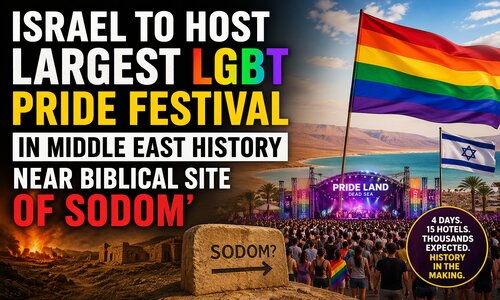
In early June 2026, thousands are expected to gather along the shores of the Dead Sea for “Pride Land,” a four-day festival billed as the largest LGBT celebration the Middle East has ever seen. Organizers promise a temporary “Pride City” in the Judean Desert–complete with hotels, beach venues, music stages, and even family-friendly programming. Israel’s official government channels have promoted it with a striking phrase: “Pride rises at the lowest place on earth.”
At first glance, it reads like clever marketing.
But for many Christians who love and stand with Israel, those words land very differently.
Because the “lowest place on earth” is not just a geographical fact. It is a place layered with memory–biblical, historical, and deeply spiritual. And that is where this story begins to shift from celebration to something far more sobering.
The region surrounding the Dead Sea has long been associated with the account of Sodom and Gomorrah, described in Genesis 19. The meaning of that story has endured across generations: a society given over to moral confusion, ultimately facing divine judgment.
That is why this moment feels so jarring.
Not simply because a festival is happening–but because of where it is happening.
There is an unavoidable contrast between the ancient warning tied to this land and the modern message being proclaimed upon it. What was once remembered as a place of reckoning is now being rebranded as a place of celebration. And for many believers, that inversion is difficult to ignore.
It raises a deeper question: are we witnessing cultural progress–or spiritual amnesia?
To understand the weight of this moment, one must also understand Israel itself–a nation unlike any other.
Modern Israel is a vibrant democracy, deeply integrated into the global world, yet rooted in an ancient identity that stretches back thousands of years. Over time, it has emerged as one of the most progressive countries in the region on LGBT issues, legally and culturally. At the same time, it remains a nation internally divided, with large segments of its population holding firmly to traditional, biblical views of morality.
“Pride Land” sits directly in the middle of that divide.
It is not just a festival–it is a statement. A declaration about the direction of a nation still wrestling with its soul.
And perhaps that is what makes this moment so significant. Because it is not happening in a vacuum. It is unfolding in a land where faith is not merely personal–it is foundational.
For Christians around the world, the response has not been one of outrage, but of grief.
There is a long and deeply rooted love for Israel within the Christian community. Many see the nation not just as a geopolitical ally, but as a central thread in God’s redemptive story. They pray for its peace. They defend its existence. They celebrate its resilience.
So when something like this emerges, the reaction is not rejection–it is lament.
It echoes another moment in biblical history: when the people of Israel, newly delivered from Egypt, stood in the wilderness and fashioned a golden calf. It was not merely an act of rebellion–it was a misplacement of worship, a turning toward something immediate and visible instead of the God who had just revealed His power.
That story lingers because it feels familiar.
Not in form–but in pattern.
A people called to reflect something higher, now reflecting something else. A sacred story intersecting with a secular desire. A quiet drift that, over time, becomes something much louder.
And yet, even beyond theology, there is a striking cultural paradox unfolding in plain sight.
Many of the loudest global voices championing LGBT causes are also among the fiercest critics of Israel, often advocating for its dismantling in favor of a Palestinian state. But within many Palestinian-controlled territories, those same identities would not be celebrated–they would be suppressed, sometimes violently.
It is a contradiction that is rarely acknowledged, but impossible to ignore.
And it reveals something deeper about our cultural moment: that alliances are often built more on shared opposition than shared values.
So what, then, are we witnessing at the edge of the Dead Sea?
Is this simply a festival–another expression of modern identity in a rapidly changing world?
Or is it something more symbolic?
A collision between past and present. Between warning and celebration. Between a story that once defined a people and a culture that is now redefining it.
For those who believe Scripture still speaks, moments like this are not random. They are reflective. They force us to ask not only what is happening–but what it means.
Because history, especially biblical history, has a way of repeating its patterns–not always in exact detail, but in unmistakable rhythm.
As the lights go up in the desert and music fills the air, the contrast will be striking. Joy and celebration set against one of the most solemn backdrops in Scripture.
And perhaps that is the final tension.
Not that people are gathering.
But that the place itself still speaks.
The question is whether anyone is listening.
Because the land remembers.
And sometimes, it whispers truths we would rather not hear.




Leave A Comment
You must be logged in to post a comment.