The Next 9/11 Won’t Look The Same: Missing Crop Duster Drones Are Wake Up Call
April 25, 2026
By PNW Staff
Reprinted from Prophecy News Watch
It didn’t make front-page headlines for long. No explosions. No casualties. No viral footage of chaos. But what happened in New Jersey last month may prove far more unsettling than a single act of violence–because it revealed just how exposed the United States could be to the next generation of mass-casualty threats.
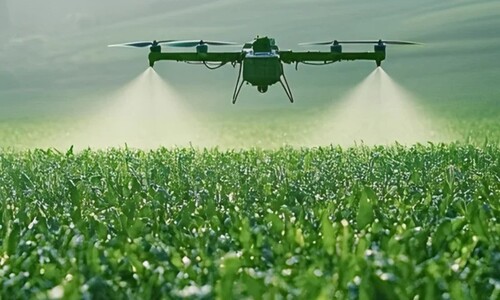
Fifteen industrial-grade agricultural spray drones were stolen from a facility in New Jersey in what investigators believe was a coordinated, technically sophisticated operation. These weren’t hobbyist toys or camera drones. These were precision machines–designed to carry between 10 and 40 gallons of liquid, programmed with GPS routes, and capable of blanketing up to 30 acres in minutes.
In the wrong hands, that’s not just farming equipment.
That’s delivery infrastructure.
According to reporting from The High Side, the Federal Bureau of Investigation has opened an investigation, though officials have remained publicly tight-lipped. Behind the scenes, concern appears anything but muted. Retired FBI agent Steve Lazarus didn’t mince words, warning of “ridiculously bad” consequences and calling the scenario a “potential nightmare.”
It’s not hard to see why.
For decades, U.S. counterterrorism planning has revolved around large, centralized threats–planes, bombs, coordinated attacks like those seen in the September 11 attacks. But technology has quietly shifted the landscape. Today, the tools required to inflict large-scale harm are smaller, cheaper, and increasingly accessible.
And perhaps most concerning–they’re dual-use.
Agricultural spray drones exist for a legitimate and beneficial purpose. They improve efficiency, reduce labor, and support food production. But the same systems that allow farmers to precisely distribute fertilizer or pesticide could, in a darker scenario, be repurposed to disperse far more dangerous substances.
That’s not speculation. That’s been a standing concern among security officials since the early 2000s, when fears centered around crop-duster aircraft. Now, the barrier to entry has dropped dramatically. You no longer need a pilot’s license or a full-sized plane. You need coordination, technical knowledge–and increasingly, access to equipment like what was stolen in New Jersey.
The most immediate assumption is that this was the work of a criminal enterprise. The resale value alone–estimated between $225,000 and $450,000–makes it an attractive target. Black-market networks dealing in stolen equipment are nothing new.
But that’s where the story becomes more troubling.
Because criminal enterprises don’t always operate in isolation.
History has shown that organized crime and terrorist networks often overlap–through financing, logistics, or opportunistic transactions. A stolen drone doesn’t have to be taken by terrorists to become a terrorist tool. It only has to be sold, transferred, or repurposed.
And unlike traditional weapons, these drones don’t immediately raise suspicion. They don’t cross borders in crates labeled “explosives.” They can be transported, stored, and even operated under the guise of legitimate use–until they’re not.
Compounding the concern is the broader context in which this theft occurred.
New Jersey has already experienced months of unexplained drone activity in 2024. Reports from law enforcement described large, coordinated aerial formations–sometimes more than a dozen drones at once–flying over sensitive locations including reservoirs, power substations, research labs, and even military installations near Picatinny Arsenal.
Some of these drones weren’t small. Officers reported aircraft the size of a small car, capable of high speeds–approaching 170 miles per hour–and possibly equipped with radar-jamming technology. In one alarming incident, multiple drones forced a medevac helicopter to abort a landing and then appeared to follow it.
Let that sink in.
Unidentified aerial systems, operating in coordinated formations, interfering with emergency services, and flying over critical infrastructure–with no clear origin and limited ability to stop them.
Now layer on top of that the theft of 15 high-capacity spray drones.
Even if the two events are unrelated, they point to the same uncomfortable truth: our airspace–especially at low altitudes–is far more vulnerable than most Americans realize.
The Department of Homeland Security has previously warned that the United States is not fully prepared to defend against weaponized drones. Lawmakers have raised concerns, but regulatory frameworks and defensive technologies have struggled to keep pace with rapid innovation in the private sector.
And that gap–between capability and security–is where risk lives.
To be clear, there is no confirmed plot. No evidence that these stolen drones are being prepared for an attack. But waiting for confirmation has never been a winning strategy in national security.
The real issue is not what has happened–but what could happen.
What if a coordinated group deployed multiple drones simultaneously over a dense urban area?
What if those drones followed pre-programmed GPS routes, dispersing harmful agents before authorities even realized what was happening?
What if critical infrastructure–water supplies, power grids, transportation hubs–became targets not through physical breach, but through aerial delivery?
These are not far-fetched scenarios. They are logical extensions of existing technology.
And perhaps the most sobering part of this story is how quietly it unfolded.
No alarms across the nation. No urgent policy debates dominating headlines. Just a report, a theft, and a lingering question.
Are we paying attention?
Because in an era where threats are evolving faster than our defenses, the most dangerous vulnerabilities are often the ones hiding in plain sight–disguised as tools of progress, waiting for the wrong hands to give them a different purpose.










Leave A Comment
You must be logged in to post a comment.