An unthinkable act, yes, but only brought about by most people in churches refusing to think, to see, to hear, to actually, truly BE CHRISTIANS. Great pretenders. Liars. Clearly not knowing nor living the Word of God, clearly by their behavior, believing merely showing up at a church on a Sunday punches one’s ticket to heaven and eternal life.
Think again.
How about spending less time talking about the grandkids, what’s for lunch, how was your vacation, did you watch the game last night when “fellowshipping” with folks in your church, and much more time in spiritual awareness and spiritual discussion?
Yes, there is a place, a need for the other. But that is almost all that takes place, if any “fellowship” occurs at all. Moist folks plant their backsides in a cushioned seat, a rare wooden pew, listen for a while, zone out, show up, can’t wait for it to end, only to get up and split. Not to be seen or heard from for six days.
Wow.
Welcome to the so-called Christian world, the so-called Christian church in America. Now just add a good dose of reality that what you’re about to read below is not as rare as one would like to believe. While it may lean to the extreme, not that much, really, for if you knew the actual daily behavior, words, beliefs of your pastor, those sitting in the seats around you, in front of you, behind you — oy vey would it open the eyes to reality!
What? Too judgmental for you?
If I am off base, then why is the church in America in the state it is in? Why have so many false teachers arisen in such great number, so many unsound doctrines, heresies grown? Why are there more and more false teachers openly practicing their lies and being accepted? Even to the point of being appointed to head the national faith board established by the White House?
What is the message being heard in most churches in America today?
Fifty years ago, not long at all in the historical timeline, there were no openly homosexual pastors, no female pastors leading congregations or even denominations. Fewer false teachers, less unsound doctrine, because there were more solidly Bible-based people in churches, and less ticklish ears willing to turn to lies as there presently are.
But we’re not in the very last of the last days?
Seriously? You actually think that?
Time to think. To see. To hear. To finally be objective. To finally live and execute what being a TRUE Christian, a TRUE disciple of the LORD Jesus Christ means, what a TRUE discerning, Bible-fluent, Bible-led, Bible-preaching, Bible-understanding Christ follower means.
I’ve been told in the past, “Oh, you need to stop saying and writing true believer, or true Christian, because it turns people off and they don’t like it.”
There can only be one reason for that. Think about it.
Do I listen to the world while it stands in front of me professing to be Christian? What do you think? You’re here now. Figure it out.
We all either stand with God, stand with Jesus, stand with the Holy Spirit within us, stand firmly, boldly, unwavering on and in the Holy Bible, or else we’re indiscernible from the world.
Please yourself, please people, please the world, and see where that gets you. Better to please the LORD.
Yes, unthinkable acts. Only possible and becoming more prevalent due to most refusing to think, to truly believe, to truly be faithful, failing to know the whole Word of God. Going through the motions. The great pretenders.
In times such as this…
Only each individual can determine to be convicted, committed, conscious, and critical in their thinking and behavior, determined to live the Word, serve the LORD, and apply the truth of Scripture.
Otherwise, why are you wasting your time merely showing up on a Sunday only to be no different than the world on its way to hell Monday through Saturday?
Read on…
Ken Pullen, Tuesday, March 24th, 2026
Unthinkable: A Church Leader Funding Abortion With Adult Toy Sales
March 24, 2026
By PNW Staff
Reprinted from Prophecy News Watch
Stories like this are uncomfortable, even disturbing, and many in the Church would rather dismiss them as fringe or irrelevant. But that instinct–to bury our heads in the sand–is precisely what has allowed confusion, compromise, and contradiction to take root in places that once stood firmly on truth. If we are to be people of conviction, we must also be people of accountability. And that means confronting what is happening inside our own churches, no matter how painful it may be.
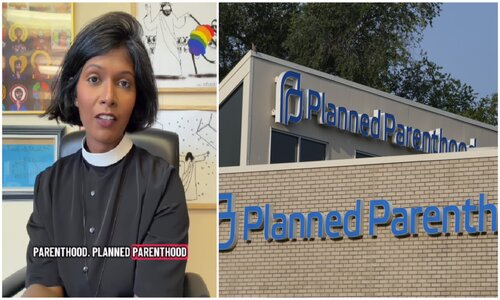
A recent controversy involving Gerlyn Henry, a self-described Anglican priestess serving in Scarborough, Ontario, has sparked outrage and disbelief among many Christians. Henry, who leads the Church of the Holy Wisdom, announced a partnership with Bellesa Boutique, an adult shop known for selling adult toys and related products. According to her own statements, she is distributing free adult items and gift cards through this collaboration. Even more troubling, she has pledged that proceeds from this partnership will be donated to Planned Parenthood, the largest abortion provider in the United States.
The facts alone are jarring. A clergy member–someone entrusted with teaching Scripture, shepherding souls, and upholding the moral teachings of the Christian faith–is openly promoting sexual products while financially supporting an organization that performs hundreds of thousands of abortions each year. For many believers, this is not merely a disagreement over secondary issues; it strikes at the heart of what the Church is called to represent.
Henry’s background adds further context. A graduate of Columbia Theological Seminary, she has previously drawn attention for progressive activism, including public statements on immigration policy and political slogans tied to global conflicts such as supporting Palestinian statehood over all of Israel. But this latest move goes beyond political expression. It represents a direct alignment with causes and industries that historic Christianity has consistently challenged–namely, the commodification of sexuality and the destruction of unborn life.
So the question must be asked: who bears the greatest responsibility for this kind of situation?
First, there is the individual leader. Gerlyn Henry cannot escape accountability for her own decisions. Scripture is clear that teachers will be judged more strictly (James 3:1), precisely because of the influence they wield. To actively promote behavior and institutions that contradict biblical teaching is not a matter of personal preference–it is a matter of spiritual leadership gone astray. Leaders are called not just to reflect culture, but to challenge it when it departs from truth.
However, it would be too easy–and ultimately incomplete–to stop there.
The congregation also plays a role. Churches do not exist in a vacuum; they are communities sustained by the participation and support of their members. When a congregation continues to attend, give, and affirm leadership that openly contradicts core Christian teachings, it sends a powerful message of approval or at least indifference. Silence, in this context, is not neutral. It becomes a form of consent. While not every attendee may agree with such actions, continued support without challenge raises serious questions about collective responsibility.
Yet perhaps the most significant failure lies at the institutional level. The broader Anglican Church–particularly its progressive branches–has increasingly struggled with questions of doctrinal authority and discipline. When there are no meaningful consequences for clergy who openly defy historic Christian teaching, it creates an environment where anything can be justified under the banner of inclusion or modern relevance. Church discipline, once considered a vital part of maintaining doctrinal integrity, has in many places been abandoned altogether.
This absence of accountability does not just affect one congregation or one leader. It shapes the culture of the entire denomination. It signals to both believers and the watching world that the Church no longer has clear convictions–or worse, that it no longer believes them to be important.
The result is confusion. And confusion, left unchecked, leads to erosion.
This story is not just about one priestess in Canada. It is a reflection of a broader crisis facing many parts of the modern Church: the tension between cultural acceptance and biblical fidelity. When the desire to be seen as relevant overtakes the call to be faithful, the Church risks losing its distinct voice altogether.
So where does that leave us?
It leaves us with a responsibility–individually and collectively–to examine what we are supporting, what we are tolerating, and what we are willing to confront. Accountability is not easy. It requires courage, humility, and a willingness to speak truth even when it is unpopular. But without it, the Church cannot fulfill its mission.
We cannot pretend these issues do not exist. We cannot dismiss them as isolated incidents. And we certainly cannot remain silent.
Because what is at stake is not just reputation–it is the very integrity of the Church itself.










Leave A Comment
You must be logged in to post a comment.