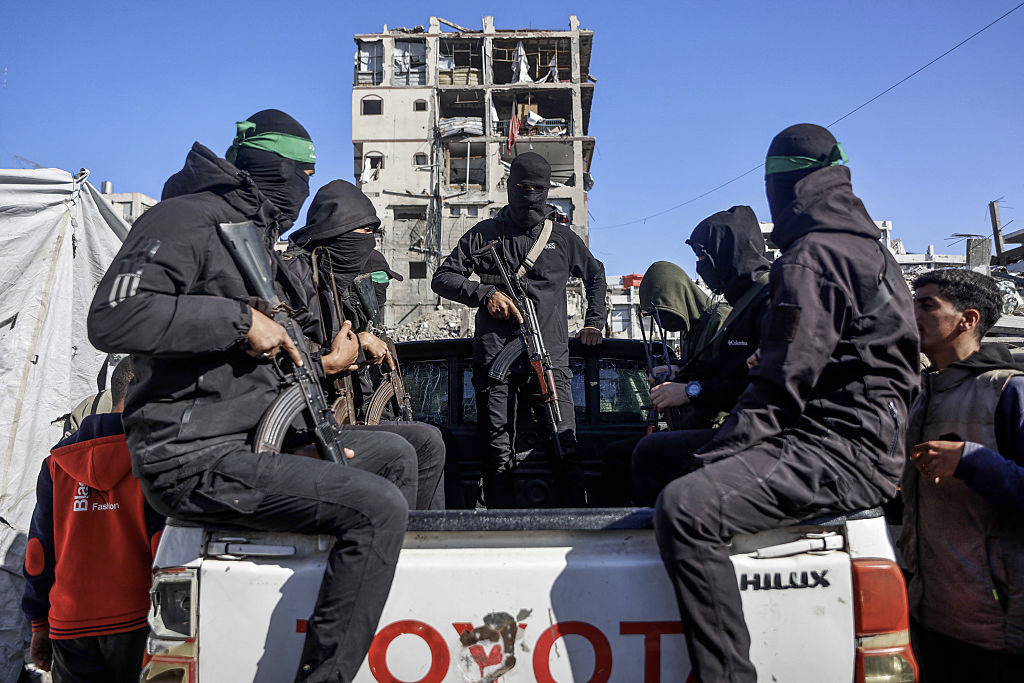
Hamas is not some misunderstood political faction waiting to be coaxed into moderation. It advocates jihad (holy war) as an “individual duty [of all Muslims] for the liberation of Palestine.” Pictured: Hamas terrorists in Jabalia refugee camp, in the Gaza Strip. (Photo by Omar Al-Qataa/AFP via Getty Images)
U.S. Direct Talks with Hamas: Legitimizing and Empowering Terrorists
Envoys from U.S. President Donald J. Trump’s “Board of Peace” recently met representatives of Hamas in the Egyptian capital of Cairo in an effort to safeguard the Gaza ceasefire, Reuters reported on March 16.
“The weekend meeting is the first publicly reported since the start of the Iran war between the Palestinian militant group and the board, a new international body personally headed by Trump, which has been tasked with overseeing post-war Gaza….
“One of the sources says Trump’s board was represented at the talks with Hamas by Aryeh Lightstone, an American aide to Trump’s special envoy Steve Witkoff…. Further meetings were expected this week. “
The Trump administration is making a huge mistake by engaging an Islamist terror group.
Direct talks with Hamas, officially designated by the U.S. government as a Foreign Terrorist Organization, risk conferring legitimacy on a group that rejects Israel’s right to exist and for decades has carried out attacks against countless Israeli civilians.
Engagement clearly signals to terrorists that violence is an effective path to power, land, and international recognition. Hamas is a group that is explicitly and fundamentally committed, in both ideology and practice, to “armed resistance” (terrorism).
Hamas’s October 7, 2023 invasion of Israel was a large-scale terror operation that illustrated the group’s commitment to terrorism. Senior Hamas officials have repeatedly vowed that they fully intend to continue such attacks.
Hamas is hardly a controversial political actor. The group, an offshoot of the Muslim Brotherhood, aims to establish an Islamic state encompassing the entirety of present-day Israel and the West Bank and Gaza Strip, through armed conflict.
Hamas’s 1988 charter as well as repeated statements by its leaders, rejects the legitimacy of Israel. Its charter quotes Muslim Brotherhood founder Hassan al-Banna as saying: “Israel will exist and continue to exist until Islam will obliterate it, just as it obliterated others before it.”
Article 11 of the Hamas charter states:
“The Islamic Resistance Movement [Hamas] believes that the land of Palestine is an Islamic Waqf consecrated for future Moslem generations until Judgement Day. It, or any part of it, should not be squandered: it, or any part of it, should not be given up. Neither a single Arab country nor all Arab countries, neither any king or president, nor all the kings and presidents, neither any organization nor all of them, be they Palestinian or Arab, possess the right to do that.”
Hamas is not some misunderstood political faction waiting to be coaxed into moderation. It advocates jihad (holy war) as an “individual duty [of all Muslims] for the liberation of Palestine.”
Article 13 of the Hamas charter says:
“There is no solution for the Palestinian question except through Jihad. Initiatives, proposals and international conferences are all a waste of time and vain endeavors.”
Since its establishment in 1987, Hamas has remained fully committed to its “armed resistance” and the elimination of Israel. In Hamas’s lexicon, the terms “compromise” and “concessions” do not exist.
Hamas’s ideological framework — rooted in Islamist “resistance” — make compromise and concessions impossible. Needless to say, there is no evidence that the terror group intends to fundamentally alter its long-term goals.
For Hamas, direct talks with the U.S. provide an opportunity to gain time, legitimacy, and concessions. As Trump’s envoys are talking to Hamas, the terror group has been continuing by force to reassert its rule in the Gaza Strip.
Unfortunately, negotiating with terrorist groups and the like, instead of defeating them, tends to end in disaster. The minute it becomes convenient, they go right back to terrorizing. The Taliban have been expanding their repression throughout Afghanistan. Russia disregarded the 1994 Budapest Memorandum, in which it guaranteed Ukraine’s sovereignty, borders and freedom from aggression if Ukraine gave up its nuclear weapons; and China appears to assume that agreements exist to be violated (such as here, here and here).
Hamas has consistently refused to disarm, recognize Israel, cease ruling Gaza, renounce violence, and accept past agreements between Israel and the Palestinians. Talking to Hamas now, without its first adhering to Trump’s preconditions, marks a sharp and potentially confusing policy reversal that weakens US credibility globally.
If Hamas is allowed to gain diplomatic access without changing its core positions, other Islamist terror groups will draw an empowering lesson: violence pays.
Across the region, the Iranian regime and its terror proxies are watching closely. The lesson for them will unmistakably be: hold out, escalate, and eventually the world’s most powerful democracy will come to deliver victory to you.
For Palestinians, direct talks would mean that Hamas’s rule in the Gaza Strip — which began with a violent coup against the Palestinian Authority in 2007 — has been marked by nearly twenty years of repression at home. It has consisted of crackdowns on dissent, summary executions, torture, intimidation and murder of rivals, stealing humanitarian aid from civilians, shooting at their own people trying to flee, using their citizens as human shields to escalate the death count and blame it on Israel; and the imposition of heavy economic burdens.
Engaging Hamas as if it were a normal governing authority will only demonstrate to other terrorist groups that terrorism works. Negotiating will not moderate reality. The message it sends to the Palestinians and like-minded groups is: The international community is willing to overlook internal abuses and human rights violations so long as the rulers in question enforce obedience. That is the job for a prison warden, not for a government one hopes will stabilize the neighborhood.
Direct negotiations with Hamas also sideline other Palestinians who are not affiliated with the terror group or who are opposed to violence and terrorism. Direct negotiations just reinforce Hamas’s claim that “armed resistance,” not diplomacy, gets results.
The Trump administration, if it believes that talking to Hamas represents a pragmatic and necessary approach for achieving peace and stability, is dangerously mistaken. This belief collapses under scrutiny. Talking directly to Hamas will only reward extremism and terrorism, weaken anti-Hamas individuals and parties, and erode the very principles Washington claims to defend.
Launching direct talks with Hamas or other Islamist terror groups absent any fundamental change in their positions is not diplomacy. It is capitulation and surrender dressed up as “realism.”
The Trump administration would do well to see that talking to Hamas only normalizes it as a legitimate regional actor rather than ostracizing it as an Islamist terror group.
Above all, direct engagement of Hamas is a concession to the jihadis, who believe Muslims are in an eternal confrontation with the enemies of Islam and must overthrow secular regimes to restore a “pure” Islamic state.
Khaled Abu Toameh is an award-winning journalist based in Jerusalem.












Leave A Comment
You must be logged in to post a comment.