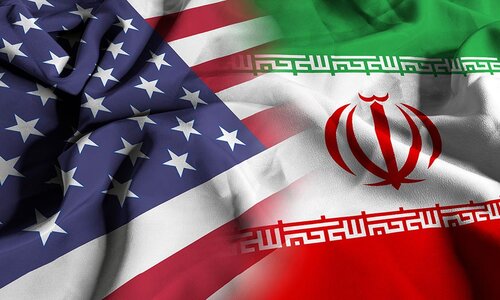
By the time you read this, the Iranian revolt by the Iranian people will be winding down, and the dictatorship of evil, the Islamic Republic, will remain in power. Just a lot of dead people and a lot of grieving families as a result of the past couple of weeks.
This might not be being reported now, but you’ll hear or read of this elsewhere very soon.
There may be no easy answer, but the most powerful leader on earth, a sitting American president, ought not shoot his mouth off continually about “help is on the way,” and that the Iranian regime will pay a heavy price if any Iranian people are murdered, and on and on, and on and on.
Either don’t say anything, or don’t spew rash words; there is no intention of backing up. Waffling. To what effect? Thinking words will make terrorists, despots, dictators, EVIL behave?
Why is it that EVERY American administration, no matter who, no matter if they all have a “D.” or an “R.” after their names, is utterly blind and deceived when it comes to Islam?
That’s more rhetorical than a question asked seeking an answer.
There is no negotiating with Islamic states, nations, leaders, and thinking their words, their promises will mean anything with the passage of time.
If you’ve been watching and listening to mainstream media, broadcast media, I feel sorry for you. Having your ears, eyes, and mind filled with the dung flung from the tongues of almost everyone on air, almost everyone writing things.
It’s all massaged, manipulated, censored, and controlled. If any real news or real information is told or written, we, the people, are only receiving 10% to at most 25% of any given item. And even those so-called “in the know” frequently are given inaccurate and utterly wrong information — including presidents, intelligence agencies, politicians, and militaries.
Privately, in conversations and talking with my wife, when it was being repoted that 500 Iranian people, perhaps as many as 1,200 had been killed in the “protests,” [its called a revolution, folks, when its of this magnitude, going on this long, and this many have been slaughtered] I was saying those numbers were more accureately 15,000 to 20,000 at that point.
As of today?
How is it that a guy like me can have a more accurate number of murders than the media? Then what a sitting president believes, and then says, “They told me the killing has stopped.”
Yeah, right…
Why were my estimates of the slaughter more accurate at the time? For one, our leaders either are truly ignorant of Islam, our intelligence services completely inept, and there is massive ignorance in Washington, D.C., and elsewhere — or they don’t want to face the facts, or they like lying to we the people and have done it for so long, are so adept at it they no longer can distinguish their lies from when they do offer a morsel of truth.
Here’s the thing, though, when many of them speak, they do so in their tone, their body language, as if they believe what they are saying. If this is the case, their naivety regarding Islam, Iran, and the condition of this world at this point is astonishing.
It’s likely that 50,000 Iranian people have been murdered. In cold blood. For wanting freedom from Islamic oppression.
And the killing has not stopped.
Does anyone in our government, in the media, actually know who they’re dealing with when it comes to the Iranian regime?
Yet, we sit down and think we can negotiate with these people. When the standing policy was not to negotiate with terrorists. We still recognize the Islamic Republic diplomatically!!!
Don’t think history is important, past history is stale, boring, and does not repeat itself?
The West twiddles its thumbs, knits itself into a knot, hesitates, pauses, fears, spews a lot of words — or remains silent about the slaughter.
Here’s the thing, believer, if a true believer, Bible literate and believing, if the Iranian regime does fall, which is highly unlikely, and the crown prince is reinstalled, and Iran goes through massive change, the Islamic Republic falls, and we think it’s going to be as it was pre-1979?
Then what of the Ezekiel 38 war talk in conjunction with all the Rapture talk?
Think about it.
I don’t see the Islamic Republic falling and the reestablishment of the monarchy in Iran again.
Even if the Iranian Civil War takes place goes on for a few more months, and the death toll ends up being 1,00,000,000.
I hope and pray the system of the ayatollahs, mullahs, and Islamists in control does fall, and the killing does stop, but what then of Ezekiel 38, the Rapture, and Bible prophecy so many are talking and writing about, as if it’s all imminent, right around the corner?
It’s a mess. A big mess.
And there is a lot of confusion, missteps, waffling, lying, fear taking place around the world — and in Washington, D.C., and capitals worldwide.
This is what happens when the people turn from God, most never even seeking, considering God, most never going to God’s Word, most refusing to repent, most living lives of sin and darkness, most thinking self or their nation, their leaders are the answer, the solution, and they have never, or stopped, trusting God, Jesus, the Holy Spirit, and living in and living out the Word of God in their daily lives.
Our leaders, too many touted as Christians, when few truly are, are Bible illiterate. Vain. Foolish. Arrogant. Confused. Misguided — because they do not allow, have never allowed God and the Holy Bible to guide and instruct them in the way to go.
It’s all unfolding. Rapidly.
Do not fear.
The Day of the LORD is near!
Each will have to answer for their individual life, beliefs, faith, or lack of it. Face to face with Jesus.
Look up.
Do not look to any man or woman to have the answers, to save a thing, as most refuse to save themselves by faith in the LORD Jesus Christ, and THAT, my friends, is the ONLY WAY to receive any light, illumination, understanding, discernment of the times and the how, why, and what of it all.
Read on…
Ken Pullen, Friday, January 16th, 2026
The War Everyone Is Preparing For – And No One Wants To Start
January 16, 2026
By PNW Staff
Reprinted from Prophecy News Watch
The aircraft carriers are already in motion.
Missile defenses are quietly repositioned. Intelligence flights sweep the region night after night. Money is moving in Tehran. Commanders are relocating. Safe houses are activated. This is what the final days before a war look like — except the war hasn’t come.
Yet.
For weeks, the United States has positioned itself as if a strike on Iran could happen at any moment. And then, just as suddenly, President Trump’s tone softened. The threats grew less specific. The red lines blurred. The world noticed.
This isn’t hesitation. It’s something more calculated — and more unsettling.
Because behind closed doors, nearly everyone is saying the same thing: don’t pull the trigger.
The Strange Coalition Against War
Saudi Arabia doesn’t want Iran struck. Israel’s Benjamin Netanyahu has reportedly warned against it. Gulf states hosting U.S. bases have pleaded for restraint. Even countries that have spent decades fearing Iranian power are suddenly arguing that weakening Tehran could make everything worse.
That should make us take pause.
Iran is not Iraq. It is not Libya. It is a regime built to survive strikes, absorb pain, and retaliate asymmetrically. Its power doesn’t rest in one bunker or one leader, but in a sprawling network designed for one moment only: the moment Iran believes it is facing extinction.
That is the moment everyone fears.
Because once Iran believes it has nothing left to lose, every restraint disappears. Missiles toward Israel. Proxies unleashed across the region. U.S. bases targeted. Oil lanes disrupted. Markets collapse. A regional war could become global in hours.
Saudi Arabia understands this. Israel understands this. And Washington understands it too — even if it doesn’t say so publicly.
A strike wouldn’t end Iran’s influence. It would detonate it.
The Silent Front: Sleeper Cells and Terror at Home
There is another reason the word “retaliation” sends chills through intelligence circles — and it has nothing to do with missiles.
Iran’s reach does not stop at borders.
For decades, U.S. and allied intelligence agencies have warned that Iran and its proxies maintain sleeper networks across Europe, Latin America, and potentially the United States. These are not standing armies. They are dormant assets — individuals, logistics channels, financial conduits — activated only when Tehran believes it is under existential threat.
A U.S. strike could flip that switch.
Unlike conventional warfare, terror operations don’t require air superiority or supply chains. They require patience, anonymity, and timing. Targets are soft. Attribution is murky. Fear spreads faster than facts.
From cyber sabotage and infrastructure disruption to coordinated attacks on symbolic or civilian targets, Iran has long viewed asymmetric warfare as its most effective response to superior military power. In such a scenario, the American homeland — long insulated from Middle Eastern conflict — would no longer feel distant from the war.
This possibility weighs heavily on U.S. decision-makers. Once unleashed, such networks are difficult to track, harder to dismantle, and politically devastating if even one attack succeeds. The risk is not hypothetical. It is baked into Iran’s doctrine.
War with Iran would not stay overseas.
Why Americans Are Pulling Back
At home, the public mood is clear: most Americans oppose intervention. Not because they sympathize with the Iranian regime — they don’t — but because they recognize a familiar trap.
A strike would be dramatic. It would dominate headlines. It would feel decisive.
And then what?
Without regime change, the U.S. would own the consequences without owning the outcome. Retaliation would be guaranteed. Victory would be undefined. The risk would be permanent.
Americans have lived through this before. They know what happens when military action outruns political reality. They’ve learned that the most dangerous wars are the ones that begin with confidence and end with no exit.
This time, the public is ahead of the politicians.
The Intelligence Game Behind the Curtain
Here is the part rarely discussed.
The threat of war itself may have already delivered something more valuable than missiles ever could: visibility.
With an attack appearing imminent, Iran has begun acting accordingly. Assets have moved. Leaders have shifted locations. Financial networks have been activated. Contingency plans have come alive.
And intelligence agencies have been watching.
In preparing for the worst, Iran may have exposed its survival blueprint — how it expects to ride out a strike, where it hides, how it intends to respond. In chess terms, Tehran revealed its endgame strategy before the first move was made.
That alone may explain the sudden restraint.
When you know your enemy’s escape plan, patience becomes power.
But What About the Iranian People?
And this is where the moral tension tightens.
Are we abandoning them?
For years, Iranians have protested their rulers, risking imprisonment and death. They have watched their economy crumble under corruption and sanctions. They have looked outward, wondering if the West would ever help break the grip of a regime that does not represent them.
Now, as the threat of U.S. action fades, that question hangs heavy: Was this their moment — and did we walk away?
It’s a painful question, and there is no easy answer.
A U.S. strike might weaken the regime — or it might strengthen it by rallying nationalism and crushing dissent under the banner of survival. History suggests authoritarian regimes often emerge more brutal, not less, after external attacks.
Yet restraint carries its own cost. When America pulls back, hope can collapse with it.
The tragedy is this: there may be no military path that truly liberates the Iranian people without destroying the country they live in.
The Pause Before History Turns
This moment is not resolution. It is suspension.
The war is prepared. The intelligence is gathered. The consequences are understood. And for now, the most powerful weapon in America’s arsenal may be the one it hasn’t used.
But pauses don’t last forever.
Iran knows it is being watched. The region knows how close it came. And the Iranian people are left waiting — again — wondering whether silence means patience… or abandonment.
In geopolitics, the most dangerous sentence is never spoken aloud:
“We’ll decide later.”
Because later always comes — and when it does, it rarely looks like the plan anyone imagined.









Leave A Comment
You must be logged in to post a comment.