The ‘Multicultural’ Terrorist Threat Inside Europe: The Exported War No One Wants to Name
When Israel’s Mossad intelligence agency publicly revealed in November 2025 that it had helped European countries expose a Hamas terrorist infrastructure “in the heart of Europe” – including weapons caches and plans to hit Jewish and Israeli targets – it simply confirmed what intelligence professionals have warned since October 7, 2023: The war in the Gaza Strip is no longer local. It has been exported, operationally, to European soil.
As early as December 2023, German, Dutch and Danish authorities had already arrested Hamas operatives accused of preparing attacks on Jewish institutions in several European countries. Prosecutors described long-standing members of Hamas, directed to stockpile weapons in Berlin. Since then, intelligence and security reports have spoken of a “realistic possibility” that the Hamas-Israel war will embolden networks across Western Europe to move from propaganda to mass-casualty attacks.
Europol’s 2025 Terrorism Situation and Trend Report openly acknowledged that the Gaza conflict has reshaped the threat picture inside the EU. The foreword warns that wars beyond Europe’s borders – explicitly including Gaza – fuel radicalization, propaganda and operational planning within European states. In parallel, news outlets report that, since 2023, European authorities have quietly disrupted several plots linked to Hamas, Hezbollah and Iran.
Behind these plots lies an entrenched Hamas infrastructure in Europe that long predates 2023. A detailed study from George Washington University describes how Hamas built extensive fundraising and logistical networks in Western countries, using charities, NGOs — often European-funded — and business fronts whose names and legal entities are constantly changed to stay ahead of authorities. These same countries, the study’s authors warned, are the natural incubator for future terrorist operations in the West.
In 2024, the Foundation for Defense of Democracies summarized new research by ELNET that identified 30 Hamas-linked organizations and figures active in the U.K., Germany, Italy, Belgium and the Netherlands. These groups include “civil society” associations, aid organizations and lobbying platforms that propagate Hamas narratives while maintaining close personal ties with known extremists. They operate with “relative freedom,” despite Hamas having been officially designated as a terrorist organization by both the EU and individual states.
Germany, to its credit, has gone further to confront this problem than most. Berlin has not only banned Hamas and the international network Samidoun, but has also started outlawing local “solidarity groups” whose activities glorify terrorism and promote antisemitic agitation. The German Interior Ministry reported that some 450 Hamas members are active in the country and involved in propaganda and fundraising, and has ordered raids against groups such as Palestine Solidarity Duisburg for supporting Hamas under the cover of activism.
Even in Germany, however, every ban on one structure appears followed by the birth of another. NGO Monitor has documented how Samidoun, officially linked to the PFLP terrorist organization, simply inspired successor networks such as Masar Badil, which German media describe as closely connected to Hamas, Palestinian Islamic Jihad and Yemen’s Houthis. Belgian authorities stripped Samidoun’s European coordinator of his residency only in 2025, after he publicly praised the October 7 massacre.
Fundraising and logistics are only one part of the story. Hamas also invests heavily in indoctrination – particularly among students. A report from the University of Indiana shows how a transnational network of NGOs and campus groups spread antisemitic and pro-Hamas narratives, coordinated across borders and amplified by social media. The message is simple: Israel is “colonial,” Jews are “settlers,” and violence against them is “resistance.”
The results are visible on European campuses. A 2024–2025 wave of “Gaza encampments” imported the rhetoric of “globalize the intifada” to universities from Paris to Berlin and Glasgow. In Scotland, on the anniversary of October 7, students marched under a banner proclaiming “Glory to our martyrs,” openly celebrating the atrocities of Hamas. Surveys and reports currently detail a sharp rise, since 2023, in antisemitic incidents and intimidation at European universities.
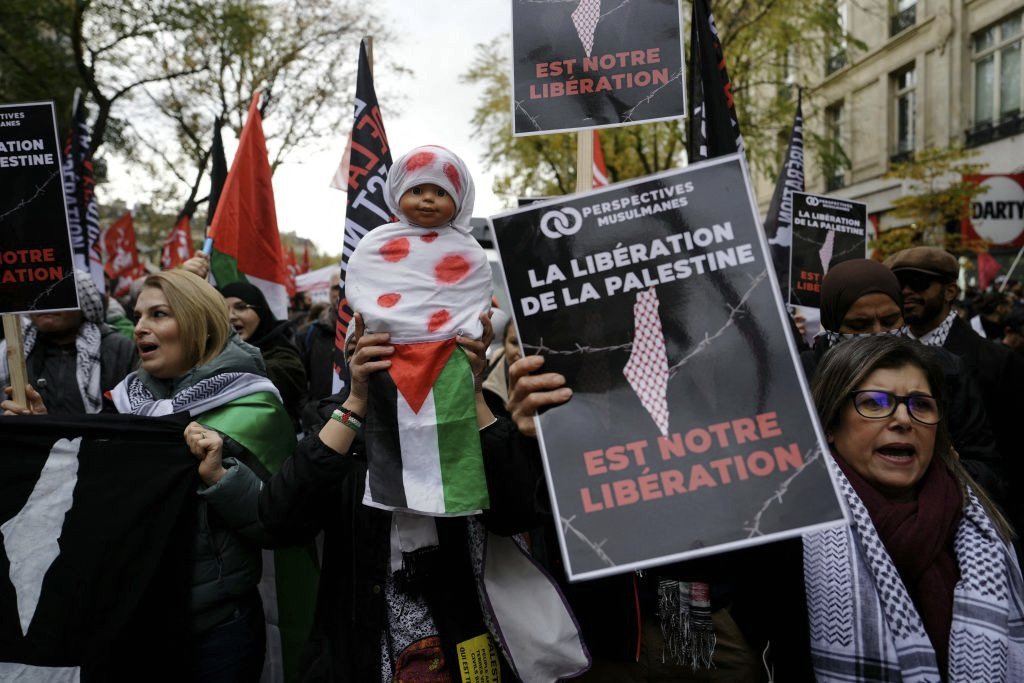
This is where “Palestinian activism” becomes a protective shield for extremist cells. Peaceful protesters certainly exist, but in many instances, the same marchers who cry “from the river to the sea” also provide cover, logistics and recruitment spaces for operatives who work closely with Hamas or other terrorist organizations. European rallies have repeatedly featured Hamas flags, praise for the October 7 attackers and calls to “repeat” the massacre – all under the label of “human rights.”
Law enforcement sees the problem more clearly than politicians. The same EU reports that speak delicately of “violent extremism” in public also describe behind closed doors how online propaganda, diaspora networks and Middle Eastern conflicts interact to create hybrid terrorist ecosystems in Europe. Israeli and European intelligence routinely give briefings on how Iran, Hezbollah and Hamas coordinate surveillance of Jewish targets in cities such as Berlin.
Even so, on the political level, Europe still refuses to name the ideological enemy: an Islamist project that openly seeks the eradication of Israel and spills over to advocate eliminating the United States and the West. “The one Jewish state is the first to suffer,” notes Jerusalem Post reporter Liat Collins, “but the nearly 50 Muslim-majority countries and the nominally Christian world are all in the line of fire.”
Clifford May, president of the Foundation for Defense of Democracies, has described how European governments rush to recognize a Palestinian state even as Hamas thanks them for rewarding its “resistance.” This same cognitive dissonance runs through EU institutions that condemn “terrorism” in the abstract while lavishly funding NGOs that glorify its perpetrators.
Europe’s retreat into denying intangible threats staring them in the face unfortunately has extremely tangible results. For years, Western courts and regulators tried to distinguish between Hamas’s “military” and its so-called “political” or “social” branches – a distinction many serious experts regard as fanciful. Studies of Hamas funding stress that social and religious front organizations are integral to the movement’s terrorist attacks: they launder money, recruit sympathizers and create safe spaces where support for terrorism can flourish under a “humanitarian” cover.
The same “doublespeak” dominates the discourse on “Palestinian activism.” When Germany bans Samidoun or a small local front group, NGOs and academics denounce the act as a “repression” of civil society. When Belgium moves against a man praising the October 7 massacre, activist networks cry that “solidarity” is being criminalized. In this narrative, it is always the state – never the terrorist infrastructure – that is on trial.
Meanwhile, Europe’s Jewish communities live under siege. Synagogues require fortress-style protection, Jewish schools resemble military bases, and Israeli tourists are warned by their own government to avoid displaying any visible sign of Jewish or Israeli identity when traveling. The dramatic rise in antisemitic incidents across Europe since October 7, 2023 can be directly linked to pro-Hamas agitation, even when officials pretend that the hatred has “nothing to do” with imported Middle Eastern conflicts.
The war that has been exported from Gaza to Europe has three pillars: money, indoctrination and operational cells. All three are embedded in structures that call themselves “Palestinian solidarity” or “human rights organizations.” As long as European governments accept this masquerade, the continent will remain both a financial base and a potential battlefield for Hamas and its Qatari, Turkish and Iranian sponsors.
What would a serious policy look like? First, full exposure and the expansion of existing terror designations: not just banning Hamas as an abstract entity, but shutting down its front groups, closing its “charities” and prosecuting those who fund or glorify its violence. Second, conditioning all funding for Palestinian NGOs on clear, independently verified rejection of terrorism and incitement. No more American or European funding, period, for organizations that celebrate terrorist “martyrs” and teach children to hate Jews, Christians, or any other racial or religious group.
Third, Europe must finally confront the indoctrination dimension. This means holding universities accountable for campus groups that praise terrorism under academic cover, enforcing existing laws against incitement, and protecting Jewish and pro-Israel students with the same zeal shown for every other minority. It also means recognizing the obvious: When demonstrators chant “globalize the intifada,” they are not calling for peace, they are calling for the expansion of a global jihadist war.
Finally, Europeans must abandon the illusion that the “Palestinian cause” is a harmless protest disconnected from terrorism. Hamas itself, backed by Qatar, Turkey and Iran, has explained over and over that Europe is part of their battlefield. The only question is whether European leaders will listen to their own police and intelligence services, and Israel’s Mossad, or whether they will continue pretending that a war raging against them has no name and does not exist.
Pierre Rehov, who holds a law degree from Paris-Assas, is a French reporter, novelist and documentary filmmaker. He is the author of six novels, including “Beyond Red Lines”, ” The Third Testament” and “Red Eden”, translated from French. His latest essay on the aftermath of the October 7 massacre ” 7 octobre – La riposte ” became a bestseller in France.As a filmmaker, he has produced and directed 17 documentaries, many photographed at high risk in Middle Eastern war zones, and focusing on terrorism, media bias, and the persecution of Christians. His latest documentary, “Pogrom(s)” highlights the context of ancient Jew hatred within Muslim civilization as the main force behind the October 7 massacre.











Leave A Comment
You must be logged in to post a comment.