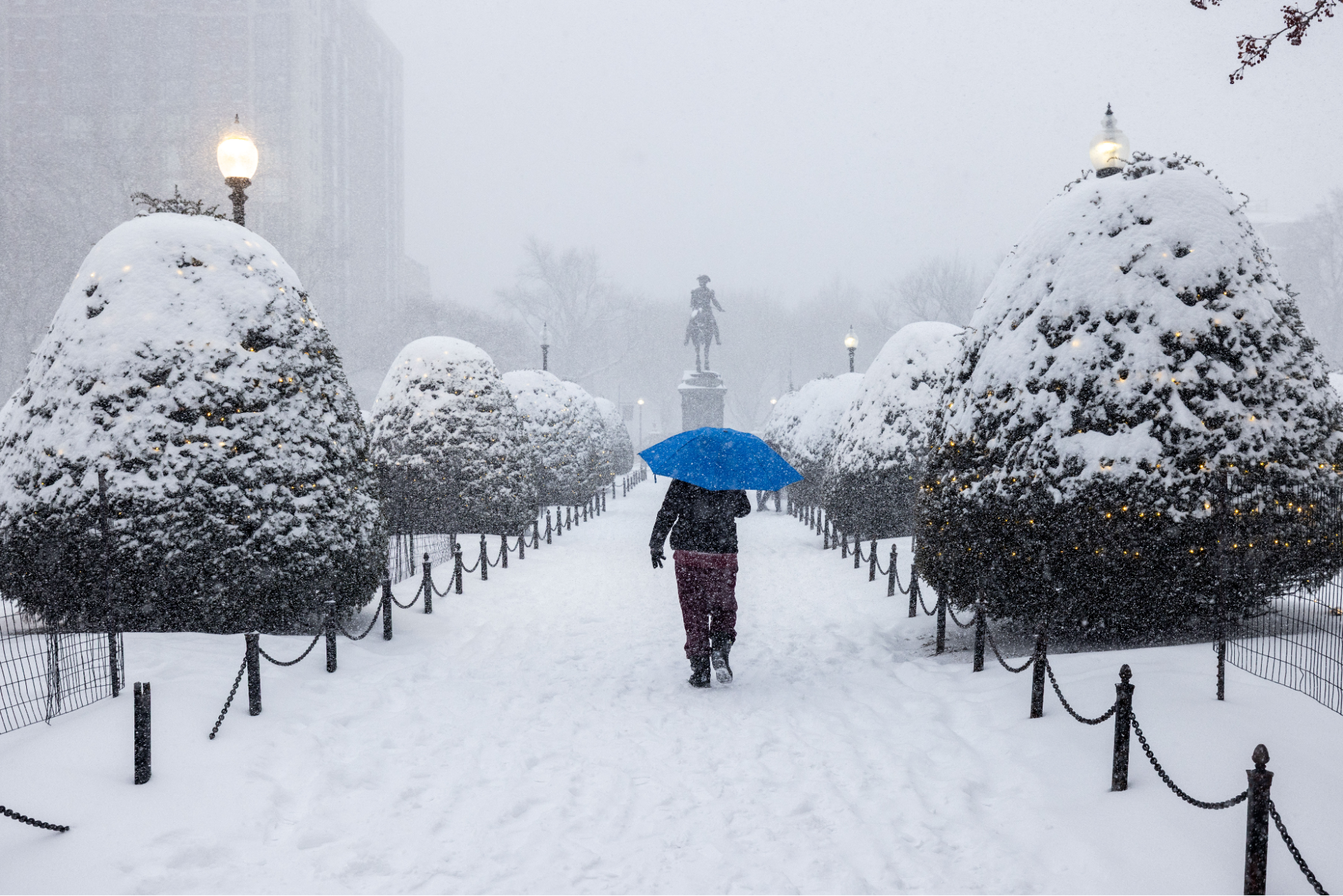
A person walks through Boston Public Garden during heavy snow in Boston, Mass., on Jan. 25, 2026. (Scott Eisen/Getty Images)
The Climate Change Racket
February 10, 2026
By Jeffrey Tucker
Reprinted from The Epoch Times
When I was very young, the climate scientists were hard at work propagandizing the children. There was an Ice Age coming, probably as a result of the industrial civilization our parents created. Woolly mammoths will roam the earth.
They certainly roamed my nightmares. Kids don’t know the difference between a thousand years and tomorrow, so I woke up each day expecting to see snow and ice—and huge beasts with tusks—even though I lived in West Texas.
Time passed and at some uncertain point, that new Ice Age claim went away. There was a new claim that we were entering into global warming. The polar ice caps would melt and coastal cities would be under water. People were extremely dogmatic about it. It was demanded that I believe else be called a denier.
I never took it seriously. First, I looked at the models and realized that all claims about trends were subject to the way they were measured and what precisely was being measured. The models could produce any results desired.
Second, it was screamingly obvious that there was no way to prove cause and effect from anything because there were too many confounding factors.
Third, I looked at real estate values on beachfront properties and saw they were only rising.
As a result, I mostly ignored the whole hullabaloo. There were books claiming that the frenzy was skewed by government funding of academics and their journals, essentially that scientists were chasing the big bucks and lying to get it.
That’s a pretty dark theory, and I dismissed it because it seemed too conspiratorial. Until COVID hit. Then I saw it plainly. Too many scientists, people we pay to tell us the truth as they see it, were willing to go along with absolute nonsense to protect their paychecks, career paths, and climb social circles.
Amazing!
Back to weather, I mean, the climate (we are told they are not the same except when they are). I’m in New England and it is unbearably cold, to the point that frostbite seems imminent after two minutes outdoors. Indeed, it’s the coldest winter in two decades. In the old days, we might have commented something like “Hey, whatever happened to global warming?”
Now, we have a different problem. These climate scammers have rigged the game completely. They have made their thesis unfalsifiable. Instead of precise predictions of warming or cooling, they now raise alarms about “climate change.”
No doubt this was in response to polling. Do you believe in climate change? Oh sure! Who doesn’t? Ever heard of the seasons?
The brazenness of the racket was so preposterous that it hardly merits comment. Except that it’s been going on for more than a decade and a half.
Just two days ago, the New York Times had a headline: “What’s Up with this Big Freeze? Some Scientists See Climate Change Link.” Two years ago in Winter the same venue ran a headline: “Weirdly Warm Winter Has Climate Fingerprints All Over It, Study Says.”
It’s almost like they are making fun of themselves, else they think we are really dumb.
The U.S. representative to the U.N.’s Intergovernmental Panel on Climate Change under the Obama administration was Dr. Steven Koonin. At a recent academic meeting, he blasted his colleagues for wildly exaggerating the threat to the point that it is discrediting the whole of climate science. He shocked the room, like the boy who pointed out that the king had no clothes.
Truly, the entire enterprise has become nearly laughable. Every snow, rain, drought, or hurricane is routinely cited as evidence that human beings are messing everything up. Our cars, consumption, and indulgences are making Mother Nature angry and she is fighting back with storms and lightning.
The theory is really no more sophisticated than some primitive religion.
The effects of this theorizing have been profound. Half of humanity has seen its access to power throttled, raising prices and imposing rationing on the poor. In the United States, the wide-open landscapes have been filled with wind turbines even in areas where oceans of oil sit beneath the surface.
I once flew over miles of solar panels that were covered in sand. Only yesterday, I drove past a house that converted its roof into solar panels, except now they are fully covered in snow. Whoops!
It’s remarkable to think that an ideology that has stretched from the beginning of my life to the present is based on nothing but payola, pretense, and profound intellectual error. It’s the apotheosis of the planning mentally—complete with five-year plans to monitor how well governments are doing in controlling the climate for the whole world and do so in a way that affects temperature 100 years from now.
There is an old story involving King Canute, who ruled Denmark, England, and Norway a millennium ago. According to popular legend, as a way of demonstrating his awesome power, he rolled his throne up to the sea and commanded it to stop rising.
It didn’t work. Still, the image appears in many works of art. Even Lego offers a King Canute scene from its historical set.
Historians have challenged the point of the story. The only account we have of this incident, if it occurred at all, is from Henry of Huntingdon. He reported that after the sea rose despite his command, the King declared: “Let all men know how empty and worthless is the power of kings, for there is none worthy of the name, but He whom heaven, earth, and sea obey by eternal laws.”
He did and said this, say modern experts, to demonstrate to his courtiers and flatterers that he is not as wonderful and powerful as they were proclaiming him to be. Instead of subservience to his own person, he was urging all citizens to save their adoration for God.
His point was that power—even the absolute power of kings—has limits. During his rule, King Canute was enormously popular and evidently benefitted from the common tendency of people to credit authority for the achievements of the spontaneous evolution of the social order itself. His sea trick, if it happened at all, was designed to show people that he is not the man they thought he was.
Why do scientists backed by government so often pretend to know what they cannot know, and purport to plan what they cannot plan? F.A. Hayek called this habit the harshest possible word: “charlatanism.”
In the climate case, we can’t really know how climate will change 50–100 years from now or how they might affect life on earth. We don’t know the precise causal factors and their weight relative to the noise in our models, much less the kinds of coercive solutions to apply and whether they have been applied correctly and with what outcomes, much less the costs and benefits of attempting such a far-flung policy.
We can’t know any of that before or after such possible solutions have been applied. Science requires a process and unrelenting trial and error, learning and experimentation, the humility to admit error and the driving passion to discover truth.
In other words, science requires freedom, not central planning. The idea that any panel of global experts, working with appointed diplomats and bureaucrats, can have the requisite knowledge to make such grand and final decisions for the globe is outlandish and contrary to pretty much everything we know.
Throw the reality of politics into the mix and matters get worse. Fear over climate change was the last best hope for those who long to control the world by force. The entire nightmare scenario of rising tides and flooded cities—one that posits that our standard of living is causing the world to heat up and burn—is just the latest excuse.
Hayek says: “If man is not to do more harm than good in his efforts to improve the social order, he will have to learn that in this, as in all other fields where essential complexity of an organized kind prevails, he cannot acquire the full knowledge which would make mastery of the events possible.”
Or we could just quote King Canute after the tides failed to respect his edict: “Let all men know how empty and worthless is the power of kings, for there is none worthy of the name.”
Jeffrey A. Tucker is the founder and president of the Brownstone Institute and the author of many thousands of articles in the scholarly and popular press, as well as 10 books in five languages, most recently “Liberty or Lockdown.” He is also the editor of “The Best of Ludwig von Mises.” He writes a daily column on economics for The Epoch Times and speaks widely on the topics of economics, technology, social philosophy, and culture












Leave A Comment
You must be logged in to post a comment.