
NOTE: I took the liberty of changing, improving, correcting the mind-numbing, Satan-satisfying use of acronyms to numb the spirit and soul, anesthetize the mind, and conform to the world, and introduced correct terminology.
Also, not only stop using these lazy acronyms to please the world, the flesh, and Satan, but also stop using stolen and incorrect words to define the sin of homosexuality. Call it what it is, for it certainly isn’t gay, or have anything to do with being gay. Quite the opposite, if only those professing to be salt and light would pause and live to think, to stand apart, and to please God more than worry about fitting in and pleasing lost men and women.
Read on…
Ken Pullen, Tuesday, January 13th, 2026
The conservative justices’ apparent misgivings about the transvestites challenges bode well for female athletes.
January 13, 2026
Reprinted from Blaze Media
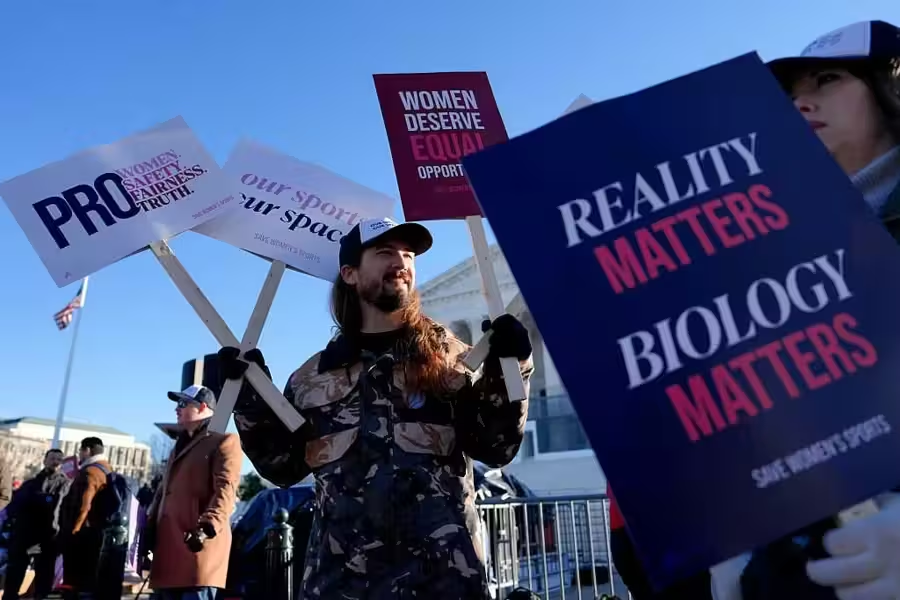
Just six months after the U.S. Supreme Court upheld a Tennessee law banning sex-rejecting genital mutilations and puberty blockers for minors, the high court’s questions and remarks during oral arguments on Tuesday regarding two cases concerning men competing on girls’ and women’s sports teams in Idaho and West Virginia signal that gender ideologues are set to lose more ground.
Background
Twenty-seven states have passed laws and/or regulations prohibiting males from participating in girls’ or women’s sports.
West Virginia, for example, enacted the Save Women’s Sports Act in 2021, requiring public school and collegiate sports teams to require athletes to participate on teams corresponding with their sex.
Becky Pepper-Jackson, a 15-year-old male transvestite in West Virginia who has pretended to be a girl since the third grade and taken puberty blockers, sued the state’s board of education as well as other officials, claiming that his exclusion from girls’ sports violated both Title IX and the Constitution’s Equal Protection Clause.
This case, West Virginia v. B.P.J., has been kicked through the courts and is now before the Supreme Court.
The other case taken up by the high court on Tuesday, Little v. Hecox, is highly similar.
Lindsay Hecox, a 24-year-old male student at Boise State University who took cross-sex hormones for only one year, wanted to join the women’s cross-country team, where his male physiology would serve as a tremendous advantage over his female competitors. He was unable to join the women’s team on account of Idaho’s Fairness in Women’s Sports Act, which banned male transvestites from competing on female athletic teams.
Like the transvestite student in West Virginia, Hecox sued, claiming the Idaho law violated his constitutional rights.
Both cases were brought to the Supreme Court by the two states’ Republican attorneys general with attorneys from Alliance Defending Freedom.
“Men cannot become women; their biological differences are scientifically clear. And no ideological arguments attempting to justify allowing males to enter female sports can stand against this truth,” stated ADF president and chief counsel Kristen Waggoner.
The possibility that the Supreme Court will rule again against gender ideology has sexual perversion, sexual deviancy radicals panicking.
For instance, Erin Reed, the boyfriend of cross-dressing Montana state Rep. Zooey Zephyr (D), wrote that “depending on how the Court rules, these cases could reshape the legal framework governing transgender rights for an entire generation.”
The Human Rights Campaign wailed: “As transgender youth continue to face numerous targeted attacks from health care to education, these cases mark another key moment in the fight against anti-sexual perversion+ discrimination that could have implications beyond the sports world.”
GLAAD previously stated: “Similar to misleading narratives about bathrooms and other single-sex spaces, propagating inflammatory scenarios about transgender women and girls participating in sports has become a common tactic in broader attacks on trans rights and equality.”
Conservative majority signal victory for sanity
In Hecox, liberal justices raised questions about whether the case might be moot because of the transvestic student’s claim that he won’t attempt to compete in collegiate women’s sports again; whether transvestic men with low testosterone levels might qualify as a sub-class deserving of a legal carve-out; and whether the Supreme Court could decide that while most men have an unfair advantage in women’s sports, the transvestite in this particular case does not.
Idaho Solicitor General Alan Hurst argued in turn that the case wasn’t moot, as Hecox has time left to change his mind about future participation; that it “will always be possible to carve the class down further”; and that an exception would not be administrable as it’d be invasive, requiring ongoing testosterone monitoring of the athlete.
Hurst — who on multiple occasions attempted to help remedy Justice Ketanji Brown Jackson’s confusion — later emphasized in his rebuttal that male athletes pose a threat to women’s sports, citing a 2024 U.N. special rapporteur report that indicated that “over 600 female athletes in more than 400 competitions have lost more than 890 medals in 29 different sports” as the result of male interlopers.
“Idaho’s law classifies on the basis of sex because sex is what matters in sports,” Hurst said. “It correlates strongly with countless athletic advantages like size, muscle mass, bone mass, and heart and lung capacity.”
RELATED: ‘Not medicine — it’s malpractice’: Trump HHS buries child sex-change regime with damning report












Leave A Comment
You must be logged in to post a comment.