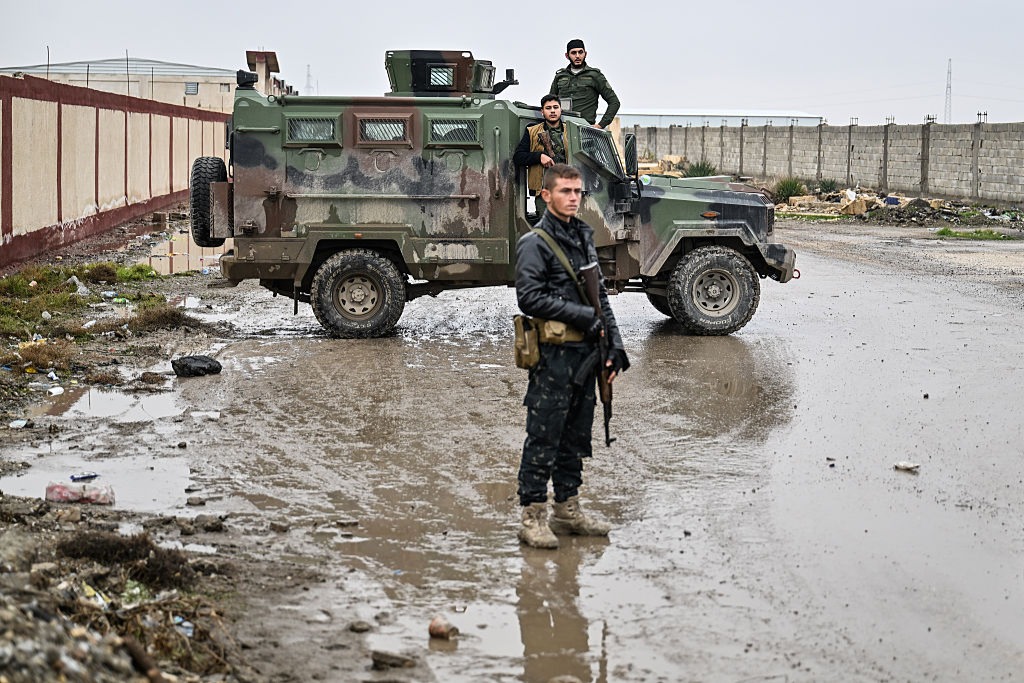
In Syria, Ahmed al-Sharaa’s regime, after taking almost full control of the country, has been largely dismantling the Kurdish autonomous region that controlled the northeast for over a decade, while the US administration has abandoned its allies – the Kurds and the SDF – who had courageously fought ISIS and helped liberate Syria from ISIS occupation. Pictured: Syrian regime forces block a road as they take over Al-Aqtan prison near Raqqa, on January 23, 2026. (Photo by Abdulmonam Eassa/Getty Images)
NOTE: While here, use the RELATED resources following the commentary by Mr. Bulit. I guarantee you’ll discover more real news regarding this subject than anything found on any American broadcast so-called news network. The times require such observation and awareness. Diligence. Due to the massive number of people in this world, in utter darkness. Starting at the top. Within. A thick blanket of rotting darkness passing itself off as light, peace, and prosperity. Boasting. Arrogant. Ignorant of the ways and word of God, though using God’s name in vain to further deceive, keeping many following false teachings and the lie as they forsake the truth. KP/ACP/Friday, February 6th, 2026
Syria’s Genocidal ‘Peace’: Trump’s ‘Friends’ Have Been Setting Him Up with Jihadists Faking Tolerance
Next Stop, Gaza
It is hard to tell which, so far, is the greatest scam of the century: “Climate Change” while watching North America enjoying its global warming; Putin’s protestations of wanting peace while demolishing Ukraine, or the trap being lubricatively laid for U.S. President Donald J. Trump throughout much of the Middle East.
Start at Syria. It was Turkish President Recep Tayyip Erdogan who reportedly groomed al- Syrian President Ahmed al-Sharaa for Western consumption, and it was Saudi Arabian Crown Prince Mohammed bin Salman who persuaded Trump, during his visit to Riyadh May 2025, to give Sharaa, a former Al Qaeda operative, “a chance at greatness” – presumably meaning to bring peace to Syria:
“And I’m very pleased to announce that Secretary Marco Rubio will be meeting with the new Syrian foreign minister in Turkey later this week. And very importantly, after discussing the situation in Syria with the Crown Prince, your Crown Prince, and also with President Erdogan of Turkey who called me the other day and asked for a very similar thing, among others and friends of mine, people that I have a lot of respect for in the Middle East, I will be ordering the cessation of sanctions against Syria in order to give them a chance at greatness.
“Oh, what I’d do for the Crown Prince.”
The “success” being brought to Syria — slaughtering non-Muslims — appears to be the same kind of “success” being brought into Gaza, after Trump leaves office, of course. Some of Trump’s “friends” and devoted donors, such as Qatar, Saudi Arabia, Indonesia and Pakistan, appointed to his “Board of Peace,” do not even recognize Israel.
Trump’s vision seems to be that economic prosperity will supersede jihadist ideology and deradicalize “all ships” — but what if it does not? As can be seen in Qatar, one can be rich and radical – and able to buy even bigger weapons, whether nuclear, broadcastable or financial. Qatar, which runs its state-owned Al-Jazeera television network at an estimated cost of billions of dollars, has, according to reports, donated more than $1,000,000,000 to Washington, D.C.’s Georgetown University alone. Georgetown happens to specialize in training future diplomats. Just what information will these future diplomats be exporting?
In Syria, the recent assaults on its Christians, Kurds and Yazidis are the third ethnic cleansing campaign that the army and affiliated militias under al-Sharaa have conducted since he took over Syria in December 2024. The others targeted the Alawites, Yazidis and Druze.
Al-Sharaa’s Islamist government is currently targeting Kurds and the Kurdish-led Syrian Democratic Forces (SDF) in the country’s northeast. Since January 6, an estimated 150,000 people, mainly Kurds, Christians, and Yazidis, have been internally displaced by Syria’s armed forces.
Al-Sharaa was head of the terrorist group Hay’at Tahrir al-Sham (HTS), and before that, he led Syrian al-Qaeda (also known as the Jabhat Al-Nusra or the Nusrah Front), a U.S.-designated Foreign Terrorist Organization. HTS, based on its affiliation with al-Qaeda and ISIS, was blacklisted as a terrorist organization by the U.N. Security Council and the European Union. Last year, the U.S. State Department, presumably as part of its effort to facilitate the consolidation of al-Sharaa’s rule, delisted it as a terrorist organization.
Al-Sharaa became Syria’s self-proclaimed president after a jihadist offensive, spearheaded by HTS and supported by the Turkish government, overthrew the Assad regime in November 2024. A $10,000,000 bounty for al-Sharaa’s capture was removed by the Biden administration on December 20, 2024.
The regime forces’ current attacks against the Kurds started on January 6 in the Kurdish-majority neighborhoods of Sheikh Maqsoud and Ashrafieh in the northern part of Aleppo.
On January 18, regime forces seized Raqqa, the former capital of ISIS, and controlled by Kurds since the defeat of ISIS. There, al-Sharaa’s forces released thousands of ISIS terrorists from prison.
Al-Sharaa’s regime, after taking almost full control of the country, has been largely dismantling the Kurdish autonomous region that controlled Syria’s northeast for over a decade, while the U.S. administration has abandoned its allies – the Kurds and the SDF – who had courageously fought ISIS and helped liberate Syria from ISIS occupation.
Videos on social media show al-Sharaa-affiliated forces abducting Kurdish women, mocking them as “gifts” (sex slaves) and massacring Kurds.
One Kurdish woman and SDF fighter was reportedly videotaped being beheaded, and another, Deniz Ciya, thrown from a tall building.
Another video circulating online shows a Syrian Arab Army (SAA) militiaman displaying a severed hair braid of a female fighter, presumably killed, from the Syrian Democratic Forces (SDF) and framing it as a trophy.
In Turkey, protests in solidarity with Syrian Kurds, such as in the city of Mardin, were violently crushed.
In Germany, an Arab supporter of the Syrian Islamists publicly celebrated the murder of Kurds by chanting songs associated with calls to kill the Kurds.
In Belgium, a man attacked and wounded multiple people with a knife at a Kurdish demonstration, leaving some in critical condition.
Despite a ceasefire agreed on January 20 between al-Sharaa’s regime and the Kurdish-led SDF, regime forces and affiliated factions continued attacking areas controlled by Kurds.
On January 30, after al-Sharaa’s forces captured swathes of northern and eastern Syria from the Kurds, forcing them to retreat, his regime and Kurdish forces declared an “integration deal.”
The city of Kobani, still controlled by Kurds, is currently encircled on three sides by al-Sharaa’s army and affiliated militias, while the border with Turkey remains closed. Al-Sharaa’s armed forces, according to the Kurdish media, also targeted the region’s sole source of power, the Tishrin Dam, thereby cutting off the city’s electricity and water supply since January 15.
As a result, northeastern Syria is facing a rapidly accelerating humanitarian crisis. There is a severe shortage of bread and a collapse of basic services.
On January 27, local officials and international observers warned that food security for approximately 150,000 civilians is in immediate jeopardy, compounded by a lack of fuel, electricity, and a record-breaking winter storm.
Meanwhile, Syria’s Islamists have also been targeting Christians. The X account of Greco-Levantines Worldwide reported on February 1:
“Eli Najjar Taqla, a 21-year-old Antiochian Greek Christian from Muhardeh, was killed in a shooting that has deepened fears among Syria’s Christian communities. His death is not seen as an isolated incident, but part of growing concerns over insecurity and the spread of weapons.”
On the same day, Antiochian Greeks assembled in Damascus beside the Holy Cross Greek Church to protest the murder and ongoing targeting of Christians in Syria.
Amid this violence and siege, Syrian Christians fear they could be next in an ethnic cleansing campaign.
Eiad Herera, spokesman of the Antiochian Greek Organization, told Gatestone:
“Christians have tended to remain politically silent after what they witnessed and experienced following December 8. This silence is driven by sectarian and radical abuses and rhetoric, Islamist hegemony over both society and state, and clear as well as implicit threats—some of which were carried out, most notably in the Saint Elias Church bombing. This is how Christians are responding to the new reality.
“What makes their fears particularly credible is what other minorities have experienced. The massacres against Alawites in March, the genocidal attempt against the Druze in July, and the most recent attacks on Kurdish communities have reinforced the belief that no minority is safe.
“Christians, alongside other minorities, see that the international community and major powers remain largely silent about what is happening in Syria, especially as regional powers such as Turkey and some Arab states support al-Sharaa’s authority.
“Christians fear the normalization of jihadist governance under softer branding. They fear selective justice, where crimes against minorities are ignored or quietly settled. They fear ideological control over education and the imposition of beliefs on their children. They also fear that Western governments, exhausted by Syria, will accept “stability” at the expense of pluralism.
“The long-term goal remains ideological dominance. Al-Sharaa’s own trajectory—from an al-Qaeda affiliate to a self-declared “national leader”—does not represent a theological rupture, but rather a tactical evolution. “Governance has become the new battlefield. Sharia-informed authority, centralized control, and the marginalization of non-conforming identities are consistent features of this model.
“What is happening in Syria today suggests there is no perfect solution, but there are clearly bad ones we must stop pretending will work. A centralized Islamist state would guarantee future violence, even if temporarily quiet. A return to Assad-style authoritarianism would be equally disastrous.”
Rafael Issa, a Christian born in Syria and the founder of the Levantine Greek Association, told Gatestone:
“[Al-Sharaa’s] ultimate goal is an Islamist dictatorship in Syria. It was made clear after it leaked from the meeting between him and the Kurds when he asked Mazloum Abdi [SDF leader]: ‘why did you let the Christians form their own police force?’
“Federalism was an idea we initially thought of. Each for his own, but with surprisingly high levels of extremism we have witnessed so far, division is the only plausible solution. The areas of the coast inhabited by religious and ethnic minorities should be separated from Damascus.
“The U.S. should investigate what is really going on in Syria, and not use Tom Barrack’s [U.S. Ambassador to Turkey and Special Envoy for Syria] point of view. Tom Barrack is obviously working for his own interests.
“If the U.S. government does not want to continue the forming of basically a Sunni Islamic state, they should support the separation of Syria’s coast from Damascus because the minorities in Syria are not willing to give their lives for an Islamic state that treats them like cattle – that is, for a state that will sooner or later take them to the slaughter.”
Meanwhile, according to a report by Kurdistan24 detailing the conditions within Kobani, the population of central Kobani has nearly doubled in recent weeks as displaced persons from Raqqa, Tabqa, and various frontline villages seek refuge from ongoing instability. This demographic surge has placed unsustainable pressure on the city’s limited resources.
The human cost of the siege has already turned lethal. The Democratic Autonomous Administration of North and East Syria (DAANES) announced that at least one child recently died in a Kobani hospital due to a critical lack of medical oxygen.
Health facilities are reportedly functioning solely on emergency generators, and medical professionals warn that diesel reserves are almost entirely depleted.
In addition, the Kurdish Red Crescent reported on January 24 that five children, including an infant, died in the city specifically due to exposure to the extreme cold. The fatalities are linked to a significant drop in temperatures and a total lack of heating fuel, which has also allowed for the rapid spread of respiratory and chest illnesses among children.
Monitoring groups such as the Syrian Observatory for Human Rights have corroborated these reports, describing the situation as a “major humanitarian catastrophe” where citizens lack access to medicine for chronic conditions like diabetes and hypertension.
On January 27, the organization Genocide Watch issued a report entitled “Genocide Emergency: Rojava and Northern Syria:”
“Rojava (the Kurdish-led Autonomous Administration of North and East Syria) is facing a coordinated campaign of annihilation. Following the collapse of the Assad Regime and Ahmed al-Sharaa’s (Abu Mohammed al-Julani) rise to power, Damascus’s conflict with the Kurds has been revived.
“Since mid-January 2026, forces of the Syrian transitional government, joined by allied local tribal militias, have engaged in siege tactics, spreading terror, and mass displacement. The government forces are attacking the very conditions needed for Kurdish survival, through cuts to water and electricity, food scarcity, blocked access routes, displacement, violence and humiliation. We are witnessing a convergence of destruction and destabilization from multiple directions.
“Kobani is a symbol of Kurdish resistance, the city where the Kurds were besieged by the Islamic State (ISIS) and triumphed. Today that same city is being pushed towards collapse.
“People have been melting snow to drink water. Four Kurdish children have died from cold exposure as the siege by government forces tightens, according to the Kurdish Red Crescent. A statement from the United Nations Office for the Coordination of Humanitarian Affairs (OCHA) describes Kobani as cut off, with civilians facing growing shortages.
“The siege by the Syrian military is especially dire for internally displaced persons (IDPs), who have the least protection and the fewest survival options. Deprivation is not ‘collateral’ when it is systematic, prolonged, and lethal. This is a humanitarian disaster caused by siege conditions.
“Fighting and coercion are producing more displacement in and around northern Syria, including Aleppo. Humanitarian reporting describes families fleeing violence in freezing temperatures with urgent needs for shelter, food, heating, and protection. Local agreements intended to protect civilians are being undermined. Documentation by Syria-focused accountability groups warns of dangerous escalation affecting civilian neighborhoods…
“International abandonment is now explicit. The United States has again abandoned the Kurds, while Damascus demands the full “integration” of the SDF into the State’s forces, without credible guarantees for Kurdish civilian protection or self-administration.
“Genocide is not only mass killing. It is also the deliberate destruction of a group’s ability to live, as stated in Article II, act (c) of the U.N. Convention on Genocide.
“Kurds are being punished for seeking autonomy, their aspiration branded as illegitimate. Kurdish identity is being attacked through symbolic violence. The campaign is coordinated and escalating into a humanitarian disaster.”
Nadine Maenza, former chair of the United States Commission on International Religious Freedom (USCIRF), told Gatestone:
“In my conversations with Christians living in northeast Syria, most are terrified as they watch Syrian security forces advance. Recent videos have intensified that fear. Footage circulating appear to show Syrian security forces and aligned fighters beheading SDF fighters, including women, and executing civilians—including the parents of a family after they admitted they were Kurdish.
“For Christians, Yazidis, and other vulnerable communities, these images reinforce a clear message: if forces with a record of abuses take control of the northeast through violence, their families may be next. They want to keep living in a region with religious freedom and where communities coexist in relative peace. They do not want the Syrian government to import the sectarian violence that has devastated so much of Syria into the northeast.
“The U.S. has a decisive role in these negotiations, and Syria’s religious and ethnic minorities are counting on Washington to press for a settlement that delivers durable peace and stability—for their communities and for Syria as a whole.”
RELATED:
Board Of Peace: Behind The Language Of Reconstruction And Prosperity Lies A Very Real Danger
Trump’s Board Of Peace Explained: Many Layers, One Huge Risk For Israel
Trump’s Jihadist ‘Board of Peace’
Trump’s “Board Of Peace” Reveal Is Coming Soon – Kings Without Kingdoms?
Kings Without Kingdoms: Is the Board of Peace a Part of Bible Prophecy?
The Trump Administration’s Delusional Gaza ‘Master Plan’
Plan For New Gaza Is Already Looking Like The Old Gaza
Not warm and fuzzy, I understand
Who Cares About Bible Prophecy?
Why Are We Following Qatar’s Foreign Policy on Iran?
‘Gaza’s Colonization Council’: Hamas’s Actual Position on Disarmament, Trump’s Board of Peace
Witkoff, Kushner Spark Criticism by Defending Hamas, Criticizing Israel
How Hamas Is Planning to Deceive the Trump Administration
Terrorist Organizations Are Using AI To Make Their Agenda More Deadly
Steve Witkoff: Hamas Promised Me It Would Disarm
Witkoff’s ‘Palestinian’ Advisor Claims Hamas Only Has to Give Up ‘Heavy Weapons’
Report: U.S. dropping demand for Hamas to disarm, worrying Israel
‘Palestinian’ Statehood is America’s Longest Nation Building Project
Trump Gives Hamas a New Lease on Life
When a Blessed Nation Turns Its Back on God?
As The Days Grow Darker, Now Is Not The Time For Christians To Go Weak-Kneed
THESE ARE JUST A SAMPLING OF WHAT HAS BEEN TAKING PLACE. IF INTERESTED, GO HERE TO FIND AND EXAMINE MORE ON THIS MATTER.
Uzay Bulut, a Turkish journalist, is a Distinguished Senior Fellow at Gatestone Institute.










Leave A Comment
You must be logged in to post a comment.