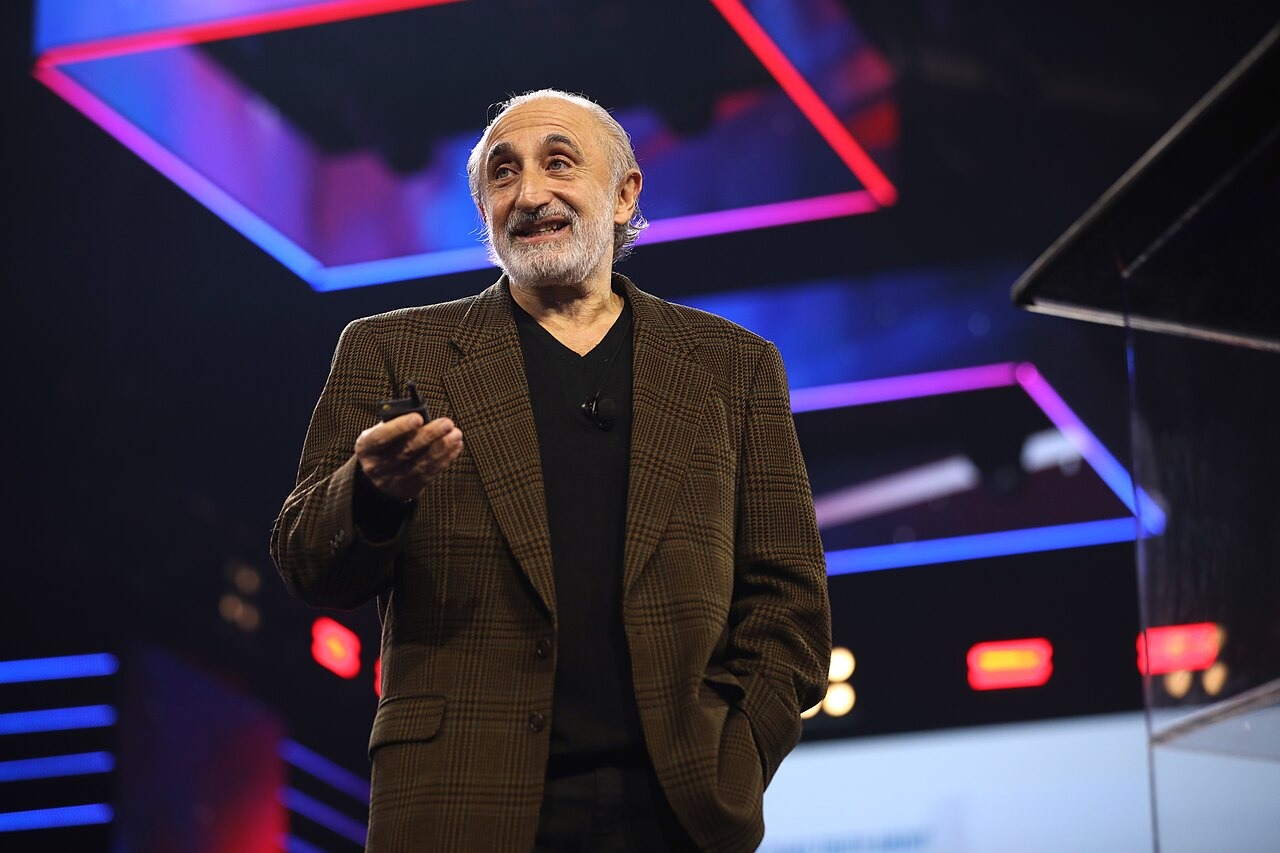
Pictured: Gad Saad speaks at Turning Point USA’s AmericaFest convention on December 18, 2023, in Phoenix, Arizona. (Photo by Gage Skidmore/Wikimedia Commons)
As with many words over the past few decades, meanings, thus understanding, and execution of words have become corrupted. Perverted. Compassion and empathy are two such words.
We are instructed by God in His word to love our enemies. To show them agape love, the same love that Jesus showed us, and everyone who comes to Him as Lord and Savior, faithfully, understanding His love of going to that tree of shame and giving up His life willingly to save those who come to believe in Him and obey Him.
Agape love, compassion for lost souls destined for eternity in hell, is quite different than the worldly definition and understanding of compassion, love, and empathy.
We are to love our enemies because we realize no matter what may divide us here, upset us here, it can’t compare to an eternity condemned to hell, and we don’t want anyone to endure that. So, we show compassion and love, not as the world knows it, in bearing good fruit, showing others Christ living in us, and taking the opportunity to tell them of Jesus’ saving grace.
It doesn’t mean being blind to our enemies’ bloodlust to destroy us and allowing them to do so. That we are blind to their ideologies and beliefs. We are to be watchmen and watchwomen on the wall, keen observers and respondents to what we hear, see, observe, and come to learn accordingly.
Compassion is not turning the keys to the kingdom over to those whose main desire is to see you dead and to take over your land and impose their godless, loveless, compassionless, hateful, lost, evil ways.
Have empathy for those who are truly suffering, hurting, and being persecuted. Not for those who lie and deceive in order to gain the upper hand and destroy you.
We’re also told by the LORD to be as innocent as doves, but as shrewd, cunning, and vigilant as a serpent. Serpents are continually flicking their tongues to gain a sense of their surroundings, the what’s what, the lay of the land, any dangers lurking around or ahead. They have been cursed by God to eat dust on their bellies.
We, on the other hand, are made in God’s image. We have ears to hear, eyes to see, we’re upright and can navigate much better than a serpent, plus we have the mind, the brain that God gave us — along with His Word!
Use every faculty, every bit, every ability, every source, every sense, every grace God is willing to provide and give to be compassionate and empathetic when those attributes are needed, as a fruit of our spirit, our agape love for others — but that does not mean to be a quiet, laid low carpet to be walked upon and worn down by the heels of those whose sole intention is to dominate, destroy, delude and decapitate Western laws, ways, truth and the Western world’s established foundation in Judeo-Christian beliefs and values.
Wake up.
Before it’s too late, and that time is swiftly nearing.
Europe has already succumbed. The United Kingdom is now an Islamic kingdom, even though given the illusion of having a king in Buckingham Palace and English leaders in government. Check out how quickly and how vastly the British and Scottish government has shifted to Islamists in power and control. Africa has quickly turned Islamic. The Middle East, save for God’s land, Israel. South America is turning. Much of Middle and Near Asia. Australia has succumbed. Is America exempt? Because we’re special? Hardly/ Yes, we are special — it was only by Divine Providence and the foundations of our Founders that made this nation possible, but negligence, apathy, downright stupidity, and misguided intentions, ignorance of the overwhelming public, and overwhelming number of elected and appointed government officials at every level — federal, state, and local lost and in darkness have allowed the destroyer, The Enemy, to gain so much ground in so short a time.
September 11th, 2001, to November 2025, New York City. Not very long at all for such a turnaround.
Islam is not a religion. Islam uses its religious arm to deceive and as sleight-of-hand while working its main objective, which is world domination. Its geopolitical aspirations far outweigh its religious aspirations. They use their “religion” to achieve their domination agenda. Wake up.
Religion of peace? Right. You buying that crock of rancid manure still? Still think it’s only a few bad apples, only a handful of radicals? Wake up.
What is happening, what has happened in the U.S. Congress, statehouses, local city councils, and school boards is the result of Islam’s geopolitical efforts. And they are winning. We are losing.
Compassion? Empathy? Whew! Blindness, being lost, and ignorance. Serving the world rather than serving the LORD clearly, firmly, boldly, fruitfully.
Wake up already.
Read on…
Ken Pullen, Friday, January 30th, 2026
‘Suicidal Empathy’: Is the West Committing Suicide-by-Compassion?
The theory of “suicidal empathy,” taken up and developed by Canadian Professor Gad Saad in his book Suicidal Empathy: Dying to Be Kind, describes a psychological and societal condition in which excessive or misguided compassion leads Western societies — particularly, it seems, “progressive” ones — to adopt self-destructive attitudes and policies that will ultimately “succeed” in destroying them. The process, however well-intentioned, is a form of civilizational suicide.
According to Saad’s thesis, empathy becomes misdirected into a type of benevolent altruism that prioritizes the perceived feelings and needs of “marginalized” or external groups at the expense of the survival, security, and interests of one’s own group and its values. The outcome is the weakening, and ultimately the destruction, of the very civilization that expressed this emotion.
Saad draws on evolutionary psychology to suggest that empathy is a natural adaptive mechanism designed to promote cooperation within small groups, such as family or the community. In modern societies, however, this mechanism has become “hijacked” by big-hearted supporters who take pride in what they see as a virtue of caring about others.
The problem? This concept of suicidal empathy, unfortunately, does not work. As the term predicts, it ends up killing its host.
Suicidal empathy, according to Saad, rests on a fundamental misunderstanding. Empathy, a feeling, can open you up to feel with and understand another, or you can stay closed, enabling you to stay safely detached. Half-measures — selective empathy toward only carefully curated, presumably “deserving” groups — can become something else entirely: political manipulation, pity, narcissistic preening, virtue-signaling, or emotional tourism.
Empathy can embrace humanity — or in many people, may not exist whatsoever. “You never really understand a person until you consider things from his point of view… until you climb inside of his skin and walk around in it,” Harper Lee wrote in To Kill a Mockingbird. Ideally, empathy might extend to everyone: “Love thy neighbor as thyself,” perhaps impossible to do, is still a noble aspiration.
What we observe, however, in many people, is a highly selective empathy, precisely the opposite of caring about everyone. What shows up is an exclusive, and exclusionary, concern for certain groups — asylum seekers, ethnic minorities, people unhappy with their gender, racialized people (whatever that means), criminals, for example — at the same time paired with indifference or even open hostility toward other groups that might be equally minoritized, victimized, or marginalized.
Consider the case of our Jewish compatriots. It is no exaggeration to say that the contemporary Western left has grown accustomed to the mistreatment of American and European Jews, even though they consist of only the tiniest minority in Europe (only 0.16% of Europe’s population) as well as the US (2.3% of the population).
What, then, is the criterion for this so-called “selective empathy”? We are told: victimhood. Jews are — based on “evidence” that probably applies just as well to successful Christians and other non-Jews — are deemed “dominant.” How is a Jewish child beaten in the street in Europe, and targeted only for being Jewish, “dominant”? Because we are told, Jews are not victims: Look, they say, at what is happening in Gaza.
European and American Jews, however, have no connection to Gaza, except through the smoky notion of “collective responsibility,” which holds that any crime committed by one person renders all people from that group responsible, whether Blacks, Jews, Whites, Asians, Muslims, non-Muslims, and so on. This notion of collective responsibility — as opposed to judging people one-by-one based on individual merits — has, even since earliest biblical times, been considered immoral: Let not the sins of the father be visited upon the children.
Having empathy does not require it to be universal toward everyone — any more than love, friendship and loyalty are required to be universal. Empathy, like all emotions, is elastic – one minute you might love someone, the next minute hate him. You can enjoy the deepest, most intense love for your spouse and children, but feel only mild benevolence (or even indifference) toward the rest of humanity; no one would seriously claim that your feelings are therefore “fake” or “not real love.” You can be profoundly moved by the suffering of abused children in your own neighborhood while remaining relatively unmoved by equally terrible suffering occurring in distant countries you have never visited. That does not make your empathy inauthentic.
Empathy follows exactly the same path. It is probably common to feel more deeply about those who are physically close (family, friends, neighbors), those who belong to “our” group (shared language, culture, history, values, appearance…), and those whose pain we can see, hear or share directly. The farther someone is removed from us (in space, time, culture, or identity), the more deliberate mental work might be required to generate a comparable emotional response.
This is not hypocrisy; it is simply human nature. What becomes harder to defend as genuine empathy is the increasingly common pattern of displaying loud, intense, public identification with distant victims while simultaneously showing indifference, contempt, or outright hostility toward victims right under one’s nose, here in one’s own society, whose suffering is visible and immediate.
We might be dealing then with a moral posture, a political performance, a selected narrative for virtue or social status.
In short: selective empathy — with selective hostility or indifference nearby — is not “higher”, “purer” or “more universal”. It is just a posture wearing empathy’s clothes.
The psychological mechanism of the contemporary Western “left” seems to be unfolding in two stages. First came the collapse of Marxism in 1989, with the Berlin Wall being dismantled, piece by piece, was also the main ideology of the left, undergoing deconstruction. Marxism was the dominant ideological framework of the Western left through much of the 20th century. In The Age of Extremes (1994), the Communist historian Eric Hobsbawm argues that Marxism was the dominant intellectual and ideological framework of the Western left for much of the twentieth century. He explained that communist parties, socialist movements, trade unions, and left-wing intellectual circles largely operated within conceptual horizons shaped by Marxist theory — even when they were not strictly Marxist in doctrine. In other words, Marxism structured how the left understood history, capitalism, class, and political struggle throughout most of the century. The collapse of Soviet communism in 1989 symbolized the failure of Marxism as a viable political-economic system. Therefore, the left lost its core ideology and began searching for replacements.
A hatred of the West, of capitalism, of “inequality,” has been around at least since the writings of Karl Marx. In the West, this rejection of what exists, and of what has founded our civilizational predominance, has been a constant—at least since the French Revolution in 1789. Marxism, later, proposed a supposed “solution” — false and unachievable, but claiming theoretical, even “scientific,” coherence. None of that, however, has ever existed.
This outrage and anger then seized upon a motley collection of ideological substitutes, some good, such as the abolition of slavery and universal suffrage; some not good, such as the abolition of borders, radical environmentalism, political Islam, and the abolition of prisons. What appears lost is the freedom to disagree. Diverge from these new precepts, and you exit humanity itself. You become a figure of evil.
Anyone who departs from these fragile dogmas, even marginally, is now denounced, excommunicated, morally disqualified, and, whenever possible, socially destroyed. Many people seem to be incubating a rage looking for somewhere to go. Dogmas that admit no dissent provide a perfect vehicle for that. This new rage appears to have nothing to do with empathy — or even selective empathy — but more with envy, frustration, and possibly opportunism, perhaps accompanied by large payments.
When there are real protestors out on the streets risking their lives, as recently in Iran, there is scant support. What vibrates in Western outbursts, on the left and on the right, appears to be rage looking for a cause, and constantly feeding on new dogmas. Sadly, there seems to be no shortage of them.
Drieu Godefridi is a jurist (University Saint-Louis, University of Louvain), philosopher (University Saint-Louis, University of Louvain) and Ph.D. in legal theory (Paris IV-Sorbonne). He is an entrepreneur, CEO of a European private education group and director of PAN Medias Group. He is the author of The Green Reich (2020).











Leave A Comment
You must be logged in to post a comment.