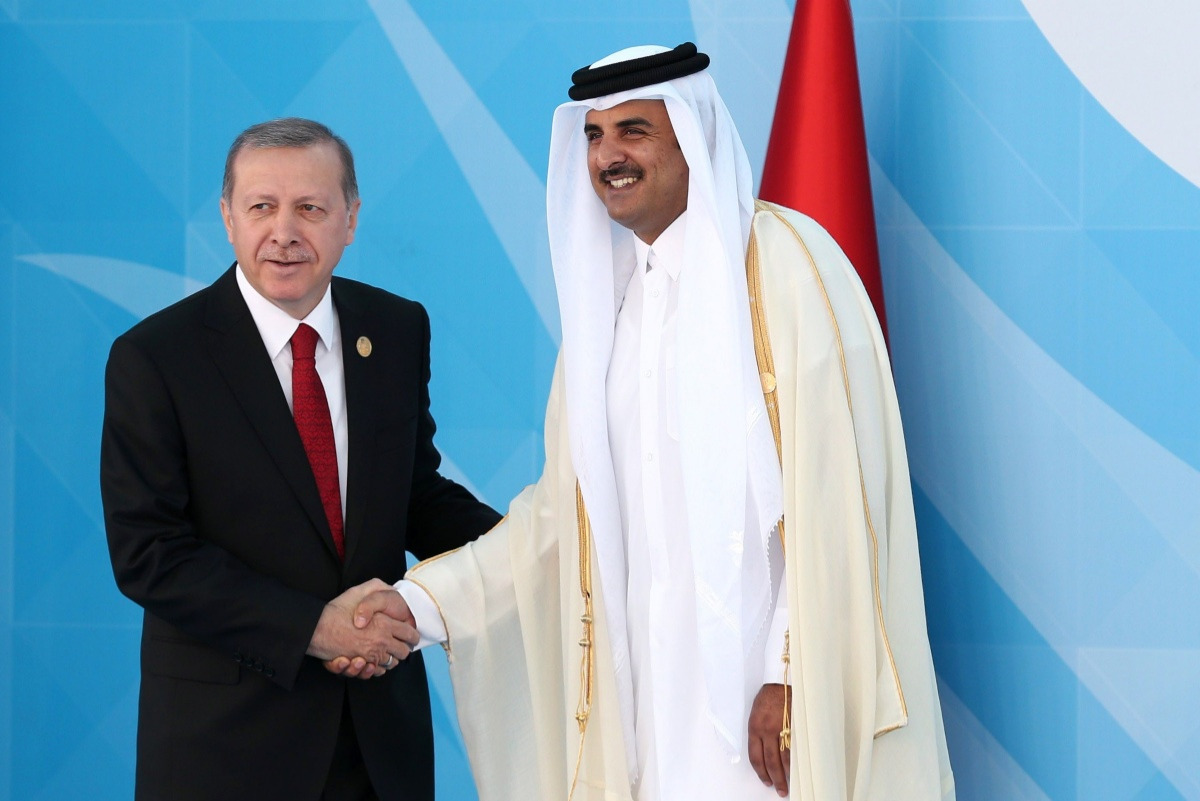
The inclusion of avowedly pro-Islamist, pro-terrorist countries such as Turkey, Qatar, and Pakistan in U.S. President Donald J. Trump’s so-called “Board of Peace” has all the potential to thoroughly undermine the American leader’s peace initiative in Gaza. Pictured: Turkish President Recep Tayyip Erdogan meets with Qatar’s Emir Sheikh Tamim bin Hamad Al Thani in Istanbul. (Photo by Arif Hudaverdi Yaman/AFP via Getty Images)
Pro-Hamas Islamist Countries, Such as Turkey, Qatar and Pakistan, Have No Place on Trump’s Board of Peace
As commendable as it may be that U.S. President Donald J. Trump is apparently hoping that he can turn “swords into ploughshares,” the inclusion of avowedly pro-Islamist, pro-terrorist countries such as Turkey, Qatar and Pakistan in his so-called “Board of Peace” has all the potential thoroughly to undermine the American leader’s peace initiative in Gaza.
With Trump’s 20-point peace plan for ending the Gaza conflict entering a new stage, the American president is insisting that the Hamas terrorist organisation surrender all its weapons within the next two months.
Speaking at the National Prayer Breakfast this month, Trump insisted that, with the war in Gaza ended, Hamas should give up its weapons.
“Now they have to disarm,” Trump said. “Some people say they won’t, but they will, and if they don’t, they’re gonna not be around any longer.”
Israeli Prime Minister Benjamin Netanyahu delivered a similar message to U.S. Special Envoy to the Middle East Steve Witkoff during a stopover in Jerusalem while travelling for talks with Iran over its nuclear programme. Netanyahu has repeatedly said that Hamas’s disarmament is a precondition of Gaza’s reconstruction under Phase 2 of the Trump administration’s peace plan.
Disarming Hamas, a key component of Trump’s initial 20-point peace plan for ending the Gaza conflict, was due to take place after the first stage of the ceasefire deal, whereby all the remaining Israeli hostages were released in return for nearly 2,000 Palestinian prisoners being freed.
Even though this first stage has now been completed, with the Israeli military recovering the body of the last remaining Israeli hostage in January.
Hamas’s terrorist leadership has shown no sign of fulfilling its part of the bargain.
On the contrary, Khaled Mashaal, the terror organisation’s political leader, has rejected calls to disarm Palestinian factions in Gaza, arguing that stripping weapons from them would turn them into “an easy victim to be eliminated”.
Speaking on the second day of a conference hosted by the Gulf state of Qatar this month, Mashaal described the discussion around Hamas handing over its weapons as a continuation of a century-long effort to neutralise Palestinian armed “resistance.”
“In the context that our people are still under occupation, talking about disarmament is an attempt to make our people an easy victim to be eliminated and easily exterminated by Israel, which is armed with all international weaponry,” he said.
The prospects of Hamas responding positively to Trump’s demand to disarm now faces the serious prospect of being undermined by the presence of so many pro-Islamist countries on his Board of Peace, the body that has been set up to oversee Gaza’s transition from being a war-ravaged area to a peaceful, demilitarised zone.
To date, nine countries from the Middle East and Asia have announced plans to join Trump’s so-called “Board of Peace” in the Gaza Strip, and have stressed the need to secure a “permanent ceasefire” in Gaza.
After a number of Arab countries — most prominently Jordan — proved reluctant to join Trump’s proposed “International Stabilization Force” for Gaza on the grounds that they did not want to become involved in military action against Hamas, many have now relented and joined the Board of Peace. Pakistan, Egypt, Jordan, the United Arab Emirates, Indonesia, Turkey, Saudi Arabia and Qatar have all issued a joint statement declaring that they would be joining the Trump-led board.
“The Ministers reiterate their countries’ support for the peace efforts led by President Trump,” the statement said.
It added that the Board’s mission is aimed at “consolidating a permanent ceasefire, supporting the reconstruction of Gaza, and advancing a just and lasting peace grounded in the Palestinian right to self-determination and statehood in accordance with international law, thereby paving the way for security and stability for all countries and peoples of the region”.
The presence of so many Islamist and terror-supporting countries on Trump’s Gaza Board, though, has prompted concerns that they will attempt to stymie the Trump administration’s disarmament demand and seek to find a compromise agreement whereby Hamas terrorists are allowed to continue holding weapons to be used later to continue attacking Israel, especially after Trump is a lame duck after the U.S. midterm elections this year or no longer holds office
Qatar, Saudi Arabia and Pakistan still refuse formal diplomatic relations with Israel.
Both Qatar and Turkey, which support hardline Islamist groups such as the Muslim Brotherhood, have a long history of backing Hamas. Qatar, in particular, provided much of the funds that enabled Hamas to build the terrorist infrastructure used for carrying out the October 7, 2023 invasion of Israel, the worst terrorist attack in Israel’s history. One report claimed Qatar had transferred $1.8 billion to Hamas in the decade preceding the atrocity.
Qatar also has a documented history of funding virtually every Islamist terror group (such as here, here, here, here, here, here, and here) then, when conflicts flare up, offering to serve as the supposedly “impartial” mediator.
“Qatar is at the top of funding terrorism worldwide, even more than Iran,” according to Udi Levy, a former senior official of Israel’s Mossad spy agency who dealt with economic warfare against terrorist organisations.
Turkey, meanwhile, has taken the perverse decision to intensify its support for Hamas in the wake of the October 7 attacks, with Turkish President Recep Tayyip Erdogan making a series of inflammatory anti-Israeli statements, including comparing Israel to the Nazis and repeatedly calling Israel’s self-defence “genocide” – while Turkey bombs the Kurds.
Erdogan has even warned that Turkey could find itself in a regional war against Israel, and threatened Israel that it would pay a “heavy price” if it renewed hostilities with Hamas.
Pakistan, another pro-Islamist country that has signed up to Trump’s board, has also attracted criticism for its pro-Hamas stance, with reports that Islamabad is allowing Hamas terrorists to operate freely on Pakistani soil.
A detailed report published in September by the Middle East Media Research Institute (MEMRI) found that:
“Pakistan is allowing Hamas representatives on their soil to operate freely, participate in public events, and forge alliances with local militant outfits. This behaviour undermines Western efforts to isolate Hamas and puts under question whether the U.S. should keep on considering Pakistan as a ‘major non-Nato ally.'”
Unsurprisingly, the Pakistanis have made it clear that they have no intention of taking part in any effort to disarm Hamas terrorists when their troops are deployed to the Gaza enclave.
The fact, therefore, that so many Hamas-supporting countries have signed up to participate in Trump’s board raises serious questions about their true motives in joining the enterprise. Are they genuinely committed to supporting the Trump administration’s ambitious plan to end hostilities in Gaza?
Or are they, as all the evidence seems to suggest, simply joining the board so that they can protect the interests of Hamas terrorists and frustrate Trump’s ambitions of bringing peace to the war-ravaged area?
Con Coughlin is the Telegraph‘s Defence and Foreign Affairs Editor and a Distinguished Senior Fellow at Gatestone Institute.










Leave A Comment
You must be logged in to post a comment.