I don’t know if there are certain tests in certain schools or courses that I’m very familiar with. Where you knew it was test day. The document would be presented in the classroom and handed to you with instructions to keep it face down and not start until told to, and then, after receiving the word, it was now time to perform, “Turn your tests over and begin!” and off you’d go. Then, at a designated time, there would be the loud, “STOP! Pencils down, stop now!”
And it was over.
There was no whining permitted. No cheating. No excuses.
You knew the day. You’d better be prepared. And when the clock struck a specific time, it was over. You’re done. Too bad if you didn’t finish. You knew what was coming. Perhaps you should have prepared better. There was a specific time to start, a specific time to end. No excuses.
If there was any cheating? That person and their paper would be disqualified.
There are rules for a reason. Order for a reason. Laws for a reason. Someone didn’t like them or agree? Tough. That’s the way it is. Stop your bellyaching and deal with it.
When the clock strikes midnight in every state in every timezone on Election Day? No more counting. No excuses. Should have been prepared. Knew what was coming. What’s that? There was cheating? Well, anyone caught cheating will be disqualified.
Why would anyone have a problem with that?
Unless they had nefarious motives. Unless they were cheaters trying to get away with something while everyone else played it straight and followed the rules.
Read on…
Ken Pullen, Wednesday, February 18th, 2026
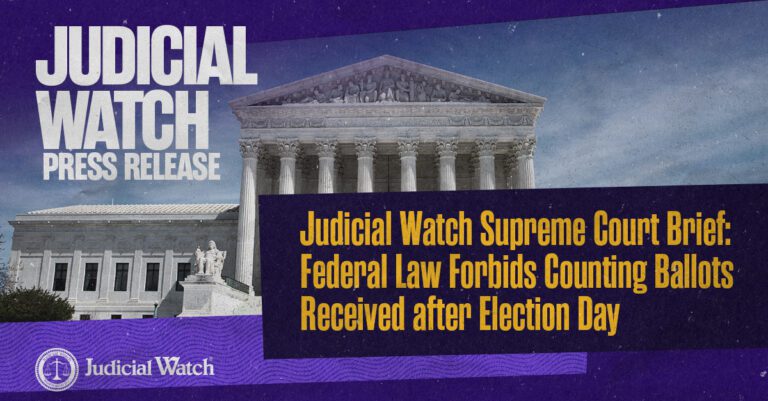
Judicial Watch Supreme Court Brief: Federal Law Forbids Counting Ballots Received after Election Day
February 10, 2026
From Judicial Watch — Because No One Is Above The Law
PRESS RELEASE
(Washington, DC) – Judicial Watch announced that it filed a brief asking the Supreme Court of the United States to affirm that federal law makes it illegal for states to count ballots that arrive after Election Day.
The brief arises in the Supreme Court’s review of a landmark Judicial Watch election integrity case brought on behalf of the Libertarian Party of Mississippi. The case seeks to uphold a ruling by the U.S. Court of Appeals for the Fifth Circuit, which struck down a Mississippi law unconstitutionally allowing election officials to count mail-in ballots received up to five days after Election Day. The suit was later consolidated with a similar challenge brought by the Republican National Committee (RNC), the Mississippi Republican Party, and others against Mississippi Secretary of State Michael Watson and local election officials (Watson v. Republican National Committee et al. (No. 24-1260 )) (Libertarian Party of Mississippi v. Wetzel et al. (No. 1:24-cv-00037)).
The brief, filed on February 9, emphasizes that the ordinary meaning of “election” at the time Congress enacted the statutes includes the full process of voting and the receipt of ballots by officials. Counting post-Election Day ballots is a relatively recent practice without any historic foundation. Allowing ballots to “trickle in” after Election Day creates opportunities for fraud and erodes public confidence.
Judicial Watch’s brief points out:
The whole point of the federal Election-Day statutes is to set a single uniform day for the election. Allowing ballots to trickle in days or weeks after Election Day is antithetical to that basic goal. Indeed, a patchwork of state ballot-receipt deadlines replicates the problems Congress was trying to remedy with a single national Election Day. It is entirely implausible to conclude that Congress—when thrice exercising its preemptive power under the Elections and Electors Clauses—left the door open for states to vitiate those statutes by postponing electoral outcomes with post-election ballot-receipt deadlines. Congress certainly did not leave states the power to undo this important federal time regulation by simply declaring all mailboxes to be ballot boxes.
Through the federal Election-Day statutes, Congress exercised its constitutional authority to set a uniform time for federal elections to occur. Text, historical practice, precedent, and common sense all demonstrate that those statutes set the deadline by which ballots must be submitted and received. Simply put, the ballot box closes on Election Day, and ballots that are not received until days or weeks after the date specified by Congress arrive after Election Day and should not be counted.
Congress set a uniform national Election Day, meaning the “ballot box closes” on that day.
The Supreme Court is considering whether to uphold a ruling by the U.S. Court of Appeals for the Fifth Circuit, which invalidated a Mississippi law that allowed election officials to count absentee ballots received up to five days after Election Day.
“This is the most important Supreme Court election integrity case in a generation. The pandemic spread of states counting late ballots received after Election Day is a flagrant violation of long-standing federal law that not only encourages voter fraud but also severely undermines public confidence in our elections,” said Judicial Watch President Tom Fitton. “The Supreme Court now has a critical opportunity to restore a fundamental guardrail to the election process.”
The public can view the High Court’s oral arguments on Monday, March 23, 2026, here: https://www.supremecourt.gov/oral_arguments/live.aspx. The stream begins at 10:00 AM ET.
Judicial Watch is a national leader in election integrity and voting rights litigation, with a record of successful lawsuits enforcing constitutional redistricting standards and cleaning voter rolls nationwide.
Judicial Watch’s election law efforts are led by Senior Attorney Robert Popper, who previously served in the Voting Section of the Justice Department’s Civil Rights Division, where he managed voting rights investigations and litigation across dozens of states.
T. Russell Nobile, a senior Judicial Watch attorney and election law expert, recently provided testimony to the House Committee on House Administration at a hearing titled: “Make Elections Great Again: How to Restore Trust and Integrity in Federal Elections.”
Eric Lee is an attorney at Judicial Watch, where he focuses on enforcing federal and state laws that promote transparency and integrity in the electoral process. Eric graduated with his B.A. from St. Mary’s College of Maryland and received his J.D. from the University of Maryland School of Law. He is licensed to practice in California, Maryland, the District of Columbia, and in federal courts in Illinois and Colorado.
Paul D. Clement, James Y. Xi, and Philip Hammersley of Clement and Murphy PLLC are assisting Judicial Watch in this case. Clement, who has argued more than 100 cases before the Supreme Court, is former solicitor general under President George W. Bush from 2005-2008 and is widely regarded as among the top Supreme Court litigators in the country.
In January 2026, the Supreme Court of the United States ruled 7–2 in favor of granting standing in a historic case filed by Judicial Watch on behalf of Congressman Mike Bost and two presidential electors. The case challenges an Illinois law allowing the counting of ballots received up to 14 days after Election Day.
Federal courts in Oregon, California and Illinois have ruled that Judicial Watch’s lawsuits against those states to force them to clean their voter rolls may proceed.
Judicial Watch announced in May 2025 that its work led to the removal of more than five million ineligible names from voter rolls nationwide.
RELATED:
Election Integrity Map | Judicial Watch







Leave A Comment
You must be logged in to post a comment.