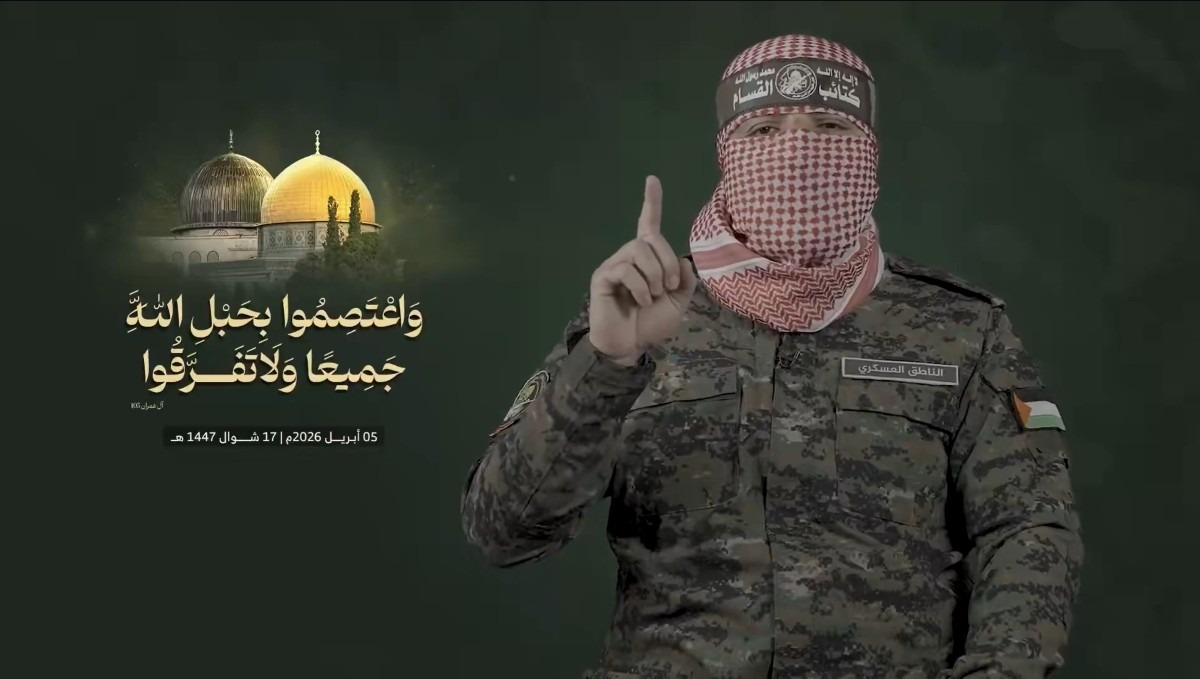
An April 5 speech by Hamas military spokesman Abu Obaida (pictured) leaves no doubt: Hamas remains fully committed to jihad (holy war) and rejects disarmament. Hamas remains a partner of Iran’s regional war machine, a committed enemy of peace, and a direct threat to the stability of the Middle East. (Image source: Hamas via X)
Hamas Signals No Retreat: The U.S. Fantasy of Disarmament and Peace
An April 5 speech by Hamas military spokesman Abu Obaida leaves no doubt: Hamas remains fully committed to jihad (holy war) and rejects disarmament.
Meanwhile, U.S. President Donald J. Trump’s “Board of Peace,” an initiative to stabilize and rebuild the Gaza Strip, seems to be increasing pressure on Hamas. According to a report published in The New York Times, the board has set a deadline for the terror group to agree to a disarmament framework in the Gaza Strip by the end of the coming week.
Abu Obaida’s speech, unfortunately, is an emphatic warning that Hamas has no intention of complying:
“What the enemy is trying to push through today against the Palestinian resistance, via our brotherly mediators [Egypt, Qatar, and Turkey], is extremely dangerous. Raising the issue of weapons in this blunt manner is nothing but an overt attempt to continue the genocide against our people, something we will not accept under any circumstances. What the enemy failed to take from us through tanks and war, it will not be able to take through politics or at the negotiating table.”
Far from preparing to disarm, Hamas is publicly declaring its commitment to continued jihad, praising the Iranian regime and its proxies, and inciting Palestinians to escalate attacks against Israel.
The “Board of Peace” is therefore confronting a harsh reality: Hamas, like Iran, is not motivated by deadlines, incentives, or promises of reconstruction. It is motivated by ideology and by war.
The speech, in fact, is a manifesto of defiance.
From the outset, Abu Obaida frames the conflict in explicitly religious terms. Portraying the war not as a territorial dispute, but as a religious obligation, he calls on Muslims to “unite their ranks in confronting the disbelievers.”
He goes further by describing the current war as a “decisive phase in the history of this Ummah [Islamic nation],” a turning point meant to restore Islamic dominance and reverse what he calls the humiliation of Muslim lands:
“For even if the balance of power is disturbed, our truth is stronger than their falsehood, and our Ummah is one, its enemy is one.”
In Hamas’s worldview, the war is not about the Gaza Strip. It is about reshaping the Middle East – and beyond. It is a call for jihad.
Equally revealing is the Hamas spokesman’s repeated reference to the “Zionist-American assault” on Iran. By fusing Israel and the U.S. into a single enemy, Hamas is openly declaring that the jihad is not directed only at Israel, but also at Washington. This is a direct message to American policymakers: Hamas does not distinguish between Israel and the U.S. It sees both as legitimate targets.
The implications are worse than they might at first look.
For Israel, the speech confirms that Hamas, like Iran, has not changed ideologically, despite the heavy military blows it has suffered since its October 7, 2023, invasion of Israel. On the contrary, the terror group remains as committed as ever to Israel’s destruction. Abu Obaida’s praise for Iran, Hezbollah, and Yemen’s Houthis underscores Hamas’s integration into a broader Iran-led war effort. Israel is not facing an isolated terrorist organization in the Gaza Strip, but a coordinated regional “Axis of Resistance.”
For the U.S., the message is equally clear. Hamas is rejecting any notion of compromise or disarmament. Despite repeated calls from Trump to lay down its arms, Hamas is doubling down on its strategy of armed struggle. The speech makes clear that Hamas views American pressure not as a reason to moderate, but as a further justification for jihad:
“The [U.S.-Israeli] aggression will not achieve its results. The illusion of normalization they seek is doomed to failure. Those who hope to impose foreign ideologies from across the seas on our nation do not know the heritage, civilization, and power that the nation possesses.”
Any policy based on the assumption that Hamas can be persuaded to disarm is simply detached from reality.
The speech also contains an unmistakable warning to pro-Western Arab states, particularly in the Gulf. By accusing unnamed actors of seeking to “alter the concepts of the Islamic religion” and impose foreign systems of governance, Hamas is effectively attacking Arab regimes aligned with the U.S. These countries are portrayed not as partners, but as part of the problem – complicit in what Hamas describes as a campaign to subjugate the Islamic world.
The danger is that this rhetoric is designed to inflame public opinion in Arab and Islamic countries against their own governments, potentially destabilizing countries such as the United Arab Emirates and Bahrain that have chosen a path of pragmatism, normalization, and cooperation with Israel and the West.
At the same time, Hamas continues to incite violence on the ground. Abu Obaida’s call for unity and confrontation, regrettably, is not “just talk.” It is a direct appeal to Palestinians in the West Bank and Jerusalem to escalate their confrontation with Israel into deadly terrorist attacks. The speech’s portrayal of the war as a global crisis – claiming that Israel is plunging “the region, and indeed the world, into its furnace,” is, in addition, part of a broader propaganda effort by Hamas to shift blame for regional instability onto Israel and the U.S.
Stripped of its religious and ideological language, the message is simple: Hamas has no intention of ending the war. It is preparing for more.
The speech by Abu Obaida is a loud wake-up call. Hamas is planning an escalation.
For Israel, the U.S., and pro-Western states, any strategy that assumes Hamas can be integrated, moderated, or coaxed into abandoning its weapons is not only unrealistic; it is naïve and dangerous.
Hamas at least is being honest. Hamas is not negotiating. Hamas is not moderating. Hamas is not preparing for peace. October 7, 2023, was not an isolated attack. It was part of an ongoing jihad: “The strikes [against Israel] by the fighters of Iran, Lebanon, and Yemen are an extension of the Al-Aqsa Flood [Hamas’s October 7 massacre].”
Israel, the U.S., and the Arab states aligned with the West might recognize the simple truth: Hamas remains a partner of Iran’s regional war machine, a committed enemy of peace, and a direct threat to the stability of the Middle East.
The question is whether the U.S. is ready to listen.
Khaled Abu Toameh is an award-winning journalist based in Jerusalem.






Leave A Comment
You must be logged in to post a comment.