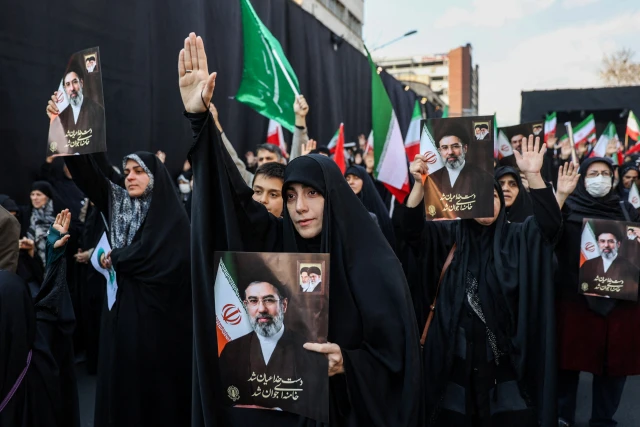
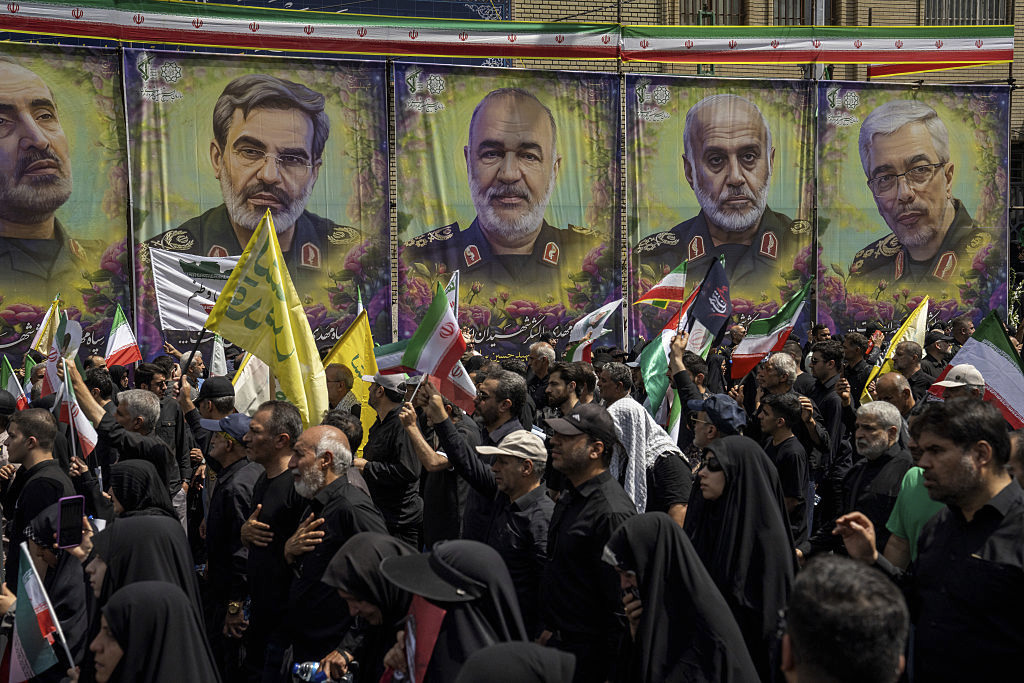
People hold placards with images of Iran’s new supreme leader, Mojtaba Khamenei, during a gathering to support him, amid the U.S.-Israeli conflict with Iran, in Tehran, Iran, March 9, 2026. (Photo: Reuters)
Experts warn: Iran’s new leader is ‘obsessed’ with end times, believes himself to be a prophesied figure paving the way for the Mahdi
Mojtaba Khamenei & supporters think he is the ‘Khorasani’, tasked with conquering Jerusalem & Mecca
March 10, 2026
Reprinted from All Israel News



With Mojtaba Khamenei, the Iranian regime elevated a dangerous ideologue who is obsessed with the end times – and even believes he is a prophesied figure playing a key role in bringing about the return of the Mahdi, according to several experts.
This isn’t particularly surprising considering that “Iran is a theocracy in which the mosque is the state, the Qur’an provides constitutional logic, and eschatology shapes foreign policy,” as Ali Siadatan has recently explained on AIN.
Nevertheless, the new supreme leader, who has yet to appear in public, is particularly radical, even compared to his own father, warned Jaber Rajabi.
The regime in #Iran has been holding rallies today in support of Mojtaba Khamenei’s elevation as supreme leader. But Mojtaba has not made any public appearance since he’s been named leader. No photo, no video message. Under the current wartime conditions, there are significant… pic.twitter.com/uIs3Q5VunE
— Jason Brodsky (@JasonMBrodsky) March 9, 2026
He is a former Iranian operative who participated in the creation of Iran’s proxy forces in neighboring Iraq, and studied with the new Supreme Leader in the Shia seminaries in Qom in his youth.
Speaking on ArabCast, Rajabi noted that the elder Khamenei wasn’t as obsessed with the end times, nor was he a racist like his son, who believes in “Persian supremacy.”
“He (Mojtaba) says the Persians are the true companions of the Imam of the Time, the Awaited Mahdi. Persians first… Mojtaba, from the beginning, has been a hardline Shia extremist.”
In a recent interview with The Atlantic, journalist Graeme Wood recounted that Rajabi had told her that while the elder Khamenei “demonstrated a willingness to bend and reach out to allies to ensure his regime’s survival… Mojtaba, by contrast, is calculating and ideological, and willing to cause terrible destruction to the world just to prove a point.”
Over the past few months, Rajabi has given several interviews, warning that his former study partner is much more dangerous than his father, and had predicted that he would grab power long before he was chosen to succeed his father.
In The Atlantic, Rajabi recounted that, during their studies, “he came to view the supreme leader’s son as a brilliant zealot, much more extreme and uncompromising than his father, and a uniquely dangerous potential successor.”
He described Mojtaba as “apocalypse-obsessed” at this time, adding that “He thinks there are milestones on the path to the end of the world and he himself will have a special part in hastening humanity down that path.”
جابر رجبي المنشق من فيلق القدس:
– مجتبى خامنئي أخطر من خمسين قنبلة نووية.
– مجتبى خامنئي يعتقد في نفسه بأنه هو الخرساني الذي سيقود الجيش الذي يحمل الرايات السود ليفتح القدس.
– مجتبى خامنئي رجل ثري للغاية وقام بتوزيع ثروته في أنحاء العالم تحت أسماء أشخاص مختلفين.
– مجتبى… https://t.co/wA6LqdyiTe pic.twitter.com/1yCcGH7y5H— جمال الملا (@JamalAlMullaa) March 8, 2026
Mojtaba Khamenei was born in Mashhad, a holy city of Shia Islam that lies in the far east of Iran, near the Afghan border in a neglected region known as Khorasan.
According to Shia eschatology, the return of the Mahdi, a Muslim messianic figure who precedes the end of days that is heralded by the return of Jesus (known as Isa), will be announced by the appearance of three mythological figures: The Yamani, the Sufyani – and the Khorasani.
Among radical regime circles and IRGC operatives, some believe the Yamani (literally meaning a man from Yemen) to be Abd-al-Malik al-Houthi, leader of the Houthi terrorists, while the Sufyani, who is expected to emerge from Damascus, is often identified with Ahmed al-Sharaa, the new leader of Syria.
Mojtaba Khamenei, Supreme Leader of the Islamic Republic and commander of its armed forces, believes himself to be the prophesied figure of the Khorasani.
Who is Iran’s new Supreme Leader?
Iran has chosen its new Supreme Leader: Mojtaba Khamenei, son of the recently assassinated Ayatollah Khamenei. Who is he? What does he believe? And most importantly, is his coming to power the fulfilment of ancient prophecy?
Aimen and Thomas…
— Aimen Dean (@AimenDean) March 10, 2026
Aimen Dean, a former al-Qaeda operative turned MI6 spy who now works as a security consultant, confirmed this view in a recent episode of his Conflicted Podcast.
“It became very clear that his entire research, and the papers he was studying, the books he was writing internally in the seminaries of Qom, focused a lot on putting together not only an understanding of the three people who would pave the way for the Mahdi… but also, he started to craft for himself that image, even among the religious figures within the seminaries of Qom, because many of the descriptions of the Khorasani seem to, in his mind, to fit him,” Dean said.
“He (the Khorasani) will be among those who would be fighting in the battles of Iraq – he (Mojtaba) fought in the Iran-Iraq war – and then he (the Khorasani) would advance himself further into Iraq – and he (Mojtaba) did so in the battles against Daesh (ISIS),” he added.
This view is apparently not limited to Khamenei himself, but Dean explained that even Qasem Soleimani, the legendary head of the IRGC Quds Force, who was assassinated by the U.S. in 2020 and himself seen as a leading candidate to succeed as supreme leader one day, saw Mojtaba as the prophesied Khorasani.
“Soleimani himself used to tell the leaders from Hezbollah, and the other militias from Afghanistan, Pakistan, and Iraq, that Mojtaba is the Khorasani,” he added.
Regime outlets have already referred to Mojtaba Khamenei as a “living martyr” after he survived Israeli airstrikes at the start of the war, echoing another prophecy that the Khorasani would survive an enemy attack; and Rajabbi noted that the announcement of his appointment came on laylat al-qadr, the “Night of Power,” a special day during the holy month of Ramadan.
“Mojtaba is trying to declare his presence on the Night of Power so as to grant himself a form of sanctity,” he predicted several days earlier.
Like the mythical Khorasani, Mojtaba Khamenei is also reported to have participated in wars in Syria, playing a key role supporting Soleimani and the Iranian proxies in the civil war there.
Dean’s co-host, filmmaker Thomas Small, noted that widespread reports suggest Mojtaba operated under a nom de guerre, supporting the IRGC in the war against ISIS.
“He was there to assure Bashar al-Assad that all this would be overturned by 2015-16 and he should remain steadfast, and that the Islamic Republic is working on co-opting the current occupant of the White House, or as they used to call him at that time, the ‘useful idiot,’ President Obama, into achieving the goals of the IR both in Iraq and Syria by reversing the gains of ISIS and, at the same time… reverse the gains of Sunnis,” said Dean.
The new supreme leader’s beliefs are important for Israel not just because of the current war, but because they embody the inherent danger posed by the radical Shia regime.
According to the prophecies, the Khorasani will pave the way for the Mahdi by leading his armies out of Iraq under his black banners (this is the inspiration for al-Qaeda’s and ISIS’ flags), but not just this, Dean noted, “The Khorasani would fix the black banner where? In Jerusalem!”
“He would defeat a great host of a Roman-Jewish alliance, and he would vanquish all the enemies and go all the way to Jerusalem,” explained Dean, adding that “eschatology is the narcotics of the mind among many young Muslims, whether Sunni or Shia.”
Mojtaba Khamenei’s priorities are eschatological to the degree that he is less concerned even with enforcing religious laws, like the hijab, than his father, said Rajabi.
“He doesn’t have a problem with the hijab. Mojtaba says, ‘Our duty is to control the region in general’… Our duty is to reach Jerusalem and Mecca,” he told ArabCast.
“[The elder] Khamenei’s personality is a personality that if he kills people, he justifies it… Mojtaba doesn’t even justify. I saw it personally, and for Mojtaba, the end justifies the means.”
“Mojtaba is more dangerous than 50 nuclear bombs,” Rajabi concluded.
He has been reported to have played a key role in the suppression of the large uprisings against the regime in the past few years.
“He is willing to kill over 32,000 Iranians,” Rajabi said, “Why would he hesitate to kill 100,000 people in Tel Aviv?”
Hanan Lischinsky has a Master’s degree in Middle East & Israel studies from Heidelberg University in Germany, where he spent part of his childhood and youth. He finished High School in Jerusalem and served in the IDF’s Intelligence Corps. Hanan and his wife live near Jerusalem, and he joined ALL ISRAEL NEWS in August 2023.




Leave A Comment
You must be logged in to post a comment.