
So, we’re smarter now? Must be, eh. I mean, wow, like this test mentioned is over a 100 years ago, we must be smarter, right? Knowledge, technology have increased. Mightily. And faster and faster still.
Hummm. Don’t think so.
Ahhh, all those property tax dollars being spent so wisely on educating the young people, right? Must be, gotta be better now, right? Especially with computers and all the technology, right?
Folks getting smarter? Schools, education, priorities, heart, wisdom, better now, or then?
Hummmm…
Read on…
Ken Pullen, Tuesday, December 9th, 2025
Could You Pass a School Exam From the 1800s?
Author Bess Lovejoy
Reprinted from History Facts
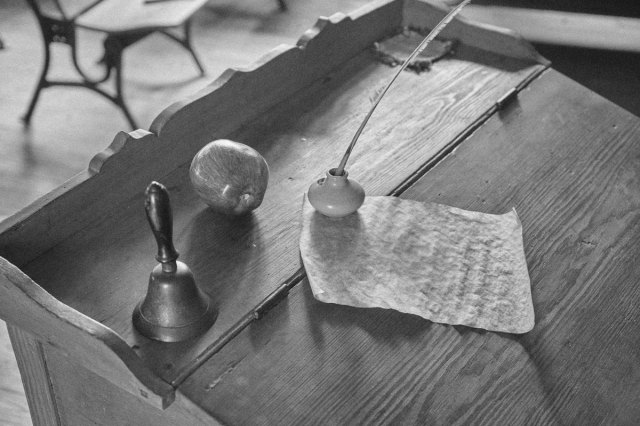
Tests are rarely enjoyable, but imagine taking one in the late 1800s, long before multiple-choice options or standardized curricula. Back then, school exams could be long, demanding, and startlingly wide-ranging. You might be asked to diagram sentences, explain the circulation of the blood, name the capitals of ancient empires, or sketch a map — all before lunch.
One window into this world is The New Common School Question Book, compiled by Wisconsin superintendent Asa H. Craig. Published in 1899 with earlier versions dating back to 1872, this question book was used by candidates preparing for teacher exams, teachers writing tests for students, and common school (public school) students of various ages — common school was generally grades 1 through 8 — studying for those tests.
The book’s thousands of questions, which are available in the Library of Congress archive, span a dizzying list of subjects — U.S. history, geography, English grammar, letter writing, written arithmetic, bookkeeping, drawing, inventions, government, physiology, and more.
The result is a vivid snapshot of what 19th-century Americans considered essential knowledge. Some questions still feel familiar, while others reflect a considerably different world.
So, could you pass a school exam from the 1800s? Let’s find out.
Note: The questions and answers below are verbatim.
Q. Which of the states border on Canada?
A. Maine, New Hampshire, Vermont, New York, Michigan, Minnesota, North Dakota, Montana, Idaho, Washington.
Q. How great is the earth’s annual motion?
A. About 68,000 miles an hour.
Q. What is essential in every syllable?
A. A vowel.
Q. Which are the five largest islands in the world?
A. Australia, Greenland, Borneo, New Guinea and Madagascar.
Q. What do the words per cent mean?
A. By the hundred.
Q. What nations explored the country now known as the United States?
A. The Spaniards, English, French and Dutch.
Q. What state is the geographical center of the United States?
A. Kansas, if we do not include Hawaii in the United States. It is also the center of population.
Q. What is the meaning of “sargasso”?
A. It is a Spanish name, meaning grassy.
Q. What part of North America is in the same latitude as England and Ireland?
A. The southern part of Canada.
Q. How are the teeth set in the jaw?
A: With long fangs, so that they may not easily be started from their places.
Q. How and by whom was alcohol discovered?
A. It is said that Paracelsus, a chemist of the fourteenth century, accidentally discovered alcohol, and upon testing its power boasted of having found the essence of life, the power to cure the weak, and the great benefactor of mankind.
Q. Define a fibre.
A. It is a thread of exceeding fineness, and may be round or flattened.
Q. Where and when was the first white child of English parents born in America? What was her name?
A. At the temporary settlement on Roanoke Island in 1587. Virginia Dare.
Q. Who said “I would rather be right than President” and why did he say it?
A. It was an expression of Henry Clay when his friends insisted that to advocate the compromise would lessen his chances for the Presidency. This step demanded great moral courage, as it required a partial surrender of his cherished theories of protection and an open breach with many political friends.
Q. What is the area of a circle whose diameter is 1 foot 1 inch?
A: 132.73 square inches.
Q. How are parts of Western Texas occupied?
A. By herds of wild horses.
Q. What became of [John Wilkes] Booth’s accomplices?
A. Harold, Payne, Atzerodt, and Mrs. Surratt were hanged; Arnold, Mudd and O’Laughlin were imprisoned for life, and Spangler was sentenced for six years.
Q. What is an impersonal verb?
A. A verb having person and number without a subject; as, methinks, meseems.
Q. Name five of the principal articles exported by the people of the United States.
A. Cotton, wheat, pork, cheese, machinery.
Q. The time since noon is 7/17 of the time to 4 o’clock p.m.; what is the time?
A. 10 minutes past 1 o’clock p.m.
Q. What law is impressed on all animal beings?
A. The law of continual change.
Q. What is a standard unit?
A. A unit of measure from which the other units of the same kind may be derived.
Q. If 3 gallons of brandy, at $3 a gallon, and 5 quarts of alcohol, at 40 cents a gallon, be mixed with 1/2 gallon of water, for what must the mixture be sold a gallon to gain 37 per cent?
A. $2.74.
Q. What can be said of the fisheries of the Columbia River?
A. They are an immense industry.
Q. What is the aim of drawing?
A. The aim of drawing is to secure culture through the senses by which we apprehend the forms of things.
Q. What are the wastes of Patagonia?
A. Sterile tracts covered with sand and gravel.
Q. To whom does the honor of having first established religious freedom in America belong?
A. To the Roman Catholics of Maryland, by the “Toleration Act” of 1649.
Q. What great calamity visited the people of America in August 1793?
A. The yellow fever broke out in Philadelphia, and raged with such virulence that within three months, out of a population of 60,000, no less than 4,000 perished.
Q. Why should care be banished from the table?
A. Care or grief restrains digestion. The nervous action holds the nourishing organs of the system back. But with merriment and pleasant thoughts the opposite is the case.
Q. A boy [was] hired to a mechanic for 20 weeks on condition that he should receive $20 and a coat. At the end of 12 weeks the boy quit work, when it was found that he was entitled to $9 and the coat; what was the value of the coat?
A. $7.50.











Leave A Comment
You must be logged in to post a comment.