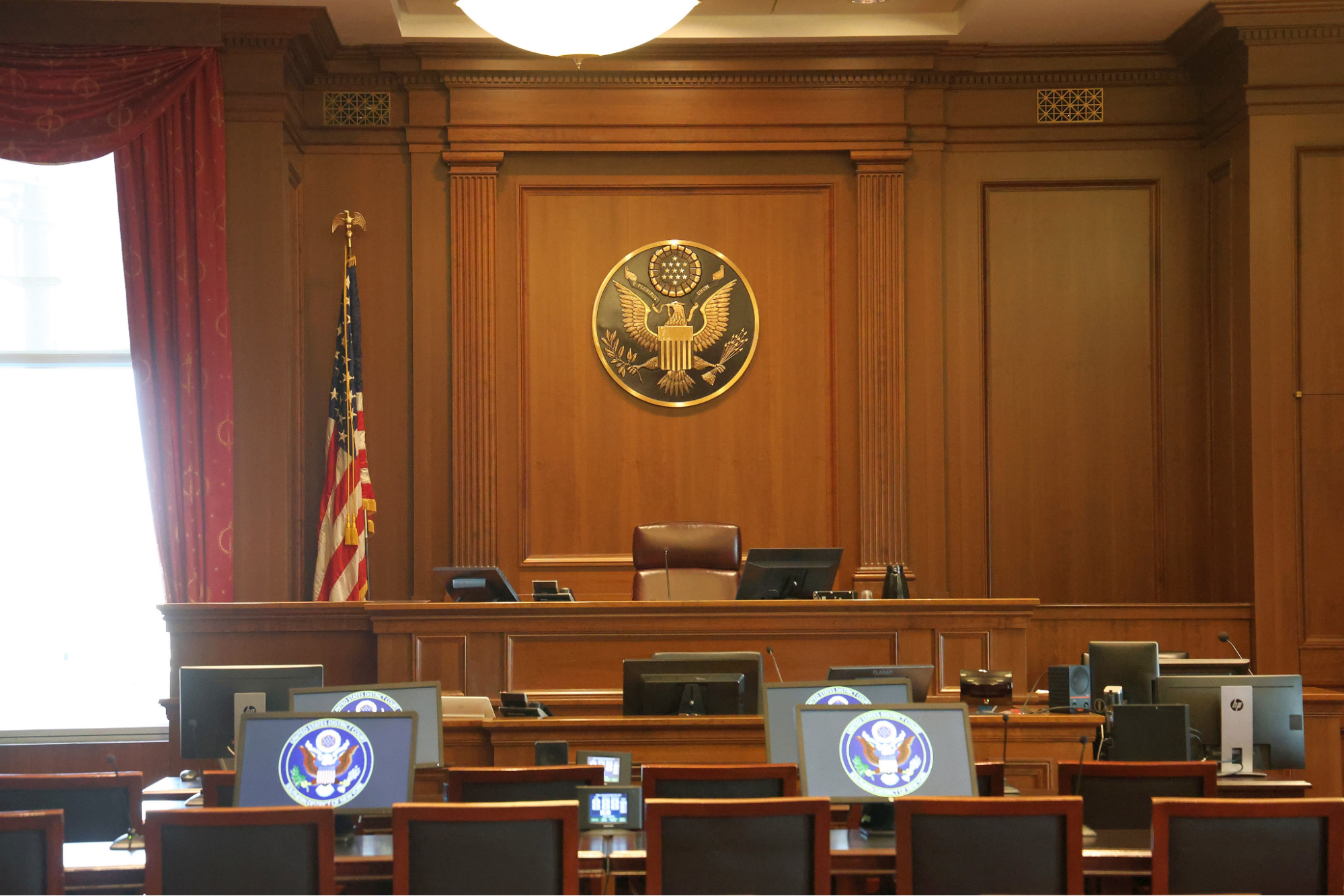
View of the judge’s bench from the audience inside a federal courtroom in a file photo. (Jefferson Siegel/Pool/Getty Images)
Can the Courts Delete Democracy?
March 24, 2026
By Jeffrey Tucker
Reprinted from The Epoch Times
Our forefathers had the idea of creating a government of, by, and for the people. The crucial tool to make this possible was the vote: the people would have their way, within law, and through their elected representatives. The idea was rooted in the ancient idea of democracy but with a republican twist—it would not be mob rule. There would be checks and balances. There would be inviolable rights.
Everyone on the planet Earth at the time said that this would never work—you need a king or a dictator or some other hereditary or ecclesiastical leader. It worked anyway. One hundred years later, the United States—its economy, culture, and freedoms—became the envy of the world.
We’ve drifted far from those ideals, but in 2024, voters on a national level delivered a clear mandate to the incoming Trump administration. It would clean up the vote, control immigration, root out fraud and waste, rebuild the country after five tumultuous years, restore the middle class, and recommit the nation to freedom and the Constitution.
It’s a compelling idea and majorities agreed.
In the last year, we’ve seen many examples of how appointed federal judges have intervened to try to stop the voters from having their way. The Supreme Court has had to intervene several times to make a simple point: The president is head of the executive branch. There is no such thing as a fourth branch of permanent administrators.
Somehow, some federal judges have not yet gotten the message.
In the U.S. District Court for the District of Massachusetts, Judge Brian E. Murphy issued a preliminary injunction on March 16, blocking several crucial changes pushed by Health and Human Services Secretary Robert F. Kennedy, Jr. to federal vaccine policy.
He did so on behalf of the American Academy of Pediatrics, a pharma-supported organization that advocates for childhood-gender transitions and maximum vaccinations.
The ruling targeted Kennedy’s Advisory Committee on Immunization Practices (ACIP), the CDC’s panel that recommends vaccine schedules. Murphy found that Kennedy likely violated the Federal Advisory Committee Act by firing all prior members (it was a deeply conflicted panel that rubber-stamped new shots) and appointing new ones. The new ACIP revised the childhood schedule.
The judge stayed the new ACIP appointments and halted votes and decisions by the reformed committee, including revisions to the childhood vaccine schedule. The schedule on the CDC site now is reversed by one year. This effectively pauses efforts to overhaul immunization guidance.
So much for democracy. So much for good science. So much for the mandate for change.
Separately, in the U.S. District Court for the District of Oregon (Eugene division), Judge Mustafa T. Kasubhai ruled from the bench on March 19, in the case State of Oregon et al. v. Kennedy et al. (Docket No. 6:25-cv-02409). He sided with a coalition of 21 Democratic-led states (including Oregon, California, New York, and others) challenging a December 2025 declaration by Kennedy.
Kennedy had said that gender-transition medical treatments for minors—such as puberty blockers, hormone therapy, and surgeries—were “neither safe nor effective” for treating gender dysphoria, did not meet “professionally recognized standards of care,” and “superseded” state or national standards.
Kasubhai vacated the declaration, finding that Kennedy overstepped his authority. The ruling blocked threats to exclude providers from Medicare and Medicaid, protecting access in states where mutilation remains legal.
These rulings make the point. Federal district judges are using procedural and statutory grounds to halt executive-branch initiatives on contested health issues. In both cases, the judges did not directly rule on the scientific merits of vaccines or gender-affirming care but emphasized acquiescence to the administrative state and not the voters.
Is this judicial overreach? Certainly. The framers of the Constitution did worry that the judiciary would have too much power and did their best to contain it. The Supreme Court is doing the same now. But this still has not stopped rogue judges from generating wild opinions and judgments that seem to have the force of law.
We can speculate that the Department of Justice will appeal whatever the final decisions turn out to be. But that’s a waiting game. Meanwhile, the judges get their way. It would otherwise be quite the step for the administration simply to ignore the courts, as much as we might fantasize that they would.
The rest of us are getting an education in how the real world of government operations really works. The administrative state and its industrial backers are happy to let us have the illusion of democratic power so long as it never impinges on their profits and powers. But the minute it does, the pieces start coming together to build blockades to reform.
Consider the larger picture. The mandate that Trump had in 2024 was an experiment without precedent. Not since the administrative state was built 100 years ago has any president and his appointees sought dramatic and fundamental change to the conduct of government, of what it consists and how it is managed.
We aren’t talking small policy changes here and there but a serious root canal for the bureaucracy and all its works. That’s never been tried before. It amounts to a hostile takeover of Washington. Is it any wonder that we are seeing dramatic pushback using surreptitious means but sneakily brutal tactics? We might have anticipated as much.
The use of judicial power like this really does represent a last resort of survival for a system that the public despises and Trump swore to upend. It’s not surprising that the goal was not achieved in one year, but not even one term is going to be enough. This effort could take a decade, provided the public has the patience and economic functioning survives.
All legal technicalities aside, never forget the big picture. What the vast majority of Americans want is the original promise of America: a government of the people, a guarantee of rights, a government limited in size, a thriving middle class pursuing happiness, and freedom above all else. That’s easily said. Getting there—restoring the Founders’ vision—is the challenge of this generation.
No, the district courts cannot delete democracy. Now we await the Supreme Court to make that crystal clear.
Jeffrey A. Tucker is the founder and president of the Brownstone Institute and the author of many thousands of articles in the scholarly and popular press, as well as 10 books in five languages, most recently “Liberty or Lockdown.” He is also the editor of “The Best of Ludwig von Mises.” He writes a daily column on economics for The Epoch Times and speaks widely on the topics of economics, technology, social philosophy, and culture.












Leave A Comment
You must be logged in to post a comment.