The Truth About the “First Muslim Country to Recognize America”
“Never pay tribute and destroy everything belonging to them.”
June 19, 2026
By
Reprinted from Frontpage Magazine
When Gov. Gretchen Whitmer announced that January would be Muslim American Heritage Month, she began it with the claim that “Muslim-majority Morocco was the first country to recognize the United States of America. Together, the two countries signed the Treaty of Friendship in 1786, which remains America’s longest-standing unbroken treaty.”
Islamists have repeatedly injected these and other blatant lies into American history.
America’s first direct confrontation with Islamic violence began when the ruler of Morocco, Sultan Mohammed bin Abdallah, seized the merchant ship Betsey in 1784 to force the United States to negotiate the ‘Treaty of Friendship’ and pay a $30,000 ransom for the release of the ship and her crew.
The first American treaty with a Muslim country was not a friendship treaty, but a hostage treaty, but Jefferson’s handpicked diplomat however avoided the Muslim ruler’s demand for tribute.
Seeing how easy it was to intimidate the United States, the Islamic corsair pirates of Algiers seized two American ships, the Maria and the Dauphine in 1785. While Morocco’s more ‘progressive’ Sultan Mohammed had been trying to pressure the United States into a trade relationship (America’s envoy however concluded that Morocco had nothing worth exporting except leather), Algeria’s Dey however, also named Mohammed, derived his income from piracy and was not about to be dissuaded from the traditional Islamic privileges of robbing infidels.
By 1802, Jefferson was warning that the actions of Morocco’s ruler were “so palpably against reason & the usage of nations, as to bespeak a settled design of war against us, or a general determination to make common cause with any of the Barbary powers at war with us.”
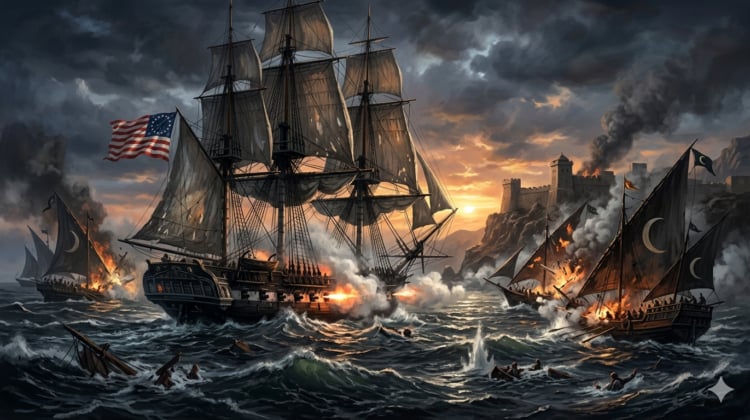
The ‘longest-standing unbroken treaty’ with Morocco lasted roughly 6 years when Mohammed’s son and successor, Sultan Suleiman, declared war on the United States in support of his fellow Islamic pirates during the First Barbary War. The governor of Tangiers ordered the capture of American vessels, and President Thomas Jefferson responded by sending in the fleet.
The USS Philadelphia liberated a captured American ship and seized the Moroccan pirate vessels, the Mirboka, which had captured the American brig, the Celia, and the Meshouda, while the USS Constitution paid a forceful call on Tangiers and found that the “Emperor is very desirous of peace, as his cruisers have been unsuccessful. I have no doubt but he would have discovered a different disposition, if they had been otherwise.”
“The threat I made on my arrival, to sink that ship or any other of his cruisers that I might meet with, and the active vigilance of our squadron, have had a good effect on the Moors,” Commodore Preble wrote to the Secretary of the Navy, and the ‘unbroken’ treaty was ‘renewed’.
Describing a treaty that was blatantly violated after only six years as “America’s longest-standing unbroken treaty” is obviously absurd and ahistorical.
“The Emperor of Morocco has, no doubt, long been meditating war with the United States. He has only been waiting for some pretext,” Preble observed. “The Christian powers will have no chance with these people, until they determine never to pay tribute or supply them with military or naval stores or ships, and to destroy everything they can belonging to them.”
Then Commodore Preble commented quite aptly on the treacherous form of diplomacy conducted by the Muslim pirates and their states. “They send out their cruisers, and if they prove successful, it is war, and we must purchase peace, suffering them to keep all they have taken; but if they are unfortunate, and we capture their cruisers, before they have taken anything valuable, it is not war, although the orders for capturing our vessels are found on board, and we must restore all we take from them,—which enables them to commence again.”
“I know not how long we shall be obliged to submit to this sort of treatment. The Moors are a deep, designing, artful, treacherous set of villains.”
Writing to the consul, he noted, “the happy combination of circumstances which has facilitated that so much desired object of our government without the agency of money, or even the promise of any future tribute or present: either of which must have degraded us in the eyes of these barbarians; and would have only been a prelude to greater insolence and demands.”
The only reason Mohammed’s son renewed the treaty was the might of the USS Constitution.
The USS Constitution had almost not been built. It was only the sustained Muslim piracy of the 1790s that had forced the approval of the Naval Act of 1794, which contained the escape clause that the shipbuilding program would be stopped if peace were reached. Fortunately, Congress decided to go ahead without relying on the worthless promises of the treaty with the Muslim pirates in Algiers, which some argued made the construction of the fleet unnecessary.
And the USS Constitution was the first of that new fleet.
“The very narrow & dirty streets, the wretched appearance of the Inhabitants, and their habitations, is enough to disgust an American,” an American on board the Constitution wrote.
“We ought not to fight them unless we determine to fight them forever,” John Adams had protested, invoking what would become known as a ‘forever war.’ Jefferson disagreed.
European nations had gotten into the habit of paying tribute. Americans would be different.
Jefferson’s fleet sent a message to Morocco and then to the corsairs of Algiers. When the USS Philadelphia was seized and renamed the ‘Gift of Allah’, unable to rescue her, a force led by Lt. Decatur snuck disguised as Muslim pirates in and set fire to the ship. The Marines were born on ‘the shores of Tripoli’ and with hundreds of American hostages still being held, America launched its first ground assault on a Muslim terrorist state.
The British had been encouraging the Muslim pirates behind the scenes, paying them tribute and using them to maintain a monopoly on international trade in a foreshadowing of future events in the 20th and 21st centuries. “I have in London heard it is a maxim among the merchants that if there were no Algiers, it would be worth England’s while to build one,” Benjamin Franklin had written after the near capture of some American ships in 1783.
The Barbary Wars ended the proxy wars and the Islamic piracy veto over American shipping.
And that is the story of what a State Department site describes as “how Morocco became America’s oldest friend”. It was a ‘friendship’ in which we regularly had to send armed warships to remind our oldest and dearest Muslim friend from 1803 through 1897 over assaults on American ships and citizens, and again in 1904 over the kidnapping of an American citizen, when Teddy Roosevelt famously warned the government, “Perdicaris alive or Raisuli dead.”
As the United States today faces similar Islamic piracy crises with Yemen and Iran, our leaders would do relearn the lessons that Thomas Jefferson learned about the basis for the Islamic piracy. “It was written in their Koran, that all nations which had not acknowledged the Prophet were sinners, whom it was the right and duty of the faithful to plunder and enslave; and that every mussulman who was slain in this warfare was sure to go to paradise.”
Paying tribute and making deals only ends one way.
A decade later, Decatur would tell the Bey of Algiers, the ‘Shadow of Allah’, “If you insist in receiving powder as tribute, you must expect to receive balls with it.”
We keep paying tribute because we never seem quite able to find the balls to go with it.




Leave A Comment
You must be logged in to post a comment.