Israel Biblical Highway
By Yishai Fleisher
VIDEO
The “Israel Biblical Highway” bridges millennia of spiritual history with the modern reality of Israel’s Route 60. Adding the new title officially to the existing road winding its way through modern communities and ancient sites is the brainchild of Rabbi Yishai Fleisher. He is working through avenues of both media and law to enhance awareness and connection to this road walked by traders, pilgrims, farmers, and armies for centuries.
This short animated film, featuring original artwork, is a journey on to itself – traversing the heart and telling the stories of the most famous narratives in human history. Indeed, there are many beautiful and historic roads in the world, but there is only one that traverses the heart of the most powerful and influential story in human history. Sweeping from north to south, the ancient Biblical Highway, journeys through the storied and holy cities of Israel’s Biblical heartland.
The highway begins in Beer Sheva, the southern capital of the Negev desert, where Abraham and Isaac found water and taught wayfarers about the One God. The road continues north to Hebron, where Abraham bought the plot of land where three generations of Israel’s founding patriarchs and matriarchs are buried, and where King David first ruled. The journey continues north through the terrain of Judea and reaches Beit Lechem (Bethlehem), burial site of the Matriarch Rachel and setting for the Book of Ruth. Yet further north, the Biblical Highway meets the heart of the world – Yerushalayim (Jerusalem), Israel’s capital, where King David reigned and where two Jewish Temples stood.
Next, the road arrives at Beit El (Bethel), where Jacob experienced a vision of a ladder connecting Heaven and Earth. The Biblical Highway then continues north to Shiloh, where the Tabernacle stood for 369 years and where Hannah’s famous prayer was heard. The road next travels to the Samaria city of Shechem (Nablus), the first place that both Abraham and Jacob arrived in the Land of Israel and where Joseph is buried. Finally, the Biblical Highway ends in the Jezreel Valley where the armies of Israel fought invaders and where beautiful Mount Tabor heralded the victorious Song of Devorah.
The Biblical Highway – the original ‘Bible Belt’ – is a path that has existed for more than 4,000 years. Now, the Biblical Highway has been revealed once again, as a world heritage site accessible to tourists and pilgrims seeking to learn about the Biblical past and connect with the modern rebirth of Israel.
Plans for the restoration of the Biblical Highway include visitor centers, rest stops, educational scenic overlooks, and a dedicated app to guide travelers through the ancient sites and stories, and to provide access to the modern amenities on the highway. Additionally, supporters from around the world will be able to “Adopt The Biblical Highway” and take part in developing the continuing story of this amazing road.
The Israeli government on Tuesday, June 16th, approved designating Route 60 — the highway stretching from Nazareth in the north to Beersheba in the south and passing through some of the most significant sites in history—as the “Biblical Highway.”
The designation is part of a broader initiative to create a Route 66-style experience for Bible enthusiasts, students and tourists.
The Biblical Highway has existed for more than 4,000 years. Running along Israel’s central mountain ridge, the route begins in Beersheba, the southern desert city where Abraham is said to have established an oasis and taught travelers about belief in one God.
David Parsons, senior vice president and spokesman for the International Christian Embassy Jerusalem, told Fox News Digital that a proper understanding of the Bible can help immunize people against what he described as the “virus” of antisemitism.
“You would better understand who the Jewish people are, the special relationship God established with them for the benefit of all mankind, and the fact that this includes a land where they could become a nation and deliver those benefits down through history,” Parsons said.
“The more you examine the archaeological record in the Land of Israel, and the more objectively you look at the evidence, the more you realize that the Bible is not a collection of fables and fairy tales, but an accurate account of a people and a land that have given the world ideas and values of universal benefit and inspiration,” he added.
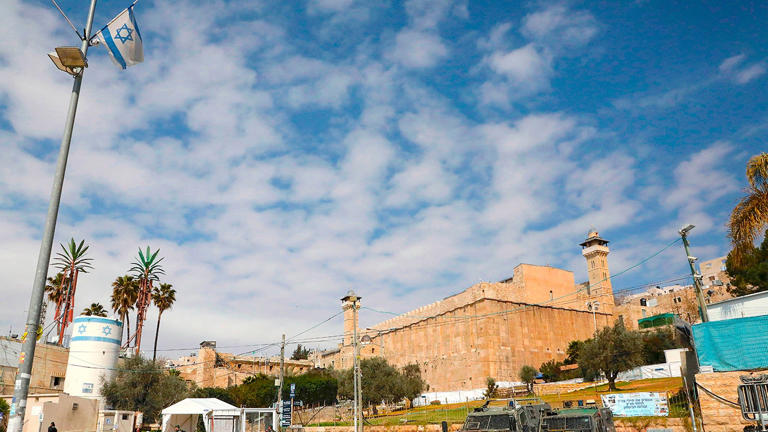
The Cave of the Patriarchs, in Hebron on Feb. 23, 2020. Getty Images© Getty Images
The road continues from Beersheba to Hebron, home to the Cave of the Patriarchs, purchased by Abraham some 3,800 years ago and traditionally regarded as the resting place of the biblical patriarchs and matriarchs. The site is marked by a monumental structure built by King Herod some 2,000 years ago. Hebron was also King David’s first capital, where he was crowned king of Israel about 3,000 years ago.
The route passes through Bethlehem, birthplace of Jesus and where Jacob buried the matriarch Rachel and which serves as the setting of the Book of Ruth, before reaching Jerusalem, the capital of modern-day Israel and home to Mount Moriah — the traditional site of the Binding of Isaac — as well as the location of the First and Second Temples.
Continuing north, the highway reaches Bet El, where Jacob, while fleeing his brother Esau, experienced the prophetic dream of a ladder connecting heaven and earth and where, 20 years later, he returned with his family and received the name Israel. It then passes through Shiloh, which served as the spiritual center of the Israelites for nearly 400 years after their entry into the Land of Israel.
Farther north lies Shechem, where Joshua is said to have buried the bones of Joseph, which the Israelites carried from Egypt during the Exodus. The route then reaches Mount Tabor, where the prophetess Deborah sang her song of victory, and continues to Megiddo, the site of numerous battles involving the armies of Israel and invading forces throughout biblical history, before ending in Nazareth, the hometown of Jesus.
Yishai Fleisher, international spokesman for the Jewish community of Hebron, told Fox News Digital he has been working on the project for many years.
“Finally, the government is recognizing it. We have been advocating for this idea, which is similar to other roads around the world,” he said.
“In Germany, they have the Romantische Straße, or Romantic Road. In Spain, they have the Camino de Santiago. And in the United States, there is the famous Route 66. For us, it’s Route 60, the Biblical Highway.
“I think it has educational, heritage and tourism value,” Fleisher continued. “The government views the Bible as an important part of Israel’s identity. We’ve been teaching it, we’ve been promoting it, and they’ve embraced the idea. Ahead of the elections, I think they want to show people that they are committed to branding Israel as the land of the Bible.”
The initiative also carries significance amid what Fleisher described as efforts by the Palestinian Authority to assert claims over sites of Jewish historical and biblical heritage.
He said there have been attempts to “erase” Jewish historical and biblical narratives, including efforts to reinterpret or displace long-held traditions associated with sites such as the Western Wall, the Temple Mount, Rachel’s Tomb and the Cave of the Patriarchs.
“It makes perfect sense because if one undermines the biblical heritage of Israel and this land, they are undermining the pillars of the Jewish state and could replace it with a Palestinian one,” he continued. “When we rename Route 60 or add the name ‘Biblical Highway,’ we are strengthening that pillar of our ancient identity in this land. Certainly, people who do not want to see Israel exist seek to remove that pillar.”
Ze’ev Orenstein, Director of International Affairs at City of David, said the initiative offers visitors an opportunity to experience biblical history through the geography where it unfolded.
“The Biblical Highway will enable millions of visitors to bring their faith, heritage, and identity to life by traveling through the very places where the Biblical story unfolded and where the values that continue to shape Western civilization were born,” he told Fox News Digital. “It is an invitation to experience the Bible not only as a book, but as a living geography, as relevant today as it was millennia ago.”
Parsons noted that there is also a King’s Highway in Jordan that the Israelites traveled along, which is marked as such by the Jordanians.
“So Israel is not doing anything different from what Jordan has done on its side. I don’t think there is anything particularly political about that; it is simply an acknowledgment of historical truth,” he said.
Israel’s Ministry of Tourism spokesperson told Fox News Digital that it supports the name change and will work to incorporate “The Biblical Highway” into Israel’s marketing and branding materials. Visitor centers, observation points and multilingual signage are expected to be included.
Come visit the Biblical Highway and walk in the great footsteps of history and prepare to be touched by the road’s rare authenticity, the warmth of the people, and the nearness to something beyond.










Leave A Comment
You must be logged in to post a comment.