We are all living in the Biblical days of the Great Falling Away, the time of the Great Deception among people. Technology has aided The Enemy in this. Accelerating delusion by the hour. Among those professing faith and belief in Jesus as much as within those walking in utter darkness. Delusion reigns within the people. Most people. Gathering their information by the moment from the glowing orb in their hand. Misinformation for the greater part.
Refusing to turn to God in His Word.
Refusing to have at hand a REAL, bound, paper, ink on paper Holy Bible. Prefering the glow from the screen, the security blanket in their weakness of the glowing screen, which is what it reveals can be changed, altered in the blink of an eye, a software update…
For there are certain men crept in unawares, who were before of old ordained to this condemnation, ungodly men, turning the grace of our God into lasciviousness, and denying the only Lord God, and our Lord Jesus Christ.
Jude 1:4
…and certain women who have crept in. Certain evil of worldly culture has crept in, denying the LORD Jesus Christ, Yeshua Hamashiach, in these, the very last of the last days. Deception grows by the hour. Not by the year, month, week, or day at this juncture — deception among people grows by the hour.
But there were also false prophets among the people, even as there will be false teachers among you, who will secretly bring in destructive heresies, even denying the Lord who bought them, and bring on themselves swift destruction. And many will follow their destructive ways, because of whom the way of truth will be blasphemed. By covetousness they will exploit you with deceptive words; for a long time their judgment has not been idle, and their destruction does not slumber.
2 Peter 2:1-3
I charge you therefore before God and the Lord Jesus Christ, who will judge the living and the dead at His appearing and His kingdom: Preach the word! Be ready in season and out of season. Convince, rebuke, exhort, with all longsuffering and teaching. For the time will come when they will not endure sound doctrine, but according to their own desires, because they have itching ears, they will heap up for themselves teachers; and they will turn their ears away from the truth, and be turned aside to fables. But you be watchful in all things, endure afflictions, do the work of an evangelist, fulfill your ministry.
2 Timothy 4:1-5
Now the Spirit expressly says that in latter times some will depart from the faith, giving heed to deceiving spirits and doctrines of demons,
1 Timothy 4:1
And for this reason God will send them strong delusion, that they should believe the lie, that they all may be condemned who did not believe the truth but had pleasure in unrighteousness.
2 Thessalonians 2:11-12
Now as He sat on the Mount of Olives, the disciples came to Him privately, saying, “Tell us, when will these things be? And what will be the sign of Your coming, and of the end of the age?”
And Jesus answered and said to them: “Take heed that no one deceives you. For many will come in My name, saying, ‘I am the Christ,’ and will deceive many. And you will hear of wars and rumors of wars. See that you are not troubled; for all these things must come to pass, but the end is not yet. For nation will rise against nation, and kingdom against kingdom. And there will be famines, pestilences, and earthquakes in various places. All these are the beginning of sorrows.
“Then they will deliver you up to tribulation and kill you, and you will be hated by all nations for My name’s sake. And then many will be offended, will betray one another, and will hate one another. Then many false prophets will rise up and deceive many. And because lawlessness will abound, the love of many will grow cold. But he who endures to the end shall be saved. And this gospel of the kingdom will be preached in all the world as a witness to all the nations, and then the end will come.”
Matthew 24:3-14
For I am not ashamed of the gospel of Christ, for it is the power of God to salvation for everyone who believes, for the Jew first and also for the Greek. For in it the righteousness of God is revealed from faith to faith; as it is written, “The just shall live by faith.”
God’s Wrath on Unrighteousness
For the wrath of God is revealed from heaven against all ungodliness and unrighteousness of men, who suppress the truth in unrighteousness, because what may be known of God is manifest in them, for God has shown it to them. For since the creation of the world His invisible attributes are clearly seen, being understood by the things that are made, even His eternal power and Godhead, so that they are without excuse, because, although they knew God, they did not glorify Him as God, nor were thankful, but became futile in their thoughts, and their foolish hearts were darkened. Professing to be wise, they became fools, and changed the glory of the incorruptible God into an image made like corruptible man—and birds and four-footed animals and creeping things.
Therefore God also gave them up to uncleanness, in the lusts of their hearts, to dishonor their bodies among themselves, who exchanged the truth of God for the lie, and worshiped and served the creature rather than the Creator, who is blessed forever. Amen.
For this reason God gave them up to vile passions. For even their women exchanged the natural use for what is against nature. Likewise also the men, leaving the natural use of the woman, burned in their lust for one another, men with men committing what is shameful, and receiving in themselves the penalty of their error which was due.
And even as they did not like to retain God in their knowledge, God gave them over to a debased mind, to do those things which are not fitting; being filled with all unrighteousness, sexual immorality, wickedness, covetousness, maliciousness; full of envy, murder, strife, deceit, evil-mindedness; they are whisperers, backbiters, haters of God, violent, proud, boasters, inventors of evil things, disobedient to parents, undiscerning, untrustworthy, unloving, unforgiving, unmerciful; who, knowing the righteous judgment of God, that those who practice such things are deserving of death, not only do the same but also approve of those who practice them.
Romans 1:16-32
The algorithms are leading many into the pit of hell.
We are the ones living within the words of Romans 1.
We are in, and have been in the beginning of the time of STRONG DELUSION, which only increases exponentially by the hour.
What can be trusted and believed in such a time as this?
Only God. Only Jesus. Only the Holy Spirit. Only the whole Holy Bible.
In Them and that Book, one will find shelter, help, comfort, instruction, uplifting, guidance, hope, and life, only in Them and in that Book.
Read on…
Ken Pullen, Monday, June 1st, 2026
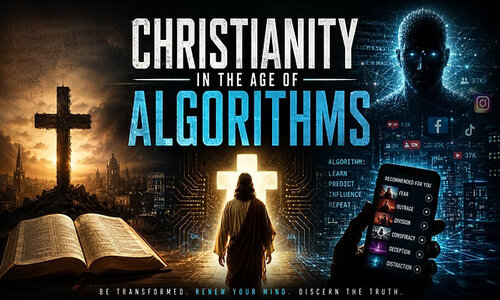
Christianity In The Age Of Algorithms
June 01, 2026
By PNW Staff
Reprinted from Prophecy News Watch
Not long ago, discipleship primarily happened through the local church, faithful pastors, family devotions, and personal Bible study. Believers gathered together, sat under sound teaching, and matured through relationships with other Christians. Spiritual growth was often a slower process. One built around reading, reflection, prayer, and learning from those who had walked with Christ longer than they had.
While those things still exist today, a significant shift has taken place. The average Christian now lives in a world saturated with digital content. Before many people open their Bibles in the morning, they reach for a phone. Before hearing from a pastor on Sunday, they may have already consumed dozens of videos, podcasts, memes, and social media posts. The modern believer often enters a worship service after spending hours immersed in a completely different information environment.
Something else has quietly entered the discipleship process.
The smartphone has become a constant companion, and the social feed increasingly functions as a type of digital pulpit. Every swipe introduces ideas, values, fears, opinions, and worldviews. The issue is not merely that people are consuming more information than previous generations; it is that invisible systems now determine much of what they see.
Those systems are called algorithms.
Unlike a pastor who prayerfully prepares a message or a teacher who intentionally builds a lesson, algorithms are designed around a different objective. Their purpose is not spiritual maturity. Their purpose is attention. They are designed to learn what captures us, what keeps us watching, and what prevents us from moving on to something else.
That reality raises an important question for Christians: If something is constantly shaping our thoughts, then who (or what) is teaching our minds?
Attention Has Become a Battlefield
The battle for truth has always involved the mind. Scripture repeatedly warns believers about deception, false teaching, and conformity to worldly thinking. Romans 12:2 tells believers, “And do not be conformed to this world, but be transformed by the renewing of your mind…” The battlefield of spiritual warfare has never simply been external; it has always involved what people believe and how they think.
What makes our present moment unique is that the competition for attention has become relentless.
Modern platforms are built around systems that study user behavior. Every pause on a video, every click on an article, every search, and every interaction becomes data. Algorithms learn preferences and then serve increasingly personalized content designed to maximize engagement. If a user watches several videos involving political outrage, more outrage appears. If they stop on conspiracy content, more conspiracy content follows. If they linger on something inappropriate, more inappropriate stories begin filling their feed.
The system simply gives people more of what appears to hold their attention.
Research in recent years has increasingly suggested that emotionally charged and sensational content often spreads more effectively online than carefully reasoned information. This creates a troubling dynamic because truth and engagement are not necessarily the same thing. Truth frequently requires patience, context, and thoughtful consideration. Emotional reactions, however, happen almost instantly.
The result is a culture increasingly conditioned to react before thinking.
For believers, this should create concern because spiritual maturity has never been built on immediate reactions. Growth in Christ often develops through slow and intentional practices: reading Scripture, praying, studying doctrine, spending time in fellowship, and allowing God’s Word to transform the mind over time.
The digital world increasingly trains people in the opposite direction.
The Rise of Fast-Food Theology
The influence of algorithms extends beyond entertainment and politics; it increasingly shapes theology itself.
Many Christians today consume biblical teaching in the same way they consume every other form of online content. Instead of sustained study, theology can become fragmented into short clips and brief emotional moments. Sermons become thirty-second videos. Complex doctrine becomes condensed into catchy quotes. Difficult passages become reduced to simplistic explanations.
Short-form content is not inherently bad. God can certainly use brief messages to encourage believers or point someone toward truth. A short video may inspire a person to study a passage further or introduce them to a teaching they might otherwise miss.
Problems emerge, however, when snippets replace substance.
There is a significant difference between hearing a thirty-second motivational clip and studying an entire chapter of Scripture within its context. There is a difference between watching a highlight and understanding the complete message. Sound doctrine requires depth, and depth takes time.
Recent concerns about shortened attention patterns have only intensified these discussions. Many researchers and educators continue observing increasing difficulty among younger generations in maintaining sustained focus amid constant digital stimulation. Whether scrolling through endless videos or rapidly switching between applications, attention increasingly becomes fragmented.
Spiritually speaking, this creates important questions.
If believers become accustomed to consuming information in ten-second increments, what happens when they are asked to sit quietly and meditate on Scripture? What happens when prayer feels slow? What happens when studying an entire book of the Bible requires more effort than scrolling through dozens of videos?
Psalm 1 describes the righteous person as someone who delights in God’s law and meditates upon it day and night. Meditation requires concentration and stillness. Yet stillness has become increasingly rare in a world filled with notifications and constant stimulation.
Technology as a Spiritual Authority
Recent developments involving artificial intelligence have introduced an entirely new dimension to these concerns.
Throughout the past year, multiple reports have highlighted people increasingly using AI systems for emotional support, life advice, and even spiritual guidance. Some users have described AI systems in surprisingly personal terms, seeking comfort, affirmation, and meaning through conversations with machines.
Technology has always served practical purposes, and artificial intelligence can certainly provide useful information and assistance. Yet Christians should recognize an important distinction. Technology is meant to be a tool, not a source of ultimate authority.
Human beings have always looked somewhere for guidance and meaning. Historically, people sought wisdom through family, tradition, religion, philosophy, or trusted relationships. Increasingly, however, many individuals now turn first toward digital systems.
This becomes concerning because algorithms and artificial intelligence do not possess spiritual discernment. They cannot convict sin. They cannot produce genuine wisdom. They cannot replace the ministry of the Holy Spirit.
Scripture describes God’s Word as “living and active and sharper than any two-edged sword” (Hebrews 4:12). The Bible does not merely comfort people; it confronts them. It exposes pride, reveals sin, and calls believers toward repentance and transformation.
Algorithms function differently.
Rather than confronting people, they frequently reinforce preferences. Instead of challenging assumptions, they often amplify them. Instead of exposing blind spots, they commonly provide more of what users already enjoy. A virtual tickling of the ear.
That creates a kind of digital echo chamber where people increasingly hear reflections of themselves.
Spiritual growth, however, rarely happens inside echo chambers.
Guarding the Mind in a Digital World
None of this means believers should abandon technology altogether. Social media and digital platforms can spread the gospel, encourage believers, and connect believers around the world in ways previous generations never experienced. Ministries can reach millions of people instantly. Biblical resources have become available at unprecedented levels.
Technology itself is not the enemy. The greater issue involves stewardship.
Believers must ask whether they are controlling technology or whether technology is controlling them. The issue is not whether someone owns a smartphone. The issue is whether the smartphone increasingly owns their attention.
Perhaps Christians need to periodically examine themselves by asking difficult questions.
How much time am I spending in God’s Word compared to scrolling through content? What voices influence me most each day? Am I consuming more opinions than Scripture? Am I pursuing truth or simply pursuing whatever captures my attention?
Those questions matter because discipleship is rarely neutral.
Something is always shaping our thinking. Something is always influencing our values. Something is always teaching us how to interpret reality.
Jesus warned His followers in Mark 4:24, “Take care what you listen to.”
Those words may carry even greater significance in the age of algorithms.
The modern world is filled with endless voices competing for attention. Yet followers of Christ must remember that not every voice deserves authority over their minds. The Church cannot allow social feeds to become its primary teachers. Believers cannot allow algorithms to replace biblical discipleship.
Because if Christians are not intentionally being shaped by God’s Word, something else will gladly do the shaping for them.
And increasingly, that something may be sitting in the palm of our hands.
Originally published at Prophecy Recon











Leave A Comment
You must be logged in to post a comment.