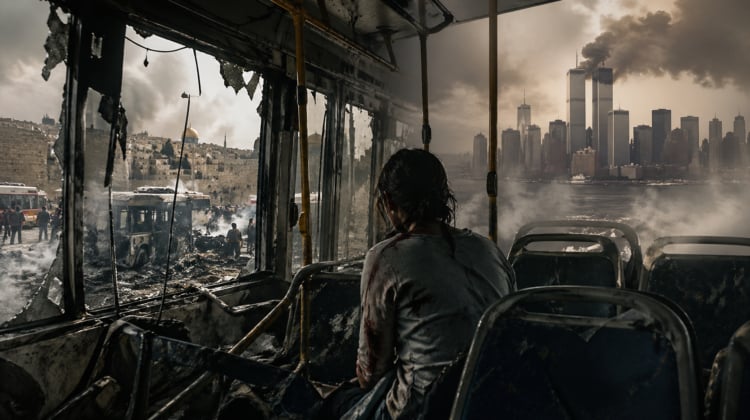
We Can’t Say “We Didn’t Know”
The threat crossed the line a long time ago.
May 4, 2026
Reprinted from Frontpage Magazine
I am not a political analyst. I don’t sit in intelligence briefings, nor do I track military strategy.
I am a victim of terrorism.
That status has given me an understanding of terrorism I never asked for. It has given me a perspective most people do not understand, and too many would rather not discuss.
Twenty-two years ago, I was sitting on a bus in Jerusalem when an eighteen-year-old suicide bomber boarded and detonated his vest just a few feet away from me. In an instant, the life I had known turned into chaos. Smoke. Fire. The silence that follows trauma. The silence of death all around me.
I survived, but 17 innocent people who were on their way home that day did not. More than one hundred of us were injured. Physical injuries can heal, though for some that is a long and painful process. The psychological impact stays with you always. You learn to cope. You learn to carry it.
The Denial of Terror
That attack did not come out of nowhere. It happened because of an ideology, a network, and a system that had been building long before I ever stepped onto that bus.
I had already been volunteering with victims of terrorism before I became one myself. I thought I understood the pain, the fear, the lasting toll. Becoming a victim revealed just how much I, and so many others like me, had not fully grasped.
Since then, in working with survivors and bereaved families around the world through Strength to Strength, I have come to understand something far more unsettling: terrorism is not a distant phenomenon. It is not contained. It does not stay where it starts.
This is the point that too many Americans do not want to face.
Many Americans do not believe that Iranian proxy terror cells are an immediate threat to them. They do not believe these networks, this ideology, or this infrastructure could reach into their own communities, their own cities, their own lives. They want to believe it is somewhere else. Israel. The Middle East. Europe. A border region. A battlefield far away. They want to believe that because it feels distant, it is not urgent. Because it is foreign, it is not their responsibility. Because it has not yet touched them personally, it does not demand action now.
That is denial.
Terrorism has never respected borders. The ideology that fuels it moves. The money moves. The influence moves. The recruitment moves. The networks move. Individuals inspired or directed by these movements do not need permission to cross from distant threat to immediate danger. The belief that this is someone else’s problem has always been false. It was false before 9/11. It was false before the attacks that struck cities across Europe. It was false before I stepped onto that bus in Jerusalem. And it is false now.
The United States has law enforcement and intelligence agencies that repeatedly warn of these threats, even when they are not visible to the public. Yet too many people in this country dismiss those warnings or treat them as political noise. Nowhere is this more apparent than in the debate over Iran and its terror proxies. The conversation is often reduced to politics, slogans, or fatigue. But terror networks are not abstractions. They are not debating points. They are not confined to the places where Americans prefer to imagine they belong.
The danger is not only that these threats exist. The danger is that so many people are determined not to see them.
Terrorism on American Soil
In less than five months, we will commemorate the 25th anniversary of 9/11. A quarter of a century has passed, but for the families who lost loved ones, for thousands of survivors, and for the first responders who ran toward the fire and smoke, that day is not distant. It is urgent. It is immediate. It never goes away.
And still, even after 9/11, people fall back into the same trap. They tell themselves that this time is different. That this threat is far away. That the warnings are exaggerated. That someone else will handle it. That the country does not need to address it now.
We have seen where that kind of thinking leads.
We see warning signs in many countries around the world. The United Kingdom, for example, has faced serious challenges with extremism and radicalization. That did not happen overnight. It developed gradually. It was underestimated. It was ignored. And then, when the danger became harder to deny, it was also much harder to manage.
No country is immune to complacency. The United States is not immune. Acknowledging that does not require panic. It requires honesty. It requires moral clarity. It requires the willingness to say that extremist ideologies exist, that they evolve, that they spread, and that they are closer to home than many Americans are willing to admit.
The problem is not only what is happening. The problem is how little we are willing to see.
When the conversation is oversimplified or avoided altogether, people are left with the impression that distance is the same thing as safety. But distance has never been a reliable measure of risk. We all have a choice. We can continue to look away. We can tell ourselves that this is not my problem, that it is someone else’s tragedy, someone else’s country, someone else’s war. We can keep pretending it can wait.
Or we can start to pay attention.
We do that by listening to those who lived through it. Survivors know what denial sounds like. We know what warning signs look like before they are understood as warning signs. We know what people say before tragedy, and what they wish they had understood after it.
Awareness is not fear. It is my responsibility.
The truth is that most people never think terrorism will happen to them. They never think they could become victims. They never think the threat they read about in another country could one day enter their own life.
I certainly didn’t. And that is exactly why we don’t get to say, “we didn’t know.” Because by the time it becomes personal, it is already too late.
The warning signs were there all along.
RELATED:
The Joy of Islam? | Frontpage Mag
Sarri Singer is a survivor of the bus #14 terrorist attack on June 11, 2003, in Jerusalem, Israel. She is the Founder and Director of Strength to Strength, a non-profit organization that unites victims of terrorism from across the globe with long-term psychological and peer support to help them heal and move forward.








Leave A Comment
You must be logged in to post a comment.