When Hatred Becomes Inheritance
The sandy path from inherited animus to sanctified bloodshed.
April 22, 2026
By
Reprinted from Frontpage Magazine
“It seems a very old argument; so is probably in the blood; so maybe it will only end with the blood.” — Franz Kafka, “Jackals and Arabs”.
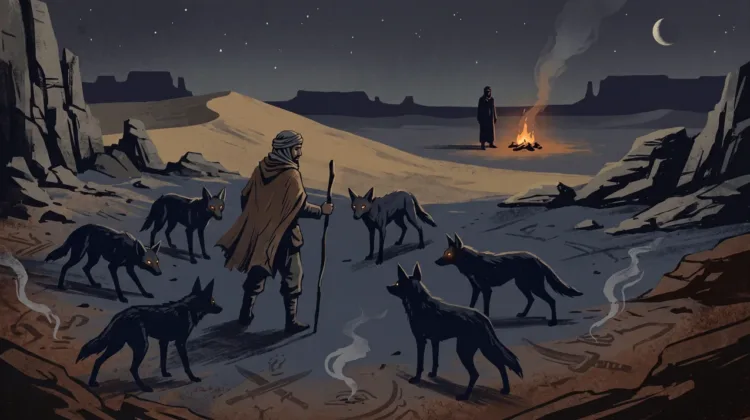
Franz Kafka’s “Jackals and Arabs” is one of the most chilling short stories ever written because almost nothing happens in it. There is no courtroom, no manifesto, no massacre, no grand ideological speech. A traveler from the north camps in the desert and jackals gather around him in the night. They speak with an ancient, fevered hatred of the Arabs and place their hope in an outsider who will somehow solve what time itself has failed to solve. The scene is quiet, nearly static, yet the atmosphere is suffocating. Kafka has trapped the reader inside a world in which hatred is no longer an event. It is sinister ambiance.
That is why the story feels so contemporary. Kafka is not writing about a disagreement, or even about ordinary prejudice; he’s writing about inherited enmity, hatred transmitted across generations until it hardens into instinct. The jackals do not argue in any recognizable sense. They do not reason; they don’t persuade; they hate as though they were born already in possession of their grievance and their language is ritual language: purity, contamination, cleansing, separation. They are not asking for justice. They are dreaming of removal and want the world purified of the object of their loathing.
One need not press Kafka’s story into a simplistic allegory to feel its force. It is enough to recognize that he understood something terrible about civilizations: hatred can become hereditary. It can become part of the emotional furniture of a society, absorbed so early and repeated so often that it no longer appears to those inside it as hatred at all. It appears as order, hygiene, piety, destiny. The abnormal becomes customary and the grotesque becomes familiar. What should horrify instead feels ordinary.
That is one of the reasons anti-Jewish and anti-Christian hostility in large parts of the Islamic world cannot be understood as a series of disconnected eruptions. It is not merely the result of current events, territorial disputes, or the latest war; it is sustained by a much older inheritance of contempt, humiliation, and sacred animus that has been cultivated through sermons, textbooks, political rhetoric, inherited memory, and social repetition. The result is not simply bad opinion; it is a moral atmosphere in which hatred finds ready lodging.
To say this is not to claim that every Moslem thinks the same way, or that history has only one cause. It is to say that there are forms of prejudice so old, so normalized, and so deeply embedded in culture that they become available at once whenever circumstances demand an enemy. That is the point Kafka saw. The hatred is waiting there already. The occasion may change, the object may be newly presented, the grievance may wear a fresh political costume, and yet, the emotional structure remains.
The modern Middle East is thick with corrupted language precisely because language is how such hatreds survive respectably. Jews are not hated as Jews; they are “Zionists,” “settlers,” “colonizers,” or “polluters of the land.” Christians are not despised as Christians; they are “Western agents,” “crusaders,” or tolerated remnants whose security depends on submission and silence. Terrorism itself is not described as murder; it becomes resistance, martyrdom, purification, holy struggle. Once the language has been bent sufficiently, bloodshed arrives already moralized.
This is why outsiders so often fail to understand what they are looking at. They imagine they are witnessing an ordinary political conflict susceptible to ordinary political remedies and take each declaration at face value. They cavil over borders, process, sequencing, and confidence-building measures while ignoring the deeper cultural engine. Kafka’s traveler from the north is precisely this figure. He is drawn into a world of immemorial hostility and invited to serve as its solver, as though the scissors handed to him could cut through something that has long since entered the bloodstream. He is flattered, enlisted, and misled at once.
The West has played that role for decades: Diplomats, journalists, academics, and mediators arrive as though they are bringing neutral reason into a solvable dispute, yet many of them refuse to see the structure of hatred in front of them. They speak of reciprocity where there is none, of symmetry where there is none, of grievances equally held where one side has sacralized grievance as identity. They prefer the sinuous evasions of process to the bluntness of cultural truth and call the problem complicated when very often it is simple: a civilization that has long been taught to regard Jews and Christians as permanent irritants will produce, at its most radical edge, movements that translate prejudice into terror.
That is what modern terrorism is in this context: not a sudden deviation from the culture that surrounds it, but its most violent culmination. The terrorist is not born in a vacuum. He emerges from a moral ecology and may be more extreme than his parents, his teachers, his imam, or his state media, but he does not emerge from nowhere. Before the bomb vest and the rifle come the tale, the image, the sermon, the phrase repeated at table, in school, on television, in the mosque, in the square. Before the atrocity comes the long schooling of imagination, a people taught for generations that Jews are filth, corruption, or cosmic enemies will eventually produce men willing to murder Jews with a clean conscience. A culture saturated with contempt for Christians will eventually produce those who burn churches, behead priests, or drive ancient communities into flight.
Nothing in this requires every believer to become a killer; it only requires enough inherited hostility, enough legitimating rhetoric, enough moral numbness, and enough institutions unwilling to resist the current. The path from prejudice to terrorism is not linear in every case, but it is real. It is deleterious not merely to its immediate victims, but to the civilization that houses it, because a society that keeps such passions warm is eventually poisoned by them. Hatred corrodes its container.
Kafka understood that, too. The most disturbing part of “Jackals and Arabs” is not even the jackals’ fantasy of purification, it is the calm of the Arab at the end, his almost amused familiarity with the whole thing. He knows the hatred as he has seen it before. He treats it as part of the desert’s order and the scene becomes truly tremblable there, because one realizes that enmity has ceased to shock anyone inside the world of the story. It has become routine.
That is the danger in the real world as well that the constant persecution of Christians in parts of the Islamic world, the chronic indoctrination against Jews, the murder of civilians in the name of God, the ritual glorification of martyrdom—none of it should have become ordinary. Yet much of it has. The world has adapted itself to the abnormal and has learned to hear incitement as background noise and to speak of pogroms as flare-ups. It waits for the next negotiation, the next cease-fire, the next humanitarian communiqué, all while the underlying inheritance of contempt remains largely untouched.
Kafka’s story is brief because it does not need length. The point is already complete. A civilization can teach hatred so thoroughly that those born into it no longer know where grievance ends and identity begins. At that point, violence is never far away: the knife, the bomb, the pogrom, the burned church, the slaughtered family—these are not inexplicable ruptures. They are the visible edge of a hatred long rehearsed in language before it is enacted in blood.
That is why the Middle East cannot be understood through corrupted language: Euphemism protects the inheritance, evasion sustains it, and false symmetry obscures it. One must speak more plainly than modern commentators like to do. In too much of the region, anti-Jewish and anti-Christian hostility has not been incidental; it has been formative.
Terrorism is what happens when that inheritance, sanctified and repeated, finally seeks its purest expression.







Leave A Comment
You must be logged in to post a comment.