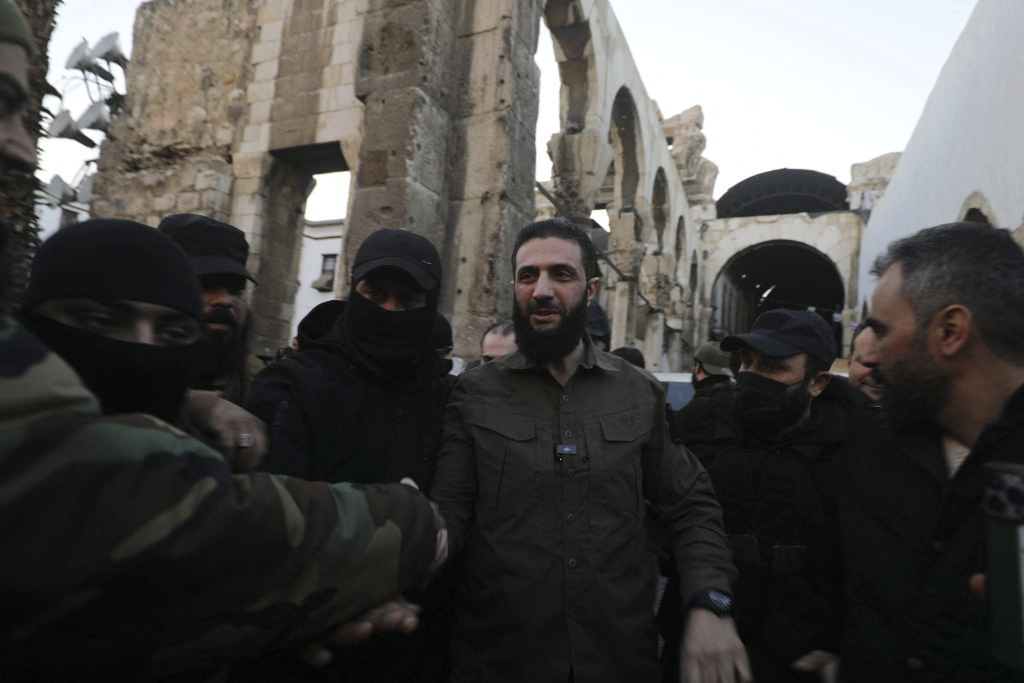
Recent footage from Aleppo and other parts of Syria should serve as a wake-up call to anyone in Washington and European capitals still clinging to the illusion of a “moderate” new Syria under President Ahmed al-Sharaa. Pictured: Al-Sharaa is greeted by jihadists at the Umayyad Mosque in Damascus on December 8, 2024. (Photo by Abdulaziz Ketaz/AFP via Getty Images)
Let’s do more than hope, let’s fervently pray that our president, our Congress, our people finally wake up to the reality and truth of what the “New Syria,” Ahmed al-Sharaa, Mohammad Bagher Ghalibaf, Iran, and all of Islam really are and stop being deceived, pretending, working as if they and Islam can somehow assimilate and fit into Western beliefs and values.
Not going to happen.
Unless what is known is altered to the degree, and the people so put upon by world conditions, that a new order is created, wherein a one-world religion, a one-world government is instituted.
Ahh, that could happen. Will happen. Is well on its way to becoming reality, as so many forces in this lost, lying world have worked towards that end for so long.
Only then.
Which is swiftly working to become the world’s now.
True faithful born again believers won’t be here to see it. Thankfully.
Read on…
Ken Pullen, Monday, April 6th, 2026
The ‘New Syria’: Same Old Jihad
Why the US Should Not Trust Syria’s Ahmed al-Sharaa (or Iran’s Mohammad Bagher Ghalibaf)
Recent footage from Aleppo and other parts of Syria should serve as a wake-up call to anyone in Washington and European capitals still clinging to the illusion of a “moderate” new Syria under President Ahmed al-Sharaa.
In the video, soldiers from Brigade 60, a unit affiliated with the Syrian Army, are seen chanting slogans that openly threaten Israel: “O my enemy [Israel], I’m coming after you!”
The message is neither subtle nor ambiguous: the struggle of the soldiers does not end inside Syria’s borders. It extends to Israel and, by implication, to its allies, especially the U.S.
This is not the language of moderation. It is the language of jihad (holy war).
For months, some Western officials, including U.S. President Donald J. Trump, have expressed optimism about Syria’s new leadership under al-Sharaa. Last year, Trump described al-Sharaa as an “attractive, tough guy.”
The argument goes that Syria has entered a new phase, that its leadership has evolved, become more pragmatic, and is ready to engage constructively with the international community.
Such assessments, however, are dangerously detached from reality. They ignore a central, deeply troubling fact: al-Sharaa’s past is not merely controversial. It is steeped in jihadist militancy.
Before attempting to rebrand himself as a statesman, al-Sharaa was known as Abu Mohammed al-Jolani, the longtime leader of Jabhat al-Nusra, al-Qaeda’s branch in Syria. Under his leadership, the group pledged allegiance to al-Qaeda and played a central role in Syria’s jihadist insurgency.
Al-Sharaa’s network later evolved into Hayat Tahrir al-Sham, a dominant force in parts of Syria that has continued to espouse Islamist governance and maintain authoritarian control. While as president of Syria, al-Sharaa has sought to present a more pragmatic face to the outside world, his regime’s roots remain firmly anchored in jihadist ideology. Rebranding is not the same as reform.
Against this backdrop, the chants from Brigade 60 are not surprising. They are consistent with the ideological environment that figures as al-Sharaa has cultivated over many years.
The chants of the Syrian soldiers are not an isolated incident. Instead, they reflect a deeper ideological current running through Syria and other Arab and Islamic countries. This is an ideology that glorifies confrontation with Israel, romanticizes armed struggle, and frames regional conflicts through a jihadist lens.
Recently, several demonstrations took place across parts of Syria in which participants voiced support for Hamas, called for jihad, and threatened Israel.
“Millions of martyrs are marching to Jerusalem,” chanted the spokesman for the Syrian Ministry of Interior, Nour al-Dina al-Baba, who led one of the anti-Israel demonstrations.
These rallies, whether spontaneous or tolerated, offer further evidence that the ideological climate inside “new Syria” remains deeply hostile, radicalized, and shaped by Islamist narratives: the use of Islam to justify intolerant, extremist governance; military conflict; glorification of jihad as armed struggle — not just “spiritual striving” or promoting the idea that Muslims must unite against perceived enemies such as Israel and the West — and the legitimization of terror groups such as Hamas, Hezbollah, Palestinian Islamic Jihad, and the Houthis, including proxies led by Iran’s regime.
It is crucial to understand what the anti-Israel demonstrations mean. Soldiers and tens of thousands of people do not chant such slogans unless these ideas are supported, if not encouraged, by their leaders.
That such rhetoric and massacres (here, here, and here) openly take place within formal military units as well as among many Syrians indicates that extremist thinking remains deeply embedded in the system al-Sharaa leads.
This should alarm not only Israel but also the U.S. and its allies.
For Israel, the implications are immediate and clear. A Syrian army infused with jihadist ideology represents a direct and growing threat along Israel’s northeastern border. The chants from the streets of Syria are not mere words; they are a declaration of intent.
The danger, however, does not stop there.
History has shown repeatedly that regimes or movements (such as Iran, Hamas, and Hezbollah) that adopt jihadist rhetoric rarely confine their ambitions to one front. Anti-Israel incitement often goes hand in hand with broader hostility toward the West.
Today it may be chants about the Gaza Strip; tomorrow it could be threats against American interests in the region.
That is why the West must resist the temptation to embrace the narrative of a “new Syria” without new rigorous scrutiny.
There is a recurring pattern in Western policy toward the Middle East: the tendency to mistake tactical shifts for genuine ideological transformation. Leaders rebrand themselves, adopt more polished rhetoric and wardrobe, and present a moderate face to the outside world, while the underlying worldview remains unchanged.
The result is predictable. Western governments lower their guards, offer diplomatic recognition or economic incentives, and hope engagement will produce more moderation.
In the instance of al-Sharaa, the early signs are already troubling. The chants from the Syrian soldiers and the recent public demonstrations suggest that the new regime has either failed to purge extremist elements from its ranks or has chosen, tacitly or not, to back them. Neither explanation inspires confidence. If anything, it suggests continuity, not change.
The West seriously needs to approach the Syrian leadership with caution. Engagement should be conditional, measured, and based on verifiable actions, not “assurances” or wishful thinking.
At a minimum, al-Sharaa needs to demonstrate a clear commitment to restraining extremist elements inside Syria and ending incitement against Israel. Until then, the talk about a “moderate” Syria — or, for that matter, a “new, moderate” Iran under Speaker of the Parliament Mohammad Bagher Ghalibaf — is premature at best and dangerous at worst.
The scenes from Syria — and the current intransigence from both Iran and Hamas — are not aberrations. They are a glimpse into the true nature of the forces now shaping the future of Syria, Gaza and Iran — a future the Trump Administration and the West need to view with skeptical open eyes, not illusions.
Khaled Abu Toameh is an award-winning journalist based in Jerusalem.






Leave A Comment
You must be logged in to post a comment.