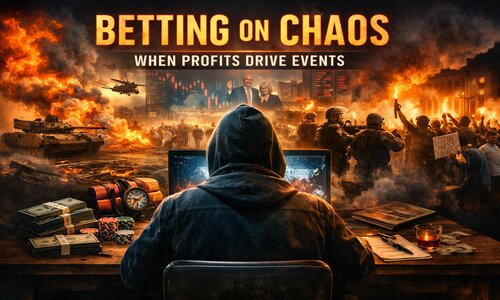
Currently, there are 4,900 online betting companies worldwide. That does not include the number of online betting websites. For example, in 2006 — 20 years ago — 465 betting companies operated over 2,500 different gambling websites. That number has escalated more than gasoline prices have in California since yesterday! Or the price of eggs…or…
We’ve become so diseased within, so lost, so dark, so immoral, so decadent, so corrupt, of such reprobate — wicked, unrighteous minds — and so numb and greedy, so bored with life we are now betting on wars, election outcomes, political resignations, death, you name it. Soon, it’ll include assassinations and every perversion and evil under the sun.
Place your bets! See if you’re a winner in this losing of soul, spirit, hope, humanity, ethics, morals, and knowing, doing what is right — while you may win some money betting on who will win or lose a war, who will win or lose an election — and the number of bettors will determine the outcome.
Imagine that.
Because none of the gambling worldwide is legitimate. Oddsmakers are oddsmakers for a reason. The odds can and do determine outcomes. Don’t be deceived or naive. Gambling is not on the up and up no matter what is said. Think about it.
All gambling with their eternities.
Hundreds of billions of dollars — HUNDREDS OF BILLIONS OF DOLLARS are involved. You know how people are about money, right?
Read on…
Ken Pullen, Monday, March 30th, 2026
Dangers Of Event Manipulation As Trading On Everything Becomes Reality
March 30, 2026
By PNW Staff
Reprinted from Prophecy News Watch
We are entering an era where more and more of real life can be turned into a tradable event — war, political collapse, resignations, sanctions, unrest, military strikes, economic panic, leadership changes, and national emergencies. Not every platform allows the most explicit forms of betting on violence or death. Some do impose restrictions. But that should not reassure anyone too much.
Because the real danger is not just what can be bet on directly.
It is what can be financially incentivized indirectly.
And once enough money is attached to fragile events, the temptation is no longer only to predict what happens next.
It becomes the temptation to help make it happen.
That is a very different kind of threat. And if society keeps normalizing this trend, it will not just create a new class of speculators. It could create a new class of people who see crisis, instability, and even bloodshed as opportunities to engineer profit.
That is not a small ethical concern.
That is a civilizational warning sign.
Most people hear about prediction markets or political betting and think first of the obvious danger: insider trading. That concern is completely legitimate. If someone has advance access to military plans, government decisions, criminal investigations, election strategy, or corporate actions, and then uses that information to place bets before the public knows, that is corruption in one of its purest forms.
It is not clever.
It is not innovation.
It is monetized secrecy.
And there is already enough suspicious behavior surrounding some of these markets to make it impossible to dismiss the concern. Strange timing. Unusually well-placed trades. Massive wagers appearing before major geopolitical developments. Patterns that make ordinary people wonder whether some traders are simply lucky — or whether they are seeing things the public cannot.
That alone is serious.
But it may not even be the worst part.
Because the more dangerous issue is not just insider information.
It is event manipulation.
That is where this story becomes much darker.
Even if a platform does not allow a blunt market asking whether a leader will be assassinated or whether a terrorist attack will occur, it may still allow markets built around adjacent outcomes: whether a leader will be removed from office, whether a ceasefire will collapse, whether a military strike will happen before a certain date, whether a government will fall, whether a national emergency will be declared, or whether unrest will spread.
That distinction may satisfy lawyers.
But it does not remove the moral hazard.
Because if someone can make a fortune when a fragile event breaks one way instead of another, then suddenly there is a financial incentive attached to instability itself.
And that changes human behavior.
If a person stands to gain millions from a war expanding, what might they be tempted to leak, provoke, distort, or encourage?
If someone is heavily positioned on whether a politician resigns or is forced out, what kinds of pressure, blackmail, rumor campaigns, or manufactured scandals become more attractive?
If a market pays out on whether a ceasefire collapses, how long before bad actors begin seeing diplomacy not as a goal — but as an obstacle to their trade?
If contracts can be built around unrest, sanctions, panic, shortages, or political upheaval, then suddenly disorder itself starts acquiring a market value.
That is where this becomes poisonous.
Because a system like this does not merely reward foresight.
It can begin rewarding sabotage.
That is not an exaggeration. It is how incentives work.
For years, society has understood that money can corrupt sports. We have seen point-shaving scandals, fixed outcomes, manipulated officiating, and players willing to compromise integrity when enough cash was on the table. Why? Because whenever an event becomes financially valuable, pressure builds around the event itself.
Now take that same corrupting principle and apply it not to a basketball game — but to an election.
Or a war.
Or a leadership crisis.
Or a public panic.
Or a geopolitical standoff between nuclear powers.
That is what makes this new world so dangerous. It extends the logic of gambling and speculative finance into areas that are not supposed to be turned into monetized entertainment or tradable opportunities.
And the pool of people who could be tempted by that incentive is much larger than most people realize.
It is not just spies and generals.
It could be campaign staffers. Bureaucrats. Corporate insiders. Political operatives. Contractors. Journalists. Social media manipulators. Hackers. Activists. Ideologues. Foreign intelligence assets. Anonymous online networks. Disgruntled insiders. Opportunists with access.
In a world where almost any major event can be transformed into a contract, anyone with proximity to disruption becomes a potential participant in a market-driven incentive structure.
A leaked memo can become a payday.
A strategic rumor can become a payday.
A manipulated video can become a payday.
A hacked email can become a payday.
A delayed statement can become a payday.
A staged incident can become a payday.
A panic-triggering lie can become a payday.
That is not healthy market innovation.
That is moral decay with a price chart.
And perhaps the most disturbing part is how casually all of this is being discussed in some circles. It is often framed as just another frontier of information efficiency — a smarter way to forecast the future, aggregate sentiment, or price probabilities.
That sounds sophisticated.
But it misses the central danger completely.
There is a major difference between observing reality and financially incentivizing its collapse.
A thermometer measures a fever.
It does not create one.
But if enough people can get rich when the fever gets worse, eventually some of them will be tempted to spread the infection.
That is the problem.
Markets are not morally neutral when they begin placing cash rewards on instability. They shape behavior. They influence what people tolerate. They create incentives that did not exist before. And when enough money is involved, those incentives do not stay theoretical for long.
That is why this issue cannot be dismissed as merely a niche concern for finance people, crypto traders, or online gamblers. It is much bigger than that.
This is about whether society is willing to allow war, collapse, unrest, and political breakdown to become just another speculative asset class.
It is about whether we are comfortable living in a world where some people do not merely fear disaster — but quietly need it.
That is the road we are drifting toward.
And if we do not draw clearer moral and legal lines, we may eventually discover that the most dangerous thing about betting on major events was never just that some people could profit from knowing what would happen next.
It was that sooner or later, some people would decide they would rather be the reason it happened.








Leave A Comment
You must be logged in to post a comment.