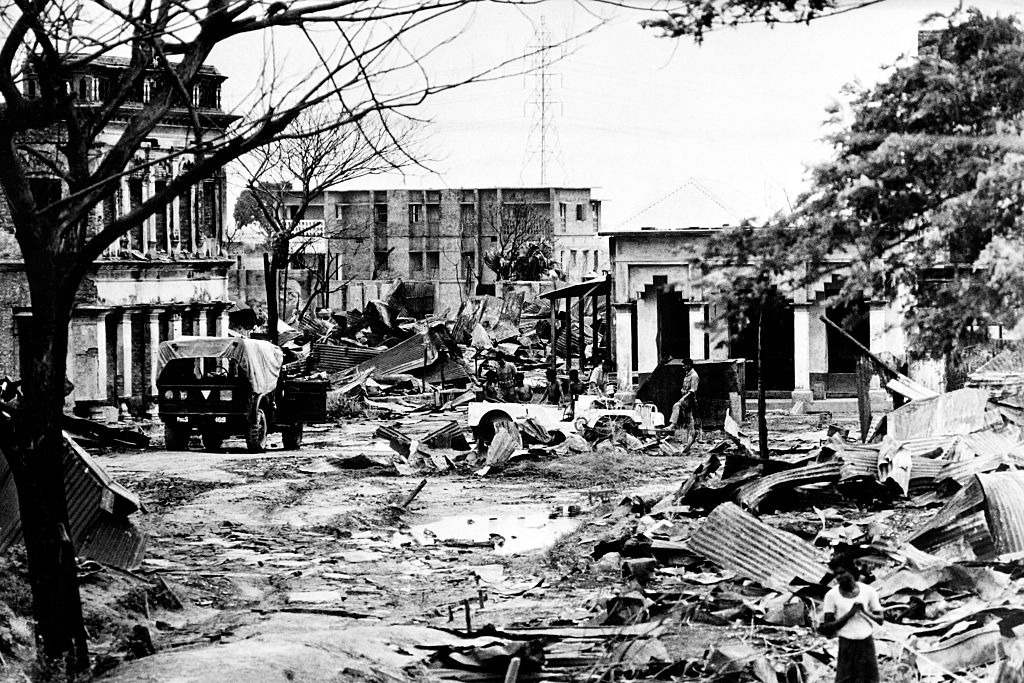
Pictured: The destroyed streets of Madhabpur, Bangladesh, during the war of liberation, on July 24, 1971. (Photo by TT News Agency/AFP via Getty Images)
World leaders, including those in America, are utterly blind to the truth, the reality of what Islam is. Proof of this has been put in front of every person’s view, ears to see and hear fr decades, as Islam grows and the way to truly deal with it wanes.
Islam is not another world religion. The whole mosque, appearance of serving a god, of holiness is a lie, a sham, a great deception, the overwhelming majority of people have fallen for, and every world leader has fallen for.
Islam is a worldwide geopolitical evil entity serving Satan with its sole intention of world domination, of destroying Israel — in the deluded thinking that no Israel, no fulfillment of Jewish and Christian Holy Bible, return of Jesus Christ to subdue the nations, and to be King of kings, Lord of lords to rule the earth for 1,000 years from David’s throne, before dissolving all that has been known and creating a new heaven, a new earth, a New Jerusalem for eternity.
World leaders fail to grasp this. As do most people.
Sad, that, isn’t it?
Well, what are you going to do as an individual with such knowledge? We can’t save the world or alter Bible prophecy. There is a Great Falling Away. The rise of false teachers, ravenous wolves entered in.
For certain men have crept in unnoticed, who long ago were marked out for this condemnation, ungodly men, who turn the grace of our God into lewdness and deny the only Lord God and our Lord Jesus Christ.
Jude 1:4
There will be the Rapture of the church. Jesus is coming back. There will be an Ezekiel 38, 39 war. There will be A Great Seven-Year Tribulation, there will be an Antichrist and false prophet to hold the people of the world in bondage to worhsip The Beast, there will be an Armageddon, and there will be the Second Coming.
But what are you going to do about your eternity?
That is the most important question, detail, thing to think deeply on this day.
Read on…
Ken Pullen, Monday, March 30th, 2026
U.S. Congress Confronts Bangladesh Genocide—But Ignores the Islamist Infrastructure Behind It
In a welcome moment of moral clarity, the United States Congress took a step toward acknowledging one of the most underreported genocides of the twentieth century. On March 20, 2026, U.S. Rep. Greg Landsman introduced House Resolution 1130, which recognizes the 1971 atrocities in Bangladesh as genocide, war crimes, and crimes against humanity. Washington, Beijing, most Arab nations — as well as Palestinian leaders Yasser Arafat and Amin al-Husseini — vehemently opposed Bangladesh’s secession from Pakistan in 1971, branding the war of liberation as a “battle between Pakistani Muslims and Bengali Hindus” and comparing it to the Israel-Arab conflict.
The House resolution, which has been referred to the Committee on Foreign Affairs, recalls the events of March 25, 1971, when Pakistan’s military launched “Operation Searchlight”, a coordinated campaign of mass murder targeting civilians in East Pakistan. Bengali Hindus, intellectuals, and pro-independence activists were systematically hunted down. Sheikh Mujibur Rahman was arrested, and a campaign of violence began that would kill millions of Bangladeshis.
Although the resolution calls upon the U.S. president to recognize the atrocities committed in 1971 against ethnic Bengali Hindus by Pakistan’s army and their allies in the Islamist Jamaat-e-Islami (JI) movement as crimes against humanity, war crimes, and genocide, it remains unclear whether the U.S. will designate Jamaat-e-Islami as a Foreign Terrorist Organization for committing such atrocities.
For decades, this genocide remained politically inconvenient. During the Cold War, Pakistan’s strategic importance shielded it from accountability, while Islamist narratives distorted the truth — portraying the conflict as a religious struggle rather than a national liberation movement.
Now, more than 50 years later, Washington appears ready to correct the historical record. But recognition alone is not enough. The central flaw in Washington’s current approach is its failure to confront the ideological and organizational infrastructure that enabled the genocide in the first place.
At the core of that infrastructure is Jamaat-e-Islami, which actively collaborated with Pakistani forces in 1971. Its militias participated directly in the mass murders, particularly targeting minority communities. Its ideology — rooted in the writings of its founder Abul Ala Mawdudi — provides religious justification for violence in pursuit of a theocratic political order. This ideology has not disappeared.
Today, Jamaat-e-Islami and its affiliates continue to operate across multiple countries, often under the guise of charitable, educational, or advocacy organizations. In some instances, these entities have been linked to extremist financing networks and the promotion of radical indoctrination.
In 2019, South Asia expert Seth Oldmixon highlighted the role of Jamaat-e-Islami in promoting and exporting religious extremism and terrorism on a global scale. He noted the enduring legacy of Mawdudi, and warned of the dangers of ignoring the activities of JI and its affiliates in North America.
“Jamaat-e-Islami’s guiding ideology and its goal of establishing a global theocracy have not changed from Mawdudi’s original vision,” Oldmixon said. He further noted continued calls for jihad by senior JI leaders, as well as ongoing violence by JI and its affiliates.
JI’s commitment to extremism is clear from its public rhetoric. Oldmixon pointed out that in 2012, a senior Pakistani JI official said: “I salute the Afghan Taliban. They have defeated America and have destroyed NATO”.
On November 1, 2019, U.S. Senator Jim Banks (R-IN), and U.S. Reps. Chuck Fleischmann (R-TN) and Randy Weber (R-TX) wrote to State Department Counterterrorism Coordinator Nathan Sales, presenting substantial evidence of terror-financing links between JI and its affiliates — Helping Hands for Relief and Development (HHRD) and the Islamic Circle of North America (ICNA).
In a 2010 report, the Investigative Project on Terrorism wrote:
“The Islamic Circle of North America (ICNA), a leading ‘domestic affiliate’ of the South Asian Sunni revivalist movement Jamaat-e-Islami (JI), was established in 1968 and formally incorporated in 1987 in Jamaica, N.Y. An introductory brochure states ICNA’s goal is ‘[t]o achieve the pleasure of Allah through the establishment of the Islamic system in this land.'”
Despite mounting evidence and longstanding concerns, the United States has not designated Jamaat-e-Islami as a terrorist organization.
Policy experts have long warned that Jamaat functions as part of a broader Islamist ecosystem connected to the Muslim Brotherhood — a network that historically has served as a radical incubator for groups such as Hamas, Al Qaeda, and others.
Internal documents, congressional inquiries, and independent reports have repeatedly highlighted concerns about affiliated organizations operating in North America. These apprehensions include allegations of financial links to extremist causes and the dissemination of radical ideological material. Yet, apparently due to the influence of Islamists in various walks of life in the U.S., enforcement remains selective, and political considerations still seem to override security imperatives.
The Muslim Brotherhood’s expansion continues under various fronts and affiliated entities. Despite growing concerns, these organizations or their affiliates continue to operate in many countries, including the United Kingdom. A December 17, 2015 report by the U.K. House of Commons noted that the Muslim Brotherhood had developed an extensive international network and was using Europe as a key base for its global activities.
Calling for the designation of Jamaat-e-Islami as a Foreign Terrorist Organization, analyst Michael Rubin has argued:
“Just as the Muslim Brotherhood spawned terrorist groups such as Hamas, Gama’a Islamiyya (which killed Egyptian President Anwar Sadat), and al Qaeda, Jamaat-e-Islami also spun off terrorist groups across South Asia such as Jaysh-i-Muhammad, Harkat-ul-Mujahidin, and Tehrik-i-Taliban Pakistan.
“Within Bangladesh, Jamaat-e-Islami was particularly brutal. It was intimately involved in the 1971 Bangladesh genocide that killed up to 3 million. For this reason, many Bangladeshis consider Jamaat-e-Islami members to be war criminals. Indeed, Jamaat-e-Islami became just the second political party after Adolf Hitler’s Nazi Party to face an international tribunal for its crimes. Nevertheless, Jamaat-e-Islami still receives active support from Pakistan’s Inter-Services Intelligence agency, the same group that helped hide al Qaeda leader Osama Bin Laden and sponsored the Taliban insurgency.”
While Washington acknowledges the crimes of 1971, it continues to tolerate — and sometimes even engage with — entities that share the same ideological foundations that made these jihadi crimes possible.
After recent political upheavals, means of accountability, such as the International Crimes Tribunal established by Bangladesh, have been significantly weakened. Charges against individuals linked to the 1971 atrocities have been dropped, and institutions originally established to deliver justice have faced allegations of politicization and misuse. This reversal not only undermines justice but also emboldens those who seek to revive violent ideologies.
The lesson of 1971 is clear: ignoring Islamist extremism only allows it to adapt, evolve, and re-emerge in new and often more sophisticated forms. If the United States is serious about confronting terrorism, it requires designating organizations with documented links to extremist activities, dismantling financial networks that sustain them, and challenging ideological narratives that legitimize violence. It also requires a willingness to confront uncomfortable truths — both about past alliances and present-day policy inconsistencies.
The introduction of HR-1130 is an opportunity — perhaps a last opportunity — to prioritize the victims of genocide but also the forces that made such crimes possible. Without such an alignment, the resolution risks becoming what so many similar initiatives have become: a statement of principle detached from any meaningful policy action. History has already demonstrated the cost of such dismissal. The question now is whether Washington is prepared to learn from it.
The author is an award-winning journalist, writer, and editor of the newspaper Blitz. He is a recipient of PEN USA Freedom to Write Award 2005; AJC Moral Courage Award 2006 and the Monaco Media Award, 2007. He specializes in counterterrorism and regional geopolitics. Follow him on X: @Salah_Shoaib






Leave A Comment
You must be logged in to post a comment.