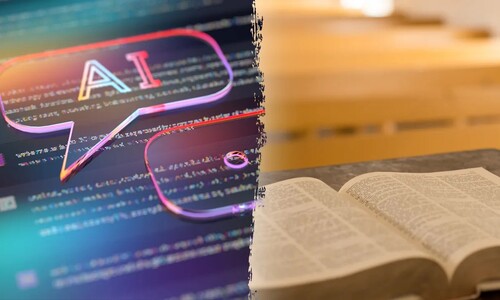
The Word of God vs. the word of man. These are the times in which we live. Always been this way, right? No, not like this.
What do you believe AI to be? Too many imagine it as an independent brain that is infallible and fast. Not knowing AI is nothing more, at this point, than an insatible energy consuming processor able to spit out what it does solely with what it has been fed by man to store. Now, if the greater weight of material were genuinely true, honest, upright, and just plain good information, put in the concern among many would not exist. Concern would only be among a few, who generally are disproportionately concerned about everything, not knowing how to relax.
The problem and genuine concern exist because what God has said is 100% spot on accurate and true.
Then the Lord saw that the wickedness of man was great on the earth, and that every intent of the thoughts of his heart was only evil continually.
Genesis 6:5
“The heart is more deceitful than all else
And is desperately sick;
Who can understand it?
Jeremiah 17:9
And He was saying, “That which proceeds out of the man, that is what defiles the man. For from within, out of the heart of men, proceed the evil thoughts, fornications, thefts, murders, adulteries, deeds of coveting and wickedness, as well as deceit, sensuality, envy, slander, pride and foolishness.read more.
All these evil things proceed from within and defile the man.”
Mark 7:20-23
Human nature has never changed. There are no “good people” and “bad people.” We all fall short of the mark; we’re all sinners destined for hell, eternal condemnation for our rebellion, until and unless we come out of our stupor and recognize this truth, recognize Jesus as God, as the only possible Savior, the only possible way out of our condemned condition to have our sin forgiven. To be washed clean in the blood of Jesus Christ, Yeshua Hamashiac.
Our hearts are wicked. Our thoughts are wicked. So, the overwhelming majority of what is fed to AI, and AI has a voracious appetite and eats whatever it’s fed. What is digested by AI to be spit out upon demand is based on the words of man. Not the Word of God as its foundation.
Can AI be used for good? Certainly, technology in and of itself is benign. It’s what the inherently wicked hearts and minds of men do with it. Certain technology can clearly be seen for its wickedness. Beware, be very careful. Test what is received. Everything. Because right now in AI development, we cannot believe or trust what is seen or heard.
Such is our time.
Unlike any other in world history.
These are words apropos for any worldly person. They might not agree with or like these words, but that does not take away from the reality that they are the truth.
These are words especially directed to and important for the professed believer in the LORD Jesus Christ.
Not my words. What is in God’s Word.
For such a time as this…when it is daily, nightly, continually now God vs. the machine. God’s words vs. the words of man. As so many sit idle, silent, going through the motions. Allowing the machine and the weakness of certain men’s minds and character to become strong and considered knowledge.
Imagine that.
Read on…
Ken Pullen, Friday, February 27, 2026
Trading The Pulpit For The Prompt: A Dangerous New Trust
February 28, 2026
By PNW Staff
Reprinted from Prophecy News Watch
A quiet but profound shift is underway in the spiritual lives of Americans–and it should command the attention of every believer, pastor, and parent. In an age once defined by pulpits and Scripture, a growing number of people are now turning to algorithms for answers about God, morality, and truth. What was once the realm of prayer and pastoral counsel is increasingly being outsourced to machines. And according to new research, this isn’t speculation–it’s measurable reality.
A recent study conducted by the Barna Group in partnership with Gloo, reveals a startling statistic: about one-third of practicing Christians now say spiritual advice from artificial intelligence is as trustworthy as guidance from a pastor. Among practicing believers specifically, that number climbs to 34%. Even more striking, younger generations show higher openness to AI as a spiritual source, suggesting this trend is not fading–it’s accelerating.
The survey of more than 1,500 U.S. adults also found that four in ten Christians say AI has already helped them with prayer, Bible study, or spiritual growth. Meanwhile, more than 41% of Protestant pastors report using AI tools to assist with sermon or study preparation. This paints a picture not of resistance, but of rapid adoption across the Christian landscape. As Barna’s vice president of research, Daniel Copeland, observed, there is “a real opportunity” for pastors to disciple congregations on how to use AI beneficially. But that statement carries an unspoken warning: if the Church does not teach discernment, technology will.
At the same time, trust in pastors has quietly eroded. Multiple recent surveys from various research organizations have shown declining confidence in clergy, often tied to cultural polarization, scandals, or perceived irrelevance. Into that vacuum steps AI–calm, articulate, immediate, and seemingly impartial. Unlike human leaders, it never stumbles over words, never shows fatigue, and always has an answer ready. For many users, that consistency feels like credibility.
But that perception hides a crucial truth: artificial intelligence is not neutral. It does not think independently, and it certainly does not possess divine wisdom. AI systems are trained on vast datasets compiled from human-produced material–books, articles, websites, forums, and social commentary. In other words, they are shaped by the collective worldview of the internet. And the internet, as every Christian knows, is not a theological authority.
Algorithms are designed by people. Training data is selected by people. Filters, safeguards, and response boundaries are written by people. That means AI inevitably reflects the assumptions, biases, and philosophical frameworks of its creators and its source material. When it speaks about morality, identity, truth, or faith, it is not drawing from eternal revelation; it is synthesizing patterns from human opinion. That distinction is not technical–it is theological.
Scripture warns repeatedly about confusing human wisdom with divine truth. Proverbs cautions believers not to lean on their own understanding. Colossians warns against being taken captive by hollow philosophies. Yet today, many are placing unprecedented confidence in systems that literally operate by pattern recognition rather than spiritual revelation. The danger is not that AI exists; tools have always existed. The danger is misplaced trust.
There is also a deeper spiritual risk: convenience can dull discernment. Searching Scripture requires patience, humility, and prayer. Wrestling with difficult passages refines faith. Seeking counsel from wise believers builds community. But typing a question into a machine and receiving an instant answer requires none of those disciplines. The very ease that makes AI appealing can quietly train hearts away from the slow, sanctifying work of pursuing God directly.
None of this means technology must be rejected. Like printing presses, radio broadcasts, and Bible apps before it, AI can serve the Kingdom when used wisely. It can help organize research, summarize commentary, or assist study. The issue is not whether Christians use AI; it is whether they trust it. A tool can assist faith, but it must never replace revelation, conviction, or Scripture itself.
The Bible–not a chatbot, not a search engine, not a predictive model–remains the believer’s final authority. Machines may generate sentences, but only God’s Word generates life. No algorithm was crucified for our sins. No dataset rose from the grave. And no artificial system can replace the living voice of the Holy Spirit speaking through Scripture.
This cultural moment demands spiritual vigilance. The Church must not merely react to technological change; it must disciple believers within it. Christians should test every insight, digital or human, against the unchanging truth of God’s Word. Because in an age of intelligent machines, the greatest danger is not artificial intelligence itself–it is authentic faith slowly being replaced by artificial conviction.
The path forward is clear, timeless, and urgent: open the Bible, seek the Lord, and measure every voice–silicon or human–against the eternal truth that never changes.










Leave A Comment
You must be logged in to post a comment.