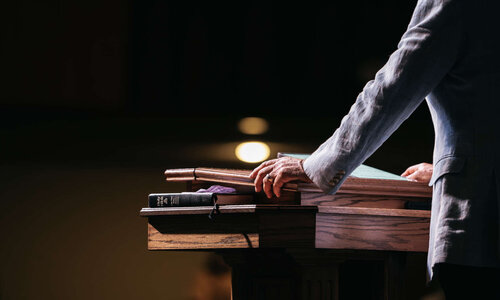
Could it be that many of those claiming to be “called” actually are not? For all the claims they “heard God” tell them they needed to be a pastor, they were “called,” it is clear that much of this is their will be done and not God’s will be done.
How many are truly born again? How many truly know and believe every word within the Word of God?
It would behoove everyone to take some time — it doesn’t take much — to learn what is taught in seminaries, Bible colleges, theology schools, and what is believed by the overwhelming majority graduating from those institutions.
The church is rife, pulpits chock full of weak, unbelieving, not truly born again men, and now women, which goes directly against Scripture. Pulpits occupied by homosexuals, those who refute the existence of hell, the virgin birth, the resurrection of the LORD! And that’s just for a start.
Need a sign that there is little time remaining for this world as it has been? Just look to the church! Look and listen to what is coming from pulpits.
Time for gathering together in true fellowship in the true whole Word of God. With likeminded fsaithful born again beleivers in everything in the Holy Bible. Even if this means praying, asking humbly, how do we start a home church? Or LORD lead me to a REAL church, even if I have to drive an hour or more from home. But stop going on autopilot to the profane, the inane, the false where the pulpit has someone standing up their giving a self-help feel good motivational talk that has nothing to do with taking up one’s cross and following Jesus, nothing to do with growing, being fed, maturing in the faith in the LORD Jesus Christ, nothing given for true Biblical spiritual food for the week only appealing to the weak!
Maybe the majority who claim to have been “called” into the ministry to pastor ought to be honest and fess up as to why they really got into being a pastor, because the evidence betrays their claims.
We live in the time of the Great Falling Away.
We live in the time of the Great Apostasy.
We live in the time of Ravenous Wolves entering in among all the ticklish ears.
We live in the time of Jude 1:4.
We live in the time of Romans 1.
We live in the time of 2 Timothy 4:1-5.
Read on…
Ken Pullen, Thursday, February 19th, 2026
The Pulpit Trust Crisis: Why Americans Are Losing Faith In Clergy
February 19, 2026
By PNW Staff
Reprinted from Prophecy News Watch
Every week it seems another pastor or prominent spiritual leader is splashed across headlines for sexual immorality, abuse, or moral hypocrisy. The pattern has become so tragically familiar that many believers no longer react with shock–but with a weary sigh. What was once unthinkable has become expected. And now the data confirms what the headlines have been whispering for years: public trust in clergy is collapsing.
A new survey from Gallup reveals that only 27% of Americans rate clergy as “high” or “very high” in honesty and ethics–the lowest level recorded in the organization’s half-century of tracking public perception. As recently as 2013, nearly half of Americans still viewed clergy as ethically trustworthy. Before 1999, pastors and pharmacists routinely ranked among the most trusted professions in the nation. Today, that moral credibility has eroded so severely that clergy now sit closer to the bottom tier of trusted professions than the top.
This collapse did not happen overnight. It came drip by drip–scandal by scandal, cover-up by cover-up, apology by apology. The public has watched story after story unfold: leaders preaching purity while living double lives, churches silencing victims to “protect the ministry,” and institutions prioritizing reputation over repentance. Each incident chips away at trust not only in individual leaders, but in the office of spiritual leadership itself.
Another study reinforces this sobering trend. Research from Barna Group found that fewer than half of American adults consider pastors “very reliable” for spiritual guidance, and only 23% of adults say pastors are definitely trustworthy sources of wisdom. Among non-Christians, that number plunges to 4%–essentially statistical collapse. Even among Christians, confidence reaches only 31%, hardly a ringing endorsement from the very people clergy are called to shepherd.
The generational implications may be even more alarming. Barna’s 2025 State of the Church study, conducted with Gloo, shows that younger Americans increasingly hesitate to trust church leaders at all. Only 28% of Gen Z adults say pastors are their most trusted source for spiritual questions. More trust their mothers (34%), and even more trust the Bible itself (39%). Among teenagers, family guidance eclipses clergy influence entirely, with 53% turning first to their mothers for spiritual direction.
In one sense, that shift reflects something healthy: Scripture and family should never be replaced by clergy authority. But the broader pattern signals a crisis. When shepherds lose credibility, sheep scatter. When spiritual authority is distrusted, discipleship weakens. When moral leaders fall publicly, faith itself is questioned privately.
The consequences extend far beyond church attendance numbers. A culture that stops trusting spiritual leadership often stops listening to moral guidance altogether. That vacuum rarely stays empty. It gets filled by influencers, algorithms, celebrities, or ideologies with no accountability and no grounding in timeless truth. Distrust in clergy can quietly become distrust in faith itself.
Yet the proper response is not denial–it is reform.
Churches must stop pretending scandals are rare anomalies and start treating them as serious threats requiring real safeguards. Healthy ministries now implement accountability structures: independent oversight boards, transparent financial systems, mandatory reporting policies, counseling requirements, and shared leadership models that prevent any single personality from becoming untouchable. These safeguards are not signs of distrust; they are signs of wisdom. Scripture itself warns that leaders will be judged more strictly. Oversight is not a lack of faith–it is obedience.
Equally important is how churches respond when sin does occur. Cover-ups destroy more trust than the original wrongdoing. History shows that congregations are often willing to forgive fallen leaders who repent honestly–but they rarely forgive institutions that lie. Transparency, confession, restitution, and cooperation with civil authorities are not public-relations strategies; they are moral obligations.
Still, amid this sobering landscape, believers must remember a vital truth: Christianity was never built on the perfection of its messengers. It was built on the perfection of the One they proclaim. Pastors are human. Priests are flawed. Ministers are fallible. Christ is not.
If faith rests on a personality, it will collapse when that personality falls. But if faith rests on Christ, it stands even when leaders fail. The tragedy of declining trust in clergy is real–but it should also serve as a spiritual recalibration. Our confidence was never meant to be in men with pulpits, titles, or platforms. It was meant to be in God.
The current crisis, painful as it is, may ultimately purify the church. Exposure can lead to repentance. Accountability can lead to integrity. Humility can lead to renewal. And perhaps, if churches choose honesty over image and holiness over hype, trust can slowly be rebuilt–not through marketing campaigns, but through lives that match the message.
Because in the end, the world is not longing for flawless pastors. It is longing for authentic ones.









Leave A Comment
You must be logged in to post a comment.