Many people are familiar with fiction novels such as Lolly Willowes, by Sylvia Townsend Warner, or The Picture of Dorian Gray, by Oscar Wilde, where an individual sells their soul to the devil. In the 20th and 21st century the world has sold its soul to the devil.
For the love of, the idolization of technology. Artificial Intelligence is the great seductress. Likely to be among the last inventions of man resulting from our ancestral parents disobeying God and eating from the Tree of Knowledge, changing everything from that day to this very minute.
All centered on self, perceived power, and control, quickly men and women learned the power of material wealth, and greed became insatiable. Never enough.
All due to that singular act a while ago in a perfect Garden in a perfect world — to the point of disobedience. And that sin is what brings about the end of all things as they have been and are known. It’s misguided thinking to cite the end due to a massive nuclear war, bioweapons, famine, pestilence, a new killer virus, and on and on. All those things, along with everything else, are merely symptoms of the chronic disease that kills each person born and has this world groaning under the weight and stench of man’s and woman’s sin.
Artificial Intelligence. That, along with the massive turning from God, a return to paganism, sorcery, idol worship of inanimate things — though the image of the beast which will be made by the Antichrist and his false prophet, in Revelation 13 is given what appears to be life. Given the power to breathe, speak, and recognize anyone who does not have the mark, the name of the Antichrist branded into their foreheads or right hands, so they can be singled out and killed. Can you say AI?
“He was granted power to give breath to the image of the beast, that the image of the beast should both speak and cause as many as would not worship the image of the beast to be killed.”
Revelation 13:15
And it’s in its infancy. Just beginning. But advancing more rapidly than man can keep up with it, or control it.
Imagine that.
The prince of the air, he who has dominion on this earth for a season, has a new thing to use to deceive more, enslave more people quicker and deeper than ever before, as most will not be able to discern what is real and what is not.
God is shortening the days. Because…
“And unless those days were shortened, no flesh would be saved; but for the elect’s sake those days will be shortened.”
Matthew 24:22
The birth pangs are increasing in frequency and intensity.
Best prepare. Now. Not later, as no one knows if they will have a later, or how long it will be until that moment appears.
Read on…
[Check out the RELATED links following the article below]
Ken Pullen, Wednesday, February 11th, 2026
How AI Is Rewriting Warfare, From Human Judgment To Algorithmic Execution
February 10, 2026
By PNW Staff
Reprinted from Prophecy News Watch
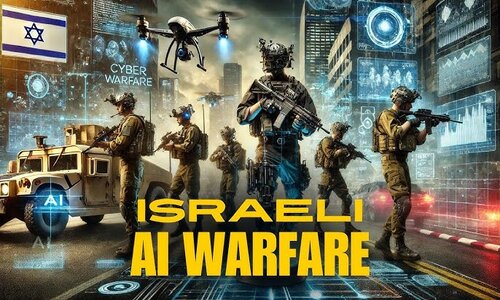
There is a quiet but profound transformation underway in modern warfare — one that may ultimately matter more than tanks, missiles, or even nuclear weapons. War is no longer simply being fought by humans with machines as tools. Increasingly, it is being executed by machines themselves, with humans drifting into the role of supervisors, validators, or spectators.
The battlefield is shifting from human judgment to algorithmic execution.
This change is not merely technological. It is philosophical. It challenges centuries of assumptions about command, accountability, and the moral weight of violence. And it is happening faster than most political leaders, ethicists, or citizens realize.
Why This Shift Is Inevitable
At its core, modern war has become a contest of speed, information, and complexity — domains where humans are at a permanent disadvantage.
A single contemporary battlefield can generate more data in an hour than a World War II commander saw in a lifetime: drone video, satellite imagery, electronic signals, thermal sensors, battlefield communications, cyber activity. Human cognition simply cannot keep up. Algorithms can.
Once militaries realized that victory increasingly depends on who can observe, decide, and act the fastest, the direction became unavoidable. AI does not get tired. It does not hesitate. It does not second-guess. It does not suffer fear — or mercy.
And in war, hesitation is often fatal.
At first, AI assisted humans. Then it recommended actions. Now, in many contexts, it executes them. Humans remain “in the loop” largely for legal and moral reasons — not because they are the most efficient decision-makers.
That distinction matters. Because when speed determines survival, anything that slows the loop becomes a liability.
Ukraine: The First Algorithmic War
The Ukraine-Russia conflict offers the clearest window yet into this future.
This war is not just being fought with artillery and infantry — it is being fought with machine vision, automated targeting, and autonomous systems operating at machine speed.
Drones now locate targets, evade jamming, navigate without GPS, and strike with minimal human guidance. Some systems select targets based on probability models — not certainty — calculating acceptable risk rather than moral judgment. Swarms of cheap drones overwhelm expensive defenses. Ground robots probe enemy positions where no soldier would survive.
What matters most is not individual heroism but system efficiency.
Ukraine, in particular, has embraced this reality out of necessity. Facing a larger adversary, it has turned to autonomy to conserve manpower and compress decision cycles. Russia, in turn, has adapted by automating defense, electronic warfare, and counter-drone responses. Each iteration pushes both sides further away from human-paced warfare.
This is not a glimpse of the future. It is the future — already underway.
Where This Is Going: War Without Pause
If current trends continue, tomorrow’s wars may look unsettlingly different.
1. Battles That Unfold Too Fast for Humans
Entire engagements may occur in seconds — too quickly for human commanders to meaningfully intervene. Algorithms will detect threats, allocate resources, strike, reassess, and strike again before a human can even comprehend the situation.
Humans won’t command these battles. They will authorize systems to fight them.
2. Autonomous Swarms as the New Infantry
Instead of soldiers advancing across terrain, swarms of autonomous drones and ground units will maneuver collectively — sacrificing individual units to achieve statistical success. Losses will be measured not in lives but in hardware attrition rates.
War becomes a math problem.
3. AI Commanders
Strategy itself may become algorithmic. AI systems could design campaigns, predict enemy behavior, optimize logistics, and continuously adapt plans in real time. Human leaders may retain symbolic authority while machines determine outcomes.
The uncomfortable truth: an AI strategist may eventually outperform the best human generals — not because it is wiser, but because it can simulate millions of possibilities instantly.
4. War Without Emotion — or Restraint
Machines do not feel horror at civilian casualties. They do not recoil from escalation. They execute parameters. If those parameters drift — or are intentionally loosened — violence can scale faster than human conscience can react.
This is where the danger lies.
Why This Actually Matters
The true risk of algorithmic warfare is not that machines will become evil. It is that war will become easier to start and harder to stop.
When leaders no longer risk their own citizens’ lives, political restraint erodes. When machines absorb the cost of combat, war becomes an optimization exercise rather than a moral crisis. When algorithms decide, responsibility diffuses — and accountability vanishes.
Who is guilty when an autonomous system makes a fatal error?
The programmer? The commander? The machine?
History has never answered that question — because history has never faced it.
The Line We Are Quietly Crossing
Human-led war was slow, imperfect, and brutal — but it was restrained by human limitation. Algorithmic war removes those brakes.
We are approaching a world where wars may be fought largely beyond human perception, driven by systems that value efficiency over meaning, probability over principle. Once crossed, that line will be nearly impossible to uncross.
The battlefield is no longer just a place.
It is becoming a process.
And increasingly, that process no longer belongs to us.
RELATED:
This Is How The World Will End. The Entire Book Of Revelation.
Artificial Intelligence and the Mind of God
Artificial Intelligence is the Illusion of a Soulless Society
The Machines Are Talking, And We’re Not Invited: Moltbook’s Dark Warning











Leave A Comment
You must be logged in to post a comment.