
A favorite of many, now that they are extinct, the T. rex. Wouldn’t be as popular if still roaming the earth.
I do hope you’ll read this preface and then the accompanying article; “Dinosaur fossils are not millions of years old: Dinosaur soft tissue, proteins, and DNA could not last millions of years. Therefore, they falsify claims that dinosaurs became extinct 66,000,000 years ago.”
Why is this here?
Well, if you happen to permit yourself to believe what the world teaches, even if professing to be a Christian, this is for you.
Or, if you’re a diehard evolutionist placing faith in one errant man’s flawed observations and conclusions drawn from those flawed observations, to be adopted by the world as fact, as gospel [though the theory has never been proved in over 167 years ago, and as science has advanced it proves each year further and further how that theory is flawed and errant], this is for you.
Or, if you know someone mired in dogma, misinformation, the out-and-out lies taught and accepted, and you’d like that person to see better, understand better, and want something to help them out, this is for you.
From the time of elementary school, being told something and adopting it without ever investigating if what you were told was true. Carrying the dung around in the gray matter for the remainder of one’s life.
What is amazing is the more educated the deeper in the dung one sinks, if sitting there with a textbook, a teacher, a professor, and just taking it all in. Without searching whether all that is being said holds water.
That’s wise? That’s intelligent? That’s using the good brain the Good LORD blessed with?
Hummm…
Seems to me that what was once considered fact, according to science, is constantly changing. Explained away as new developments, but never saying, “Ahh, what we said in the past is total rubbish, ahhh, and like, in a few years what we’re now saying is fact, well, ahhh, it’ll prove to be just more rubbish.”
Science, the mind of man, and the whims of man are constantly changing.
God, on the other hand, and His Word, are immutable.
Long before I was born of a new heart and mind, born again, I contended, even in my teens, that most of what people believed was accurate, true, was fact? Not because I’m smart. I just listened and watched, and thought why does everyone just believe this stuff unquestionably? No matter what they were being told in schools. You see, the teacher, the professor, at one time had their little backsides in the same desks I now occupied with my classmates, and they were being fed what their teacher…and so on and so on.
That’s the way to do it? Hummm…okay, how’s that worked out so far?
In fact, in many instances, the exact opposite was what was, is, truly true. Or if not the exact opposite, what was accepted and believed as fact was some neatly wrapped baloney people just swallowed. Automatically.
Could it be that when the giants were on earth, they consisted not only of the Nephilim, but also giant creatures? It’s more plausible than there was nothing. Then a massive explosion in space of nothing into something. Huge. That just happened to align in perfect orbit to the exact mile required from all the bits flying around. And from this nothing, now something, bacteria somehow existed, survived the vacuum of space, and whala! Elvis Presley! The hula hoop. Poptarts. Twinkies! Television! And everything there is!
Wow, wasn’t that big nothing that went BANG something!?
The Wickedness and Judgment of Man
Now it came to pass, when men began to multiply on the face of the earth, and daughters were born to them, that the sons of God saw the daughters of men, that they were beautiful; and they took wives for themselves of all whom they chose.
And the Lord said, “My Spirit shall not strive with man forever, for he is indeed flesh; yet his days shall be one hundred and twenty years.” There were giants on the earth in those days, and also afterward, when the sons of God came in to the daughters of men and they bore children to them. Those were the mighty men who were of old, men of renown.
Then the Lord saw that the wickedness of man was great in the earth, and that every intent of the thoughts of his heart was only evil continually. And the Lord was sorry that He had made man on the earth, and He was grieved in His heart. So the Lord said, “I will destroy man whom I have created from the face of the earth, both man and beast, creeping thing and birds of the air, for I am sorry that I have made them.” But Noah found grace in the eyes of the Lord.
Genesis 6:1-8
The History of Creation
In the beginning God created the heavens and the earth. The earth was without form, and void; and darkness was on the face of the deep. And the Spirit of God was hovering over the face of the waters.
Then God said, “Let there be light”; and there was light. And God saw the light, that it was good; and God divided the light from the darkness. God called the light Day, and the darkness He called Night. So the evening and the morning were the first day.
Then God said, “Let there be a firmament in the midst of the waters, and let it divide the waters from the waters.” Thus God made the firmament, and divided the waters which were under the firmament from the waters which were above the firmament; and it was so. And God called the firmament Heaven. So the evening and the morning were the second day.
Then God said, “Let the waters under the heavens be gathered together into one place, and let the dry land appear”; and it was so. And God called the dry land Earth, and the gathering together of the waters He called Seas. And God saw that it was good.
Then God said, “Let the earth bring forth grass, the herb that yields seed, and the fruit tree that yields fruit according to its kind, whose seed is in itself, on the earth”; and it was so. And the earth brought forth grass, the herb that yields seed according to its kind, and the tree that yields fruit, whose seed is in itself according to its kind. And God saw that it was good. So the evening and the morning were the third day.
Then God said, “Let there be lights in the firmament of the heavens to divide the day from the night; and let them be for signs and seasons, and for days and years; and let them be for lights in the firmament of the heavens to give light on the earth”; and it was so. Then God made two great lights: the greater light to rule the day, and the lesser light to rule the night. He made the stars also. God set them in the firmament of the heavens to give light on the earth, and to rule over the day and over the night, and to divide the light from the darkness. And God saw that it was good. So the evening and the morning were the fourth day.
Then God said, “Let the waters abound with an abundance of living creatures, and let birds fly above the earth across the face of the firmament of the heavens.” So God created great sea creatures and every living thing that moves, with which the waters abounded, according to their kind, and every winged bird according to its kind. And God saw that it was good. And God blessed them, saying, “Be fruitful and multiply, and fill the waters in the seas, and let birds multiply on the earth.” So the evening and the morning were the fifth day.
Then God said, “Let the earth bring forth the living creature according to its kind: cattle and creeping thing and beast of the earth, each according to its kind”; and it was so. And God made the beast of the earth according to its kind, cattle according to its kind, and everything that creeps on the earth according to its kind. And God saw that it was good.
Then God said, “Let Us make man in Our image, according to Our likeness; let them have dominion over the fish of the sea, over the birds of the air, and over the cattle, over all the earth and over every creeping thing that creeps on the earth.” So God created man in His own image; in the image of God He created him; male and female He created them. Then God blessed them, and God said to them, “Be fruitful and multiply; fill the earth and subdue it; have dominion over the fish of the sea, over the birds of the air, and over every living thing that moves on the earth.”
And God said, “See, I have given you every herb that yields seed which is on the face of all the earth, and every tree whose fruit yields seed; to you it shall be for food. Also, to every beast of the earth, to every bird of the air, and to everything that creeps on the earth, in which there is life, I have given every green herb for food”; and it was so. Then God saw everything that He had made, and indeed it was very good. So the evening and the morning were the sixth day.
Genesis 1
Read on…
Ken Pullen, Sunday, January 25th, 2026
Dinosaur fossils are not millions of years old: Dinosaur soft tissue, proteins, and DNA could not last millions of years. Therefore, they falsify claims that dinosaurs became extinct 66,000,000 years ago.
23 January 2026
By Joel Tay, & Dr. Jonathan Sarfati
Extracted and edited from their book Titans of the Earth, Sea, and Air, Ch. 13.
Reprinted from Creation Ministries International
When scientists first discovered dinosaur soft tissue, many evolutionists insisted that these findings had to be mistaken. There was no way, they said, that soft tissue could last millions of years. Of course, they would not consider the option that dinosaur bones are not that old. However, the sheer number of examples in the scientific literature, combined with lots of rigorous testing, exposes that these discoveries are quite common. At the time of writing, there are over 58 dinosaur soft tissue discoveries spanning thirty scientific journals. And most are from just the last decade.
Science via AP (From www.msnbc.msn.com/id/7285683/)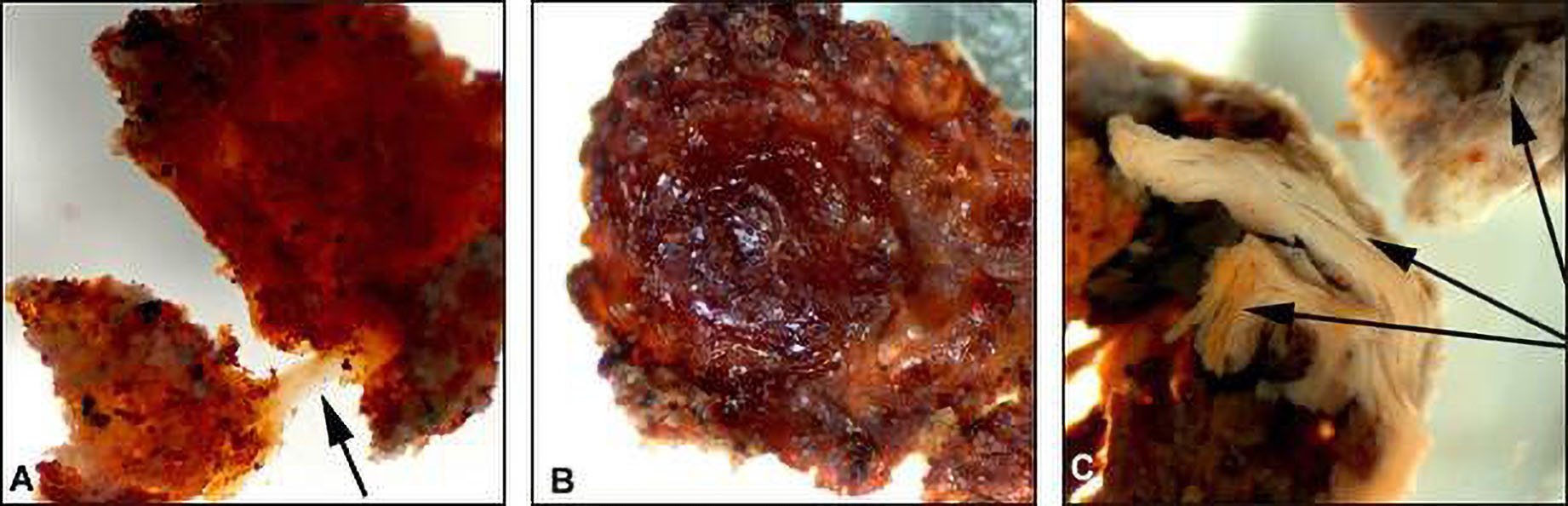
Fig. 1. One of several soft tissue discoveries of Dr Mary Schweitzer. After dissolving away encasing minerals: A: The arrow points to a tissue fragment that is still elastic. B: Some of the fresh appearance on display. C: Regions of bone showing where the fibrous structure is still present. All three are from a dinosaur fossil, supposedly at least 65 million years old!
Sometimes paleontologists refer to ‘preserved’ soft tissue, when they mean that it was originally soft material that has been totally replaced by minerals. One example is an outline left in the rocks of what was once a soft body part. In this article, to avoid confusion, whenever we use the phrase soft tissue, we are strictly referring to original biomaterial that is organic and has not mineralized.1
Under this definition, soft tissue would include the discovery of original red blood cells and dinosaur proteins such as collagen.
“At the time of writing, there are over 58 dinosaur soft tissue discoveries spanning thirty scientific journals. And most are from just the last decade.”
Suppose we include non-dinosaurian examples such as birds, reptiles, and sea creatures that evolutionists claim are millions of years old. In that case, the number of discoveries increases to around 122.2 Creation scientist Dr Brian Thomas earned a Ph.D. in paleobiochemistry from the University of Liverpool (UK) for his work on Ancient and fossil bone collagen remnants.3 So this is now a well-established field of study.
The initial reluctance to acknowledge the existence of dinosaur soft tissue stems from the belief in ‘deep time’. But it is scientifically possible to work out the maximum possible time for different proteins to break down. These studies always show that dinosaur soft tissue would not last for millions of years. Evolutionists often date fossils according to the assumed ages of the geologic layers containing the fossils. Sometimes they radiometrically date volcanic layers above and below the fossil to provide a date range.
But if these dinosaur soft tissues are not millions of years old, then they call into question the dates assigned to those rock layers. Without millions of years, there’s not enough time for evolution to happen. Not that evolution would be possible even if millions of years were granted (arguendo). That is, millions of years are necessary but not sufficient for evolution.
Mary Schweitzer
In 1990, Dr Mary Schweitzer from Montana State University discovered T. rex red blood cells in a bone that was unfossilized in its centre.4,5 Not surprisingly, the researchers were harassed by skeptics who rejected the finds. As Dr Schweitzer described, “All hell broke loose.”6 Although she is not a creationist, her career was at stake due to the huge disruption this would likely cause to the evolutionist establishment.
Mary H. Schweitzer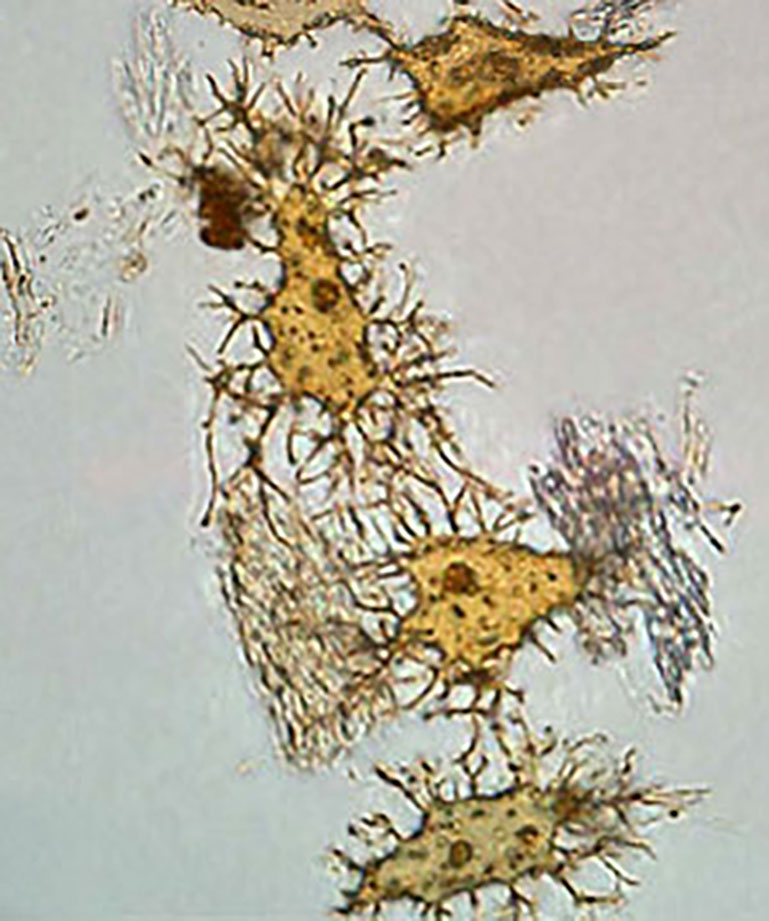
Fig. 2. The dinosaur bone cells (osteocytes) discovered by Dr Mary Schweitzer. Note the nuclei and the characteristic processes (filopodia) that extend from each cell—these are protein-containing extensions of the cytoplasm by which osteocytes are networked together within bone.
Despite the criticism she received, in 2005, Dr Schweitzer also found soft fibrous tissue and intact blood vessels.7 This reinforced her earlier discovery’s validity.
One report described the soft tissue as “flexible and resilient and, when stretched, returns to its original shape.”8 Schweitzer and others began to find more soft tissue from different dinosaur kinds. Blood cells were also found in duck-billed dinosaurs and Triceratops. Various proteins, ranging from collagen to even more delicate ones such as laminin and elastin, were also discovered, including unfossilized dinosaur bone cells (osteocytes).9,10
This caused immense consternation. Schweitzer’s supervisor Jack Horner wrote:
‘When Mary was first working on this material, she called me up to say she had found osteocytes. I assumed she meant the spaces where the osteocytes would have been, which is what I suggested.
“No, Jack, actually we have the cells and they have filopodia11 and they have nuclei.”
“Mary, the freaking creationists are just going to love you.”
“Jack, it’s your dinosaur.” ’12
Why can’t they be millions of years old?
Scientists studying the taphonomy13 of collagen have revealed it would have completely broken down within 300,000 to 900,000 years.14 Even under freezing liquid nitrogen, the laws of thermodynamics dictate that the chemical bonds still break down over time. Most dinosaurs lived in warmer climates and, if so, then the collagen would have all decayed in under 15,000 years. Evolutionists claim that the last dinosaurs went extinct 66 million years ago, yet collagen is still present. The implications are obvious: these bones are not millions of years old.
Mary H. Schweitzer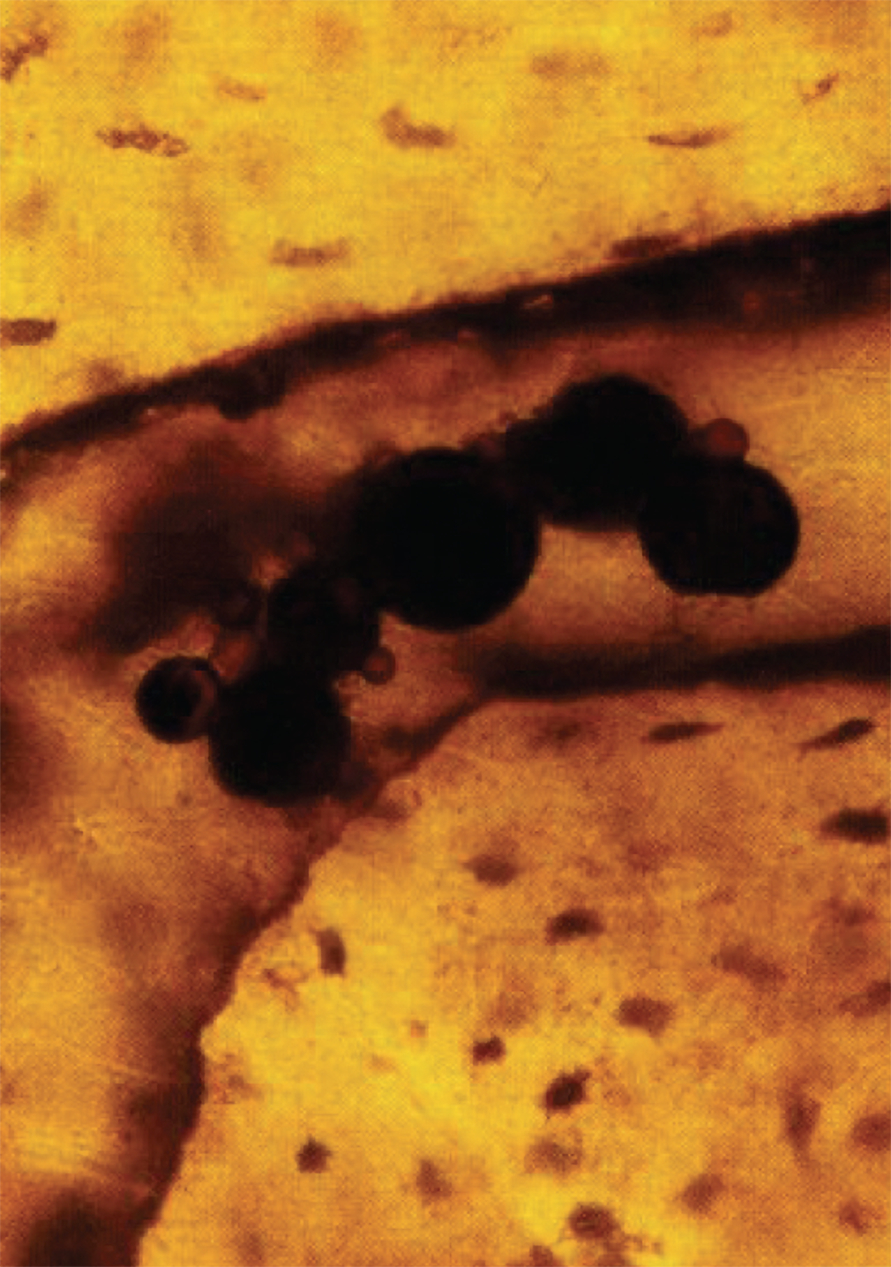
Fig. 3. Tyrannosaurus rex red blood cells
Dinosaur DNA
Dinosaur soft tissue is not the only dinosaur evidence that defies evolution. To date, at least three separate tests have indicated the presence of dinosaur DNA. Two of these tested positive using a DAPI test. This is a highly specific test that allowed the researchers to confirm the presence of double-stranded, double-helical DNA.15 The stain DAPI cleaves to the minor groove of a stable double helix, so the test confirmed the presence of original dinosaur DNA. This finding cannot be explained away as contamination since the DNA was not found anywhere else except in certain internal regions of the cells. The researchers were even able to observe dinosaur DNA in its condensed chromosomal form, suggesting that the nuclear material was largely intact.16
Mary H. Schweitzer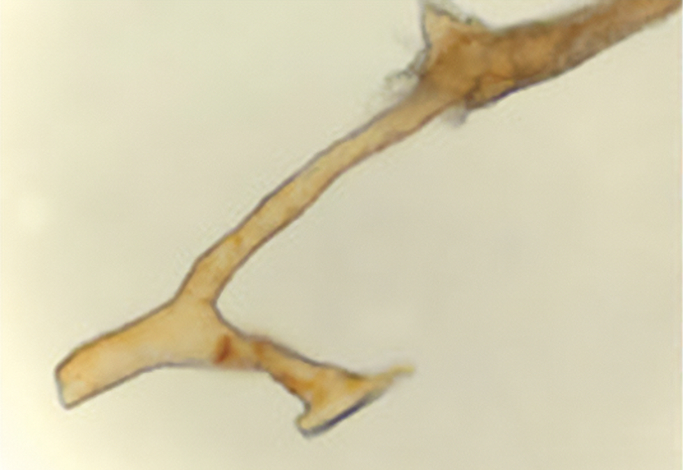
Fig. 4. The flexible branching structures in the T. rex bone were justifiably identified as “blood vessels”. Soft tissues like blood vessels should not be there if the bones were 65 million years old.
DNA is a highly unstable chemical molecule. Living creatures have many intricate repair systems to undo the chemical damages to DNA; otherwise, they would quickly die. After death, the repair machines stop working, and DNA breaks down very rapidly, as shown by the below table based on measured DNA in moa (large extinct flightless birds) bones from New Zealand.17,18
As per the laws of chemistry (Arrhenius rate law), chemical reaction rates are exponentially dependent on temperature.20 So the DNA decays much more quickly at higher temperatures. As can be seen, even under the best-preserved freezing conditions at –5°C, DNA is believed to have an upper age limit of 6.83 million years.21 This is only about 10% of the assumed evolutionary age for the extinction of dinosaurs. But at 15°C and 10,000 years, the average length of DNA would be about 13 base pairs (BP). This is important because if it were much less than 13 BP, it could not form the groove needed for DNA to test positive using DAPI. This is a huge problem for the idea of millions of years.22 But the observations are in the right ballpark if the dinosaur bones were only buried a few thousand years ago during the time of the biblical Flood.23
“Even under the best-preserved freezing conditions at –5°C, DNA is believed to have an upper age limit of 6.83 million years. This is only about 10% of the assumed evolutionary age for the extinction of dinosaurs.”
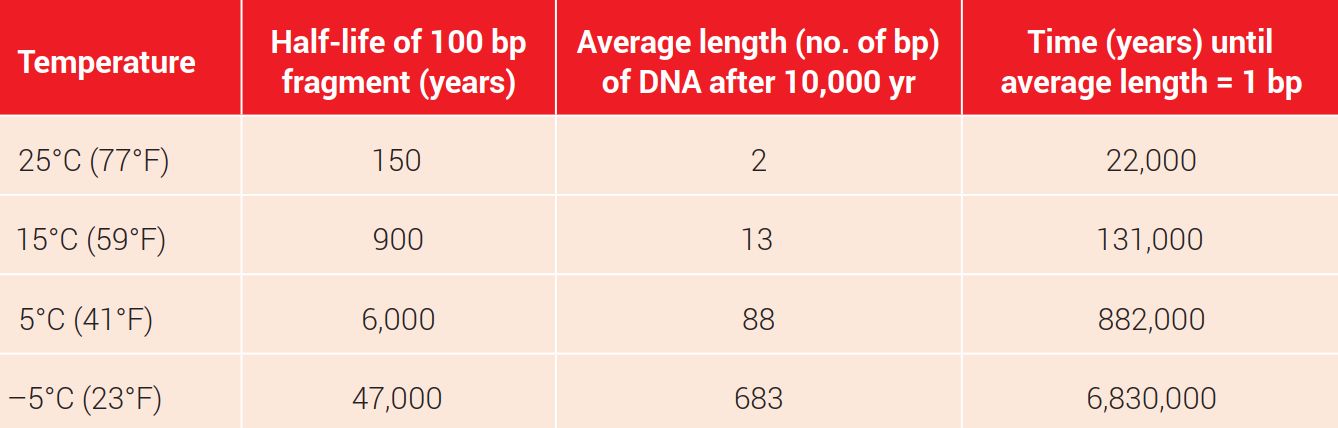
Table 1: decay of DNA at various temperatures. Right column = time until no intact bonds between DNA bases, i.e. DNA is completely fragmented, i.e. one base pair (bp).19
Conclusion
It is a straw man argument to say that creationists are unscientific, or that belief in creation is religion while believing in evolution is science. Often, it is the other way around. Everything we know from science tells us that dinosaur soft tissue, radiocarbon, and DNA cannot possibly be millions of years old. Even under the best conditions, the laws of thermodynamics and chemistry tell us that these molecules would have broken down. If one adheres to the conventional millions-of-years timeframe, one is doing so despite the scientific evidence. As Dr Mary Schweitzer concedes, “When you think about it, the laws of chemistry and biology and everything else that we know say that it should be gone, it should be degraded completely.” 24
By faith, skeptics hope that in the future some unknown natural process will be revealed, one that can preserve soft tissue for millions of years. This appeal to a ‘naturalism of the gaps’ is unscientific. But when we start with God’s Word and use it as the interpretive glasses to understand dinosaur fossils, the evidence fits very nicely.
References and Notes
- CMI Editors, Soft tissue in fossils vs fossilized soft tissue—a clarification, creation.com/soft-tissue-clarification, 25 Oct 2022.
- Thomas, B. and Tay, J., List of Biomaterial Fossil Papers (Maintained), tinyurl.com/352ekftx, acc. 11 Aug 2023
- Thomas, B., Ancient and Fossil Bone Collagen Remnants, Institute for Creation Research, Dallas, TX, 2019.
- Schweitzer, M. and Staedter, I., The Real Jurassic Park, Earth, pp. 55–57, Jun 1997.
- Wieland, C., Sensational dinosaur blood report!, Creation 19(4):42–43, 1997; creation.com/dino-blood.
- Catchpoole, D. and Sarfati, J., ‘Schweitzer’s dangerous discovery’, creation.com/schweit, 19 Jul 2006.
- Wieland, C., Evolutionists questions CMI report—Have red blood cells really been found in T. rex fossils?, creation.com/rbc, 3 Feb 2006.
- Wieland, C., Still soft and stretchy: Dinosaur soft tissue find—a stunning rebuttal of ‘millions of years’, creation.com/stretchy, 25 Mar 2005.
- Schweitzer, M. et al., Molecular analyses of dinosaur osteocytes support the presence of endogenous molecules, Bone 52(1):414–423, Jan 2013.
- Armitage, M. and Anderson, K., Soft sheets of fibrillar bone from a fossil of the supraorbital horn of the dinosaur Triceratops horridus, Acta Histochemica 115(6):603–608, Jul 2013.
- Filopodia are characteristic of osteocytes (fig. 2). They are slender projections from a cell’s cytoplasm and contain filaments of the protein actin, bundled by other proteins such as fascin and fibrin.
- Horner, J. and Gorman, J., How to build a dinosaur: The new science of reverse evolution, pp. 80–81, Dutton, 2009.
- Taphonomy (Gk. Táphos τάφος ‘burial’ and nomos νόμος ‘law’ = the processes, or the study of them, that affect organisms that die and become fossils, including their decay, burial, and preservation.
- Buckley, M. and Collins, M., Collagen survival and its use for species identification in Holocene-lower Pleistocene bone fragments from British archaeological and paleontological sites, Antiqua 1:e1, Sep 2011.
- Larsen, T. et al., The structure of DAPI bound to DNA, J. Biomolecular Structure and Dynamics 7(3):477–491, 1989.
- Bailleul, A. et al., Evidence of proteins, chromosomes and chemical markers of DNA in exceptionally preserved dinosaur cartilage, National Science Review 7(4):815–822, Apr 2020.
- Nielsen-Marsh, C., Biomolecules in fossil remains: Multidisciplinary approach to endurance, The Biochemist, 24(3) pp. 12–14, Jun 2002.
- Sarfati, J., DNA and bone cells found in dinosaur bone; creation.com/dino-dna, 11 Dec 2012.
- Allentoft, M. et al., The half-life of DNA in bone: measuring decay kinetics in 158 dated fossils, Proc. Royal Society B 279(1748):4724–4733, 10 Oct 2012. Table 1 is condensed from the paper’s Table 1.
- A summary article about Allentoft et al., ref. 19, was Kaplan, M., DNA has a 521-year half-life, Nature, 10 Oct 2012. But this was an irresponsible headline, because as explained, this half-life applies only at a specific temperature, in this case 13.1°C.
- If anything, this survival time is too high, because Allentoft et al. used 14C to ‘date’ the bones, which would provide an age greater than the true age. See Thomas, B. and Tomkins, J., How reliable are genomes from ancient DNA? J. Creation 28(3):92–98, 2014; creation.com/ancient-genomes.
- Larsen, T. et al., ref. 15. This specifically worked out the structure of DNA bound to a 12-BP long piece of DNA, C-G-C-G-A-A-T-T-C-G-C-G. Also, DAPI binding needs at least three AT pairs in a row (Bailleul et al., ref. 16).
- Robinson, P., DNA detected in duckbilled dino, Creation 42(4):15, 2020; creation.com/dna-duckbill.
- Schweitzer, M., NOVA scienceNOW, May 2009, cross.tv/21726. See also Wieland, C. and Sarfati, J., Dino proteins and blood vessels: are they a big deal? creation.com/dino-proteins, 9 May 2009.
Related Articles












Leave A Comment
You must be logged in to post a comment.