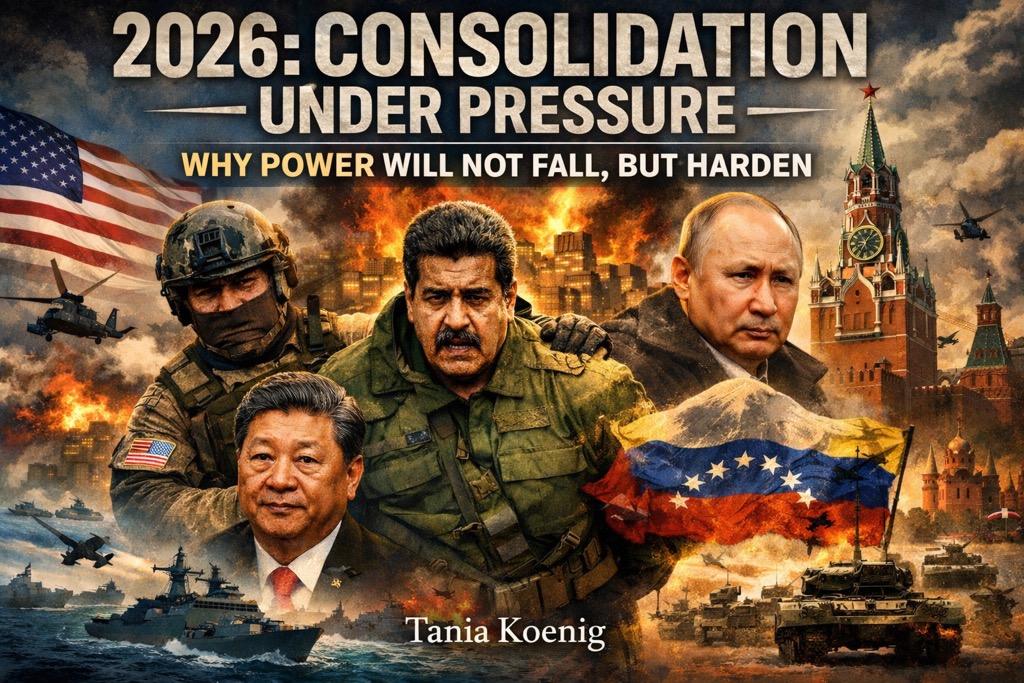
2026: Consolidation Under Pressure — Why Power Will Not Fall, But Harden
January 3, 2026
By Tania Koenig
Reprinted from Koenig World Watch Daily
As 2026 begins, the dominant mistake in public analysis is the expectation of rupture — a belief that systems must either collapse dramatically or be redeemed decisively. History offers a different lesson. More often than not, power does not fall when institutions weaken; it consolidates. What changes is not the existence of authority, but its character. It becomes colder, narrower, less persuasive, and more dependent on structure than trust. That is the moment we are entering now.
I do not write this as a distant observer. I have lived inside different political systems, under different regimes, on different continents, and I have watched the same patterns repeat with unnerving consistency. During Lula’s first term, I participated in official Dutch trade missions to Brazil, engaging with Brazilian ministries and government representatives in the context of bilateral economic cooperation. During Lula’s second term, I again worked with Brazilian ministers through trade and energy-related initiatives, particularly in the field of bioenergy and renewable energy, acting as a liaison between Dutch governmental and private-sector actors and Brazilian counterparts.
In this context, I also facilitated engagement involving former Dutch Prime Minister Ruud Lubbers, who participated in state-level and trade missions connected to energy and sustainability. My role was to bridge governments, ministries, and projects, not to shape Brazilian political leadership and saw how a system that once functioned could be hollowed out through ideological capture and administrative incompetence. I lived through the Bolsonaro years and observed the opposite extreme: polarization without institutional repair.
I spent many years working in Europe and participated in international trade missions and economic delegations involving senior Dutch political leadership. In this context, I served as an adviser to former Prime Minister Ruud Lubbers on matters related to international cooperation and energy initiatives, and I also participated in trade missions that included Prime Minister Mark Rutte. Through these engagements, particularly in the fields of energy, bioenergy, and international economic cooperation, I observed firsthand how coalition governance functioned at its strongest — and how, over time, it gradually shifted toward technocratic management and political fatigue.
I have seen military regimes. I have seen left-wing dominance. I have seen right-wing reaction. And I have seen what happens when institutions continue to operate while legitimacy drains away.
This is why I am not surprised by what I saw recently in New York.
The inauguration of Mayor Mondani was not a moment of renewal; it was a mirror. Mondani himself is intelligent, articulate, and capable, but leadership is never only about the individual. It is about the ecosystem that surrounds him. The people positioned around him — ideologically rigid, administratively weak, and visibly disconnected from execution — reminded me uncomfortably of Brazil’s Partido dos Trabalhadores at the moment when Brazil began to break. Not because of corruption alone, but because competence was replaced by narrative, and governance was replaced by moral posturing. Cities do not fail because leaders lack vision; they fail because they lack the capacity to translate vision into operational reality.
New York today inherits structural deficits so deep that no mayor can solve them without a disciplined, experienced, and politically sober apparatus. Housing, crime, migration, fiscal stress, and institutional fatigue are not ideological problems; they are execution problems. When the surrounding team is weak, the leader absorbs the blame, legitimacy erodes, and the city enters a cycle of managed decline. I have seen this before. Many times.
This brings me to the United States more broadly.
Throughout much of 2025, even I questioned whether Donald Trump’s political power had finally reached its limit. Legal pressure, media saturation, inflation, housing costs, and social exhaustion suggested a closing chapter. Yet as we enter 2026, it is clear that Trump remains far more durable than many anticipated. This is not because he has resolved America’s problems, but because no alternative has consolidated enough credibility to replace him. Power endures not because it is righteous, but because it is resilient, and resilience often outlasts moral consensus.
The United States is not collapsing. It is rebalancing under constraint. The Federal Reserve leadership transition expected around May 2026 will likely bring monetary stabilization rather than ideological upheaval. Tariff policy is already shifting away from blunt instruments toward selective leverage. Capital markets remain unmatched in depth and adaptability. America’s strength in 2026 is not optimism; it is structure. But structure without trust produces management, not leadership. That is the tension that defines the year ahead.
The midterms will not break the system or fix it; they will freeze it, forcing leaders to manage survival rather than pursue repair.
The Department of Justice reflects this same tension between authority and legitimacy. Pam Bondi’s tenure has not collapsed the institution, but it has exposed its fragility. Missteps, politicized optics, and weakened credibility do not dismantle power; they narrow it. Washington rarely corrects such failures publicly. It does so quietly — through marginalization, reassignment, or erosion of influence — while the machinery continues to function with reduced moral authority. This is how consolidation proceeds: not through scandal, but through thinning trust.
Within this environment, figures such as Marco Rubio stand out not because of ambition, but because of seriousness — a quality increasingly rare as consolidation replaces persuasion.
Globally, the illusion of a multipolar world has faded. What is emerging instead is a tri-polar reality dominated by the United States, China, and Russia — not as harmonious partners, but as hardened competitors who have accepted constraint as permanent. China has chosen internal control over rapid growth. Russia has chosen strategic relevance over economic recovery. Neither is collapsing; both are entrenching. Europe, meanwhile, reacts rather than leads, weighed down by demographic decline, energy vulnerability, and political fragmentation.
The Tri-Polar Signal: How Enforcement Is Read by Washington, Beijing, and Moscow
The capture of Nicolás Maduro immediately activated the interpretive frameworks of the world’s three consolidated power centers: the United States, China, and Russia. Each reads the event not through legal argument, but through precedent and narrative.
For the United States, the operation represents selective enforcement rather than continuous intervention. Washington did not seek to manage Venezuela indefinitely or reshape its internal structures. It intervened at a pressure point once tolerance ended. This reflects a broader shift in American posture: reduced permanent engagement, paired with decisive action when limits are breached.
China will not copy Venezuela operationally, but it will copy it narratively. Beijing’s interest lies not in legality but in precedent. A Taiwan-focused strategic analysis has already warned that U.S. coercive measures against Venezuela can be repurposed rhetorically as justification for coercive action in China’s own sphere, even where legal contexts differ, because in this era precedent is shaped more by narrative than by law. The argument China will refine is not one of sovereignty, but of security. If the United States reserves the right to neutralize perceived threats in another hemisphere, China may claim the same logic in its own.
This does not imply immediate invasion. Rather, it points to normalization of coercion: longer and more frequent military drills, increasingly assertive air and maritime encirclement patterns, intensified economic and shipping pressure, and sustained cyber and information operations aimed at political fatigue rather than rapid conquest. Control in this framework is achieved through repetition, not shock, through persistence rather than rupture.
Russia’s gain is different. Its leverage is not Venezuela itself, but the story the event allows it to tell. Within hours of the operation, Venezuelan Vice President Delcy Rodríguez was reported to be in Russia, publicly demanding proof of life for Maduro and his wife. This was not routine diplomacy; it signaled emergency alignment and narrative coordination. Russia had already pledged full support to Venezuela amid U.S. pressure, with both Moscow and Beijing backing Caracas during the buildup. For Russia, the operation becomes proof that the “rules-based order” is applied selectively, invoked when convenient and discarded when power allows. This does not give Russia the capacity to reverse U.S. action, but it gives it material to weaponize legitimacy disputes across global forums and non-aligned states.
Taken together, these reactions confirm that 2026 is not entering an era of fragmentation, but one of consolidation under pressure. The United States demonstrates selective enforcement, China refines coercive normalization without premature confrontation, and Russia exploits legitimacy fractures to erode Western moral authority without direct engagement. Power is no longer argued; it is tested.
In this environment, Israel’s position has quietly shifted.
While much of the world spent 2025 moralizing Israel, negotiating Israel, and attempting to pressure Israel into someone else’s political timetable, Israel lived inside a security clock. It fought on multiple fronts, absorbed sustained pressure, and continued to function. By the end of the year, Israel was not weaker or isolated, but operationally stronger and strategically indispensable. Defense exports surged not because of admiration, but necessity. Energy deals expanded not because of ideology, but demand. Countries that publicly criticized Israel privately relied on Israeli systems for protection. Survival clarified priorities.
This is the paradox of 2026: legitimacy erodes while capability concentrates.
Why 2026 Will Disappoint, Not Shock
The defining misunderstanding about 2026 is the expectation of rupture. Much of the world has been conditioned to wait for a dramatic break — a market collapse, a political implosion, a technological takeover, or a civilizational shock that would confirm the sense that “everything has finally fallen apart.” That shock will not come. And that is precisely why disappointment will define the year.
Disappointment emerges when narratives fail while structures endure. In 2026, institutions will continue to operate without inspiring confidence. Elections will take place without delivering renewal. Governments will manage rather than lead. Courts will rule, but legitimacy will feel thinner. Systems will persist — not because they are trusted, but because there is nothing ready to replace them.
Artificial intelligence will be central to this disappointment. AI will not take over. It remains tightly controlled by a narrow group of governments, corporations, and defense-linked actors, and its expansion is constrained by realities technology cannot escape: energy supply, infrastructure limits, material scarcity, and geopolitical friction. Compute does not scale without power, and power does not scale without stability. The promises made about AI will exceed what the physical world can sustain, producing frustration rather than transformation.
Energy will quietly impose the ceiling. Nuclear expansion will not move fast enough. Renewables will not scale evenly. Grid fragility will grow. Instead of collapse, the world will face prioritization — selective deployment, higher costs, narrower margins. The future will feel smaller than advertised.
This is why 2026 will disappoint. The collapse people expected will not arrive. The salvation they were promised will not appear. What remains is continuity under constraint — systems that endure, narratives that fail, and a growing recognition that control has limits.
The defining emotion of 2026 will not be fear. It will be disenchantment.
Institutions will continue to function. Courts will rule. Elections will occur. Governments will govern. But belief will thin. Acceptance of outcomes will weaken. Authority will feel procedural rather than moral. This is not collapse. It is erosion.
Here is where discernment matters.
When societies lose moral orientation, they do not immediately descend into chaos. They harden. They centralize. They manage. And in that management, they reveal what they truly value. Scripture never warned that deception would arrive as disorder, but as persuasion powerful enough to draw allegiance quietly.
2026 will not shock the world. It will disappoint it. And disappointment is often how truth enters.
Those expecting collapse will be confused. Those expecting redemption through politics will be frustrated. Those watching execution rather than rhetoric will understand what is happening.
Power is not falling. It is hardening.
The question is not whether systems will survive. They will.
Ultimately, the outcome of 2026 will not be determined by institutions alone, but by prayer. What unfolds will correspond to whether the Church chooses to intercede or remain passive. History shows that when the Church prays, God moves—not symbolically, but concretely—reshaping decisions, restraining harm, and opening paths no analysis can foresee. This is the moment for the Church to return to prayer with seriousness and unity, asking that God’s will be done on earth as it is in heaven. What 2026 becomes will reflect not only political choices, but the depth and faithfulness of that intercession.
RELATED:
Scriptures
And in that day will I make Jerusalem a burdensome stone for all people: all that burden themselves with it shall be cut in pieces, though all the people of the earth be gathered together against it. Zechariah 12:3
And it shall come to pass in that day, that I will seek to destroy all the nations that come against Jerusalem. Zechariah 12:9
Daily Reading: My Utmost For His Highest










Leave A Comment
You must be logged in to post a comment.